React vs Angular vs Vue in 2026: Which Framework Should You Learn
Compare React, Angular, and Vue in 2026 by job market, learning curve, architecture, TypeScript, ecosystem, team fit, and beginner strategy.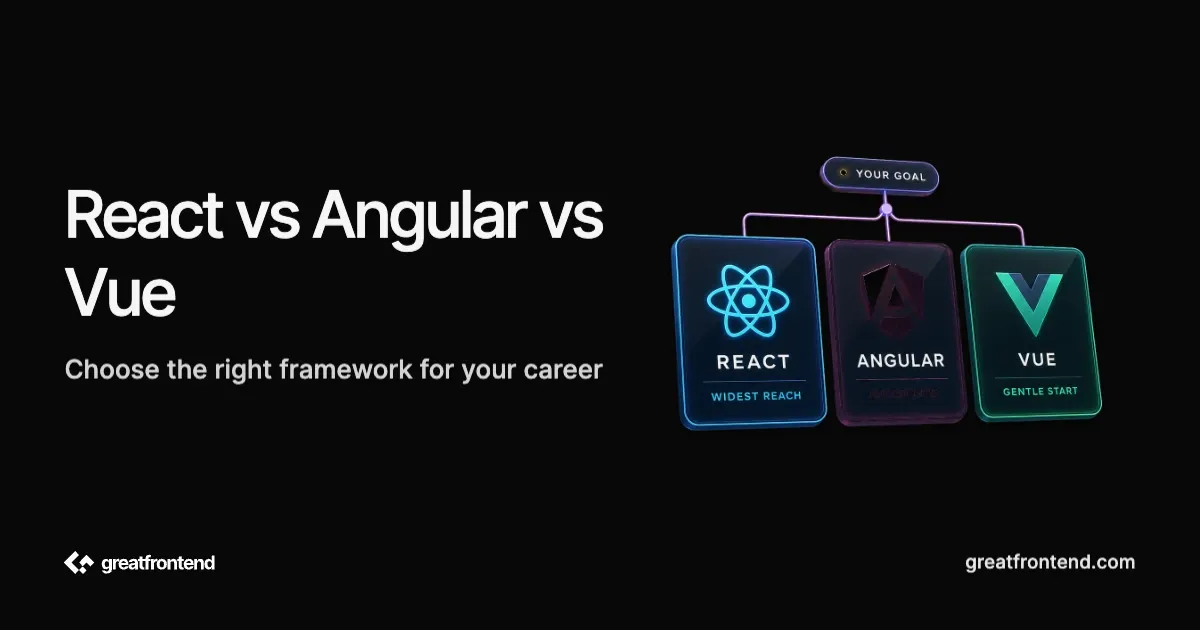
Choose React first if you want the widest frontend hiring reach. Choose Angular first if the roles you want are in enterprise teams that already use Angular. Choose Vue first if your target team uses Vue/Nuxt, or if you want the gentlest path into component-driven UI without ignoring JavaScript, HTML, and CSS.
The bad choice is not "picking the wrong framework." The bad choice is learning syntax without building the flows employers ask about: forms, routing, data loading, error states, accessibility, tests, and maintainable component boundaries.
Research snapshot checked on July 13, 2026
As of July 13, 2026, the latest published Stack Overflow technology results available for this comparison were the 2025 results. Use these numbers as ecosystem signal, then do your own job-search count for your city, country, or remote market.
| Source | What it says | What not to infer |
|---|---|---|
| Stack Overflow Developer Survey 2025 | Among all respondents, React was used by 44.7%, Angular by 18.2%, and Vue.js by 17.6%. Among professional developers, React was 46.9%, Angular 19.8%, and Vue.js 18.4%. | This does not tell you which framework dominates your local junior roles. Survey respondents are not the same as job listings. |
| Stack Overflow admired and desired 2025 | React had 30.7% desired and 52.1% admired, Vue.js had 15.3% desired and 50.9% admired, and Angular had 12.6% desired and 44.7% admired. | "Loved by developers" and "easiest to get hired for" are different questions. |
| State of JavaScript 2025 | Its 13,002-person JavaScript-community sample kept the same usage ranking: React, Vue, then Angular. Respondents also named React-specific issues, excessive complexity, performance, state management, and choice overload as common framework pain points. | State of JS allows communities to promote participation, so use it for ecosystem experience and sentiment, not as a global employment census. |
| Official docs | React's docs recommend starting new apps with a framework; Angular v22 docs present Angular as a full application platform with signals, routing, forms, DI, SSR, CLI, and DevTools; Vue 3 docs describe Vue as progressive and recommend SFCs for non-trivial apps. | Docs explain direction and APIs. They do not prove demand. |
That points to a practical 2026 conclusion: React is still the safest default for broad frontend job optionality, Angular remains a serious enterprise choice, and Vue is a mature framework with a smaller but real market. The right first framework depends on which of those three signals matters most to you.
The real difference
React, Angular, and Vue are not three versions of the same thing. They make different bets about how much structure the framework should give you.
| Question | React | Angular | Vue |
|---|---|---|---|
| What is it? | A UI library usually used through a framework such as Next.js or React Router's framework mode. | A full application framework with built-in opinions for components, DI, routing, forms, HTTP, testing, and updates. | A progressive framework that can enhance HTML, power SPAs, or scale through SFCs, Vue Router, Pinia, and Nuxt. |
| What do you decide yourself? | Routing, data fetching, forms, folder structure, state libraries, app framework, and rendering strategy. | Less at the beginning. Angular gives more defaults, but you must learn the framework's vocabulary. | More than Angular, less than React. Vue gives a cohesive component model while staying flexible. |
| What will you debug early? | Effects, stale state, prop drilling, keys, race conditions, client/server boundaries, and library choices. | Dependency injection scope, reactive forms, RxJS-heavy legacy code, signals, change detection, and route/module structure. | Reactivity loss from destructuring, prop mutation, watcher misuse, store boundaries, and mixed Options/Composition API code. |
| Best beginner proof | A React or Next.js product flow with URL filters, form states, and tests. | An admin-style Angular app with reactive forms, services, guards, and table states. | A Vue/Nuxt dashboard or content admin with SFCs, composables, Pinia, and route state. |
React in 2026
React is the best first choice when you want the broadest hiring reach across product companies, SaaS dashboards, design systems, content apps, and frontend-heavy teams.
React has also become harder to describe as "just learn components and hooks." When checked on July 13, 2026, the official docs showed React v19.2 and recommended starting new React apps with a framework. React 19 made Actions, form helpers, useOptimistic, use, Server Components support for frameworks, and ref as a prop part of the React 19 story. React's docs also describe the React Compiler as a way to handle memoization automatically when a codebase follows React's rules.
That changes what "learn React" means in 2026:
| Learn | Why it matters |
|---|---|
| Component boundaries | React gives you freedom, so bad boundaries spread quickly. |
| State ownership | Many React bugs come from storing derived values, lifting state too high, or hiding server state in local component state. |
| Effects | useEffect is for syncing with systems outside React, not for every calculation. |
| Routing and URL state | Most job tasks involve multi-page flows, filters, tabs, auth redirects, and shareable URLs. |
| Framework basics | Next.js or React Router framework mode, server rendering, data loading, and the client/server split show up in production React work. |
| Testing user flows | React teams care whether the UI still works after refactors, not whether every helper has a shallow test. |
Choose React if:
- You do not have a target company yet and want the most flexible default.
- Job listings near you mention React, Next.js, TypeScript, dashboards, design systems, or frontend platform work.
- You enjoy assembling an app from libraries and making tradeoffs.
- You want the easiest path from frontend basics into interview preparation.
Be careful with React if:
- You keep switching libraries before you can ship one flow.
- You call everything "state" instead of separating local UI state, URL state, server data, form state, and derived values.
- You learn Next.js routing before you can explain props, rendering, effects, and controlled inputs.
For GreatFrontEnd readers, a useful React path is: learn the browser basics, follow How to Learn React, then practice explaining component design and async UI behavior with React interview questions.
Angular in 2026
Angular is the best first choice when your target roles are in teams that value a complete framework, strict TypeScript, release discipline, and shared conventions across a large codebase.
Current Angular is not the AngularJS-era stereotype. When checked on July 13, 2026, the Angular v22 docs presented a broad application platform: components, signals, SSR/SSG, dependency injection, routing, forms, CLI, DevTools, and update tooling. Angular components are standalone by default, Angular Signals provide granular state tracking, and Angular's zoneless docs say zoneless is the default in Angular v21 and later. Angular also keeps a predictable release model: the release policy says major releases generally arrive every six months and major versions are typically supported for 18 months.
That makes Angular attractive for large teams for a simple reason: it reduces argument space. A React team may debate router, state, data, form, validation, folder, and rendering choices. An Angular team often starts with shared answers and spends more time inside the framework's patterns.
| Learn | Why it matters |
|---|---|
| TypeScript classes and decorators | Angular codebases are TypeScript-first and metadata-heavy. |
| Components, inputs, and outputs | You need clear boundaries before DI, services, and routing make sense. |
| Dependency injection | Angular apps share state, services, clients, and configuration through DI. |
| Reactive forms | Enterprise UI has validation, conditional fields, server errors, and disabled states. |
| Router and guards | Guards coordinate navigation and route UX; the API must still enforce auth and permissions. Lazy routes and route data loading are also common. |
| Signals and zoneless change detection | Newer Angular code uses a different mental model than older ZoneJS-heavy code. |
Choose Angular if:
- Your target listings mention Angular, RxJS, Java, .NET, banking, insurance, internal tools, GCCs, or enterprise dashboards.
- You like clear conventions and do not want to assemble every app decision from separate packages.
- You want to practice TypeScript-heavy frontend architecture.
- You are joining a team that already has Angular code.
Be careful with Angular if:
- You are looking for the fastest first week as a beginner.
- You only want to build small marketing pages or simple portfolio sites.
- Your local entry-level listings are overwhelmingly React and barely mention Angular.
Your first Angular proof project should not be a static portfolio. Build an approval dashboard: login shell, protected routes, a searchable table, a detail page, a reactive form with server-side validation, loading/error/empty states, and one service that owns API calls.
Vue in 2026
Vue is the best first choice when your target team uses Vue/Nuxt, when you want a smoother entry into components, or when you are building content/admin/product UI where templates, reactivity, and single-file components make the code easy to read.
The Vue docs are for Vue 3. Vue describes itself as progressive: it can enhance static HTML, power SPAs, support SSR/SSG, and scale through the ecosystem. For non-trivial apps, Vue recommends Single-File Components, where template, script, and style live in one component file. Vue's state guide explains local reactive state, shared state, one-way data flow, and when global state becomes necessary; Pinia is the official store library for larger apps.
Vue's advantage is not that it is a toy framework. Its advantage is that the component file often feels close to the page the user sees. Templates are explicit, reactivity is approachable, and Composition API lets larger features extract reusable logic without turning every component into a class hierarchy.
| Learn | Why it matters |
|---|---|
| SFC structure | Vue teams read template, state, and styles together. |
ref, reactive, and computed | Vue bugs often come from misunderstanding reactivity boundaries. |
| Props and emits | Parent-owned state and child events matter in reusable components. |
| Watchers vs computed values | Watchers are for side effects; computed values are for derived data. |
| Vue Router and Pinia | Production Vue apps still need routing, URL state, and shared state rules. |
| Nuxt basics | Many Vue roles expect SSR, file-based routing, and app conventions through Nuxt. |
Choose Vue if:
- Your target company already uses Vue or Nuxt.
- You are moving from HTML/CSS/JavaScript into framework work and want a readable component model.
- You build dashboards, admin flows, commerce UI, content tools, or Laravel/PHP-adjacent frontend work where Vue appears in listings.
- You value a smaller decision set than React but less ceremony than Angular.
Be careful with Vue if:
- Your goal is maximum job volume and your local market barely mentions Vue.
- You learn only Options API examples and never practice Composition API, composables, Pinia, or routing.
- You treat Vue's friendly syntax as a reason to skip JavaScript, accessibility, and testing.
Your first Vue proof project should show reactivity judgment: a content editor with autosave, validation, route params, a filtered list, Pinia store state, empty/error states, and a README explaining which state is local, which state is shared, and which state belongs in the URL.
Which framework should you learn first?
Use this as a starting point, then verify it against your job search.
| Your situation | Best first pick | Why |
|---|---|---|
| You want broad frontend job optionality and have no target company yet | React | It has the largest usage signal in the 2025 Stack Overflow survey and appears across many product-team stacks. |
| You are targeting enterprise, banking, insurance, government, large service-company, or GCC roles that name Angular | Angular | The framework's conventions match teams that need consistent patterns across many developers. |
| Your target company uses Vue/Nuxt | Vue | The fastest path to impact is learning the codebase's framework deeply. |
| You are a beginner who still struggles with JavaScript objects, arrays, events, forms, or async code | Browser basics first, then React or Vue | A framework will hide the problem for a week and expose it during the first non-trivial bug. |
| You already know React and want to expand into enterprise roles | Angular second | It teaches a different app architecture, DI, reactive forms, and framework-governed conventions. |
| You already know React and are joining a Vue/Nuxt team | Vue second | Vue will feel familiar at the component level but different in reactivity and templates. |
Run a 30-minute job-market audit
Do this before committing three months to a framework.
- Open 30 to 50 listings for your target level and location.
- Count only listings you would actually apply to.
- Separate "must have" from "nice to have."
- Count React and Next.js together, Angular separately, and Vue/Nuxt separately.
- Track TypeScript, testing, CSS, accessibility, design systems, and API work too.
- Repeat the count for junior, mid-level, and senior roles if you are near a level transition.
Use a simple sheet:
| Column | Example |
|---|---|
| Role level | Junior, frontend engineer, senior frontend engineer |
| Company type | Startup, product company, agency, bank, GCC, service company |
| Framework must-have | React, Angular, Vue, Next.js, Nuxt |
| Adjacent stack | TypeScript, Node, Java, .NET, GraphQL, REST |
| UI work | Forms, data tables, design system, charts, accessibility |
| Proof you need | Project, interview story, system design, tests, migration experience |
If React/Next.js appears in most suitable listings, learn React first. If Angular appears repeatedly in the exact enterprise lane you want, learn Angular first. If Vue appears mainly as "nice to have," do not make it your first job-search framework unless you have a Vue-specific target.
Build one serious comparison project
Do not build three hello-world apps and call it comparison. Build one serious feature in the framework you chose.
A good project is a settings and billing dashboard:
- Account settings form with field validation and server errors.
- Notification toggles with optimistic save and rollback.
- Billing history table with sorting, filters, and empty states.
- Detail route with URL params.
- Loading, error, retry, and permission states.
- Keyboard-accessible modal or drawer.
- A small test suite for the riskiest flow.
- A README that explains state ownership and tradeoffs.
Then make the framework choice visible:
| Framework | What the project should prove |
|---|---|
| React | Component composition, state placement, route state, async handling, and framework/library choices. |
| Angular | Reactive forms, services, DI, routing, guards, signals or observable state, and structured app layout. |
| Vue | SFC design, props/emits, Composition API, composables, Pinia, route state, and reactivity decisions. |
This project tells you more than a framework ranking because it exposes the daily work: keeping UI state honest while requirements change.
Common wrong conclusions
"Angular is dead"
No. Angular is less dominant in broad developer surveys than React, but it is still used by a meaningful share of professional developers in the 2025 Stack Overflow survey. Angular v22 is active, Angular v20 and v21 are in LTS windows, and the framework has continued moving through standalone components, signals, and zoneless change detection.
The better question is: are the companies you want hiring Angular developers?
"Vue is only for beginners"
No. Vue is approachable, but mature Vue work still includes routing, state management, SSR/SSG through Nuxt, accessibility, testing, performance, and migration decisions. Vue's risk is usually market size, not technical seriousness.
"React alone is enough"
No. React gives you the UI model. Most React jobs also expect TypeScript, routing, data fetching, forms, CSS, testing, performance, and some framework knowledge. The 2026 React learner should know what React solves and what the surrounding framework solves.
"I should learn all three before applying"
Usually no. Learn one deeply enough to build and explain a complete product flow. Add another framework when your target role, team, or project gives you a reason.
Final recommendation
For most beginners optimizing for job flexibility, learn React first after browser basics. For enterprise-targeted roles where Angular is repeatedly named, learn Angular first. For teams that already use Vue/Nuxt, or for learners who want an approachable component model and have matching local roles, learn Vue first.
Whichever you choose, make the next eight weeks concrete:
| Week | Build |
|---|---|
| 1 | Semantic static page with responsive layout. |
| 2 | JavaScript widgets with events and DOM state. |
| 3 | API-backed search page with loading, empty, error, and retry states. |
| 4 | The same flow in your chosen framework. |
| 5 | Form-heavy route with validation and server errors. |
| 6 | URL filters, detail routes, and saved state. |
| 7 | Tests and keyboard accessibility pass. |
| 8 | README, deployment, and interview explanation. |
React, Angular, and Vue are all valid. The useful choice is the one that matches your target roles and gets you to finished, reviewable projects fastest.
相关文章
 Learn React in 2026 with a practical roadmap covering components, JSX, state, effects, forms, data fetching, routing, TypeScript, and interview practice.
 A detailed frontend developer roadmap for 2026 covering the skills, tools, projects, milestones, and interview practice needed for modern frontend roles.
 Prepare for Vue.js interviews in 2026 with questions on Vue 3, Composition API, reactivity, components, props, emits, slots, composables, routing, state, and performance.
 100+ React interview questions and answers, prepared by senior engineers and ex-FAANG interviewers. Updated for 2026 with React 19 coverage including Actions, Server Components, the use hook, and the React Compiler.