Frontend Developer Internship
Get a frontend developer internship with a student-friendly plan for projects, GitHub, resume bullets, outreach, interview prep, and learning on the job.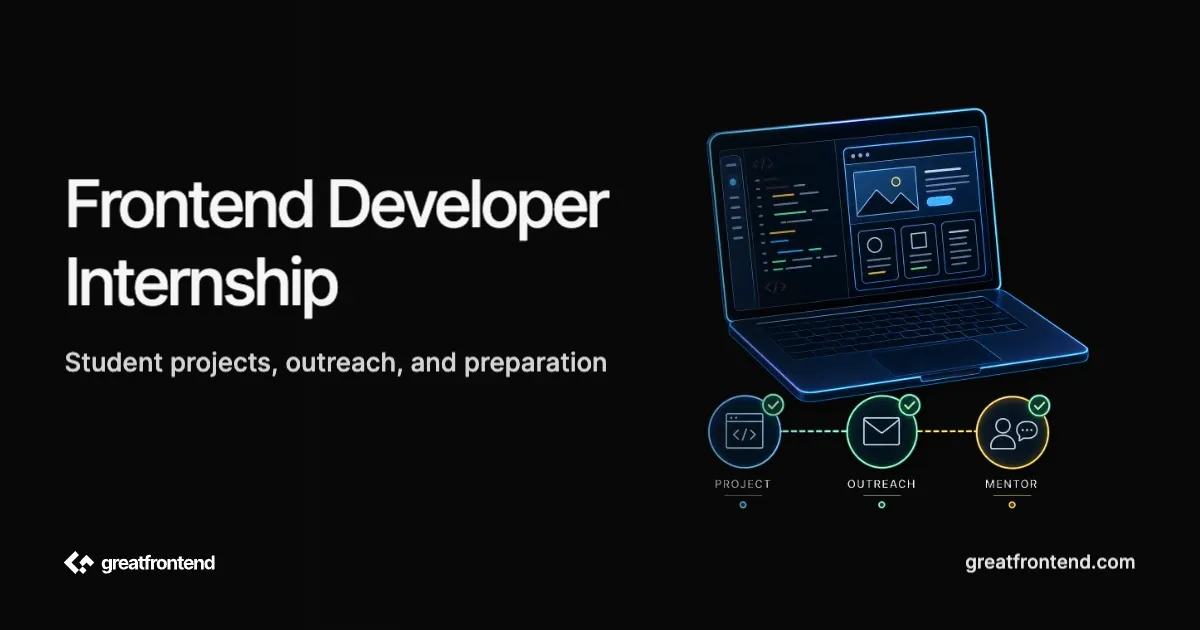
To get a frontend developer internship in 2026, prove that you can finish small UI tasks, explain how you debugged them, and improve work after feedback. You do not need senior-level scope, but you do need enough browser and JavaScript knowledge to contribute with guidance.
Your application needs three things: visible frontend basics, one or two projects that match intern work, and a short explanation of how you built and debugged them.
Use the MDN Curriculum for web fundamentals and React Learn for React basics. Then turn the learning into deployed work. A certificate without inspectable projects is weak evidence.
Know what internship listings actually ask for
Internship requirements vary by company. Start with HTML, CSS, JavaScript, responsive layout, Git, and debugging, then add the framework and tools repeated across the roles you plan to apply for. A React role may ask about components and state; another internship may use Vue, Angular, Webflow, or no framework at all.
Do not try to learn every listed tool. Build proof around the repeated core:
| Repeated requirement | What your proof should show |
|---|---|
| HTML/CSS/JS | Semantic page, responsive layout, interactive behavior |
| Listed framework | Components, props or inputs, state, forms, and routing where relevant |
| Figma-to-code | Accurate layout, spacing, breakpoints, accessible controls |
| API integration | Loading, empty, error, retry, and success states |
| Git/GitHub | README, setup steps, meaningful commits, no secrets |
| Debugging | A short note about one bug you found and fixed |
An internship-ready profile does not need ten projects. It needs enough proof that a reviewer can trust your basics.
Build three internship proof pieces
Make your portfolio easy to review without requiring the reader to clone every repository.
| Proof piece | Minimum bar |
|---|---|
| One polished UI | Responsive, accessible, close to a design, deployed |
| One API-backed app | Search, dashboard, tracker, or listing with loading and error states |
| One project explanation page | What you built, what was hard, what broke, what you would improve |
Good intern projects are not huge. They are complete. A small issue tracker with filters, empty state, keyboard-friendly form, and clean README is more convincing than a large clone where half the buttons do nothing.
Pick projects that match intern tasks
Use projects that prove the work interns are asked to do.
| Project idea | What it proves |
|---|---|
| Figma-to-responsive page | CSS layout, spacing, mobile behavior, attention to detail |
| API-backed search UI | Fetching, debouncing, loading, empty, and stale-result handling |
| Form-heavy onboarding flow | Validation, error messages, focus recovery, controlled state |
| Admin table slice | Filters, pagination, permissions, empty state, readable data display |
| Component mini-library | Reusable buttons, inputs, modal, tabs, Storybook or docs if available |
For each project, add a README section with screenshots, setup commands, known limitations, and a "what I learned" note. That note helps because intern interviews often ask about learning process.
Use student-specific channels
Do not rely only on LinkedIn quick apply.
| Channel | How to use it well |
|---|---|
| College placement cell | Keep resume and links ready before companies visit |
| Company career pages | Search "frontend intern", "software intern", and "UI engineering" |
| Internship boards | Apply early and filter for real coding work |
| Local startups | Send a short note with a relevant project link |
| Open-source programs | Build public contribution experience |
| GitHub profile | Pin the two repositories you want reviewers to inspect |
Google Summer of Code is not a normal company internship, but it is useful because accepted contributors work on open-source projects with mentors. GitHub Education can also help students access developer tools and build in public.
Write resume bullets that prove behavior
Weak bullets list tools. Strong bullets show what changed.
| Weak bullet | Better bullet |
|---|---|
| Built a React project | Built a React search UI with debounced input, loading, empty, and error states |
| Used HTML, CSS, JavaScript | Converted a Figma design into a responsive page across mobile and desktop |
| Made a dashboard | Built table filters, pagination, and empty-state handling for API data |
| Worked on GitHub | Added setup docs, screenshots, and issue notes so the project can be reviewed |
If a bullet could belong to any student, rewrite it. Your best bullet should make the interviewer ask about a specific decision.
Prepare project answers before interviews
Internship interviews often start with your project. Prepare this script for each project:
The project solves [user problem].The main frontend challenge was [layout/state/API/accessibility].I handled [loading/error/empty/invalid/mobile] states.One bug I fixed was [bug].If I had another week, I would improve [specific limitation].
Do not pretend everything was easy. A real debugging story is often more convincing than a perfect-sounding project.
Show coachability
Your application should answer a practical question: "Can this person learn with guidance?"
| Doubt | Proof that reduces it |
|---|---|
| Can this person finish? | Deployed project with working core flow |
| Can this person debug? | Bug note, issue, commit, or README section explaining the fix |
| Can this person accept review? | Before/after improvement after feedback |
| Can this person communicate? | Clear project explanation and concise outreach |
| Can this person use Git? | Readable commits, setup instructions, no generated junk committed |
If you have received feedback from a teacher, senior, open-source maintainer, or peer, mention what changed after that feedback.
Send outreach that respects the reader's time
Keep outreach short. Lead with the role and proof.
Hi [Name],I am applying for the [frontend intern] role at [company].I built [project], which includes [specific behavior relevant to the role].Live: [link]GitHub: [link]Resume: [link]Could you point me to the right application path or share one piece of feedback?Thank you,[Name]
Do not attach a long life story. Make the project do the work.
Evaluate the internship before accepting
An internship is valuable if it gives you mentorship, code review, and real tasks.
Ask these questions:
- Who will review my code?
- What does a successful intern ship in the first month?
- Will I work on production code, internal tools, or training tasks?
- Which frontend stack does the team use?
- How often do interns get feedback?
- Is there a PPO or full-time conversion path?
- If unpaid or low-stipend, what concrete learning and mentorship are provided?
Avoid internships that are only unpaid trial work, content entry, fake training, or vague "work on projects" without a reviewer.
Build a 30-day internship plan
| Week | Output |
|---|---|
| 1 | Finish one responsive UI and write a README |
| 2 | Add one API-backed project with loading, empty, and error states |
| 3 | Rewrite resume bullets around project behavior and apply to well-matched roles |
| 4 | Run project walkthrough practice and send proof-based outreach |
Keep applying while improving proof. Do not disappear for three months to take another course unless the current proof is truly missing fundamentals.
Diagnose the funnel
| Symptom | Likely issue | Fix |
|---|---|---|
| No profile views | Weak title, unclear resume, missing links | Put target role and best project near the top |
| Views but no callbacks | Projects do not match intern tasks | Add API states, Figma-to-code proof, or better README |
| Calls but no technical round | Project explanation is unclear | Practice walkthrough and rewrite project notes |
| Technical rounds fail | Fundamentals are weak | Practice the exact failed topic for a week |
| Final rounds fail | Coachability or availability is unclear | Prepare learning stories and internship expectations |
Treat the search like debugging. Change one thing per week so you know what helped.
Common questions
How many projects do you need?
Two strong projects are enough for many internships: one polished UI and one API-backed app. Add a third only if it proves a different skill.
Should you apply before you feel ready?
Yes, once you have one deployed project, a readable resume, working links, and the ability to explain your code. Waiting for perfect readiness can hide you from useful feedback.
What if you are rejected repeatedly?
Track where the rejection happens. If nobody responds, improve targeting and proof. If interviews fail, practice the exact questions that failed. Do not rewrite your whole profile every week.
Make your application easy to review
Before applying, assume the reviewer will scan before deciding what to open. Your job is to remove friction.
Your internship application should make these things obvious:
- The live project works.
- The GitHub repo is readable.
- The README has screenshots, setup steps, and one bug or tradeoff you handled.
- The resume names behavior, not only tools.
- The project matches the internship work: UI, forms, API state, responsiveness, or debugging.
- You can explain what you built without hiding behind a tutorial.
A good internship application makes four things visible: you can build, explain, debug, and improve.
Related articles
 Learn how freshers can get frontend developer jobs in 2026 with a practical skill path, portfolio projects, resume proof, GitHub cleanup, and interview prep.
 Learn how freshers can build a frontend developer portfolio with no experience using beginner-friendly projects, GitHub, case studies, and clear proof.
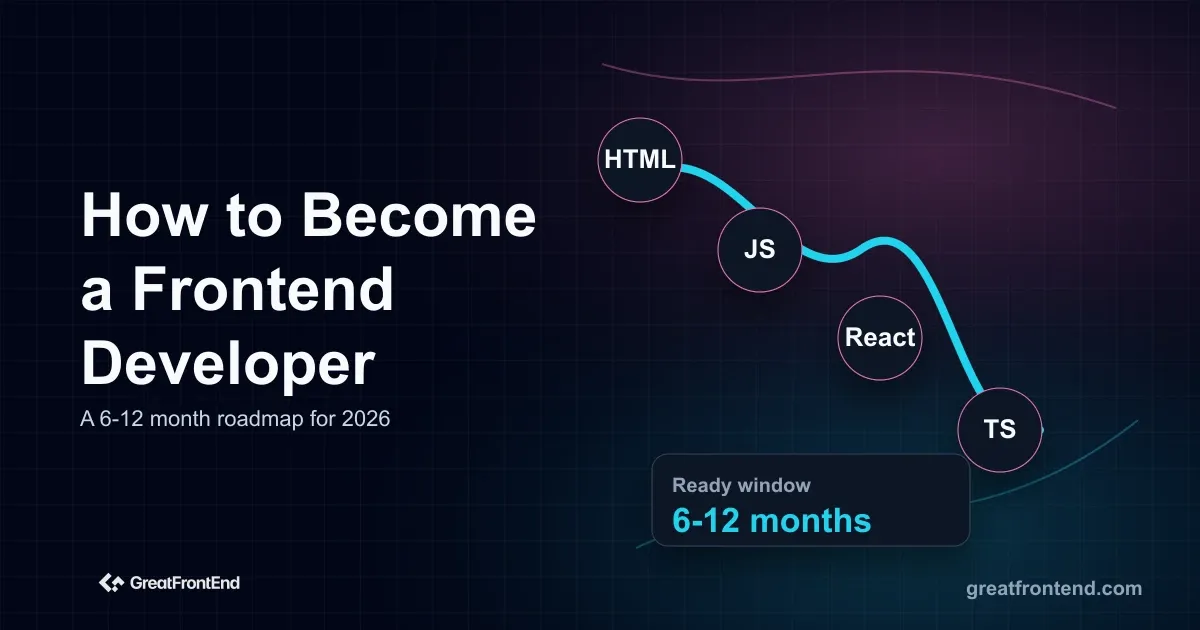 Learn how to become a frontend developer in 2026 with a staged roadmap covering web foundations, React, TypeScript, production skills, projects, and expert tracks.
 A detailed frontend developer roadmap for 2026 covering the skills, tools, projects, milestones, and interview practice needed for modern frontend roles.
 Prepare for frontend testing interviews with 30 fresher questions on unit, integration, E2E, React Testing Library, mocks, async tests, coverage, CI, and accessibility.