How to Think Out Loud in a Frontend Coding Interview
Learn how to communicate your thought process in frontend coding interviews, with practical examples of what to say while planning, coding, debugging, and testing.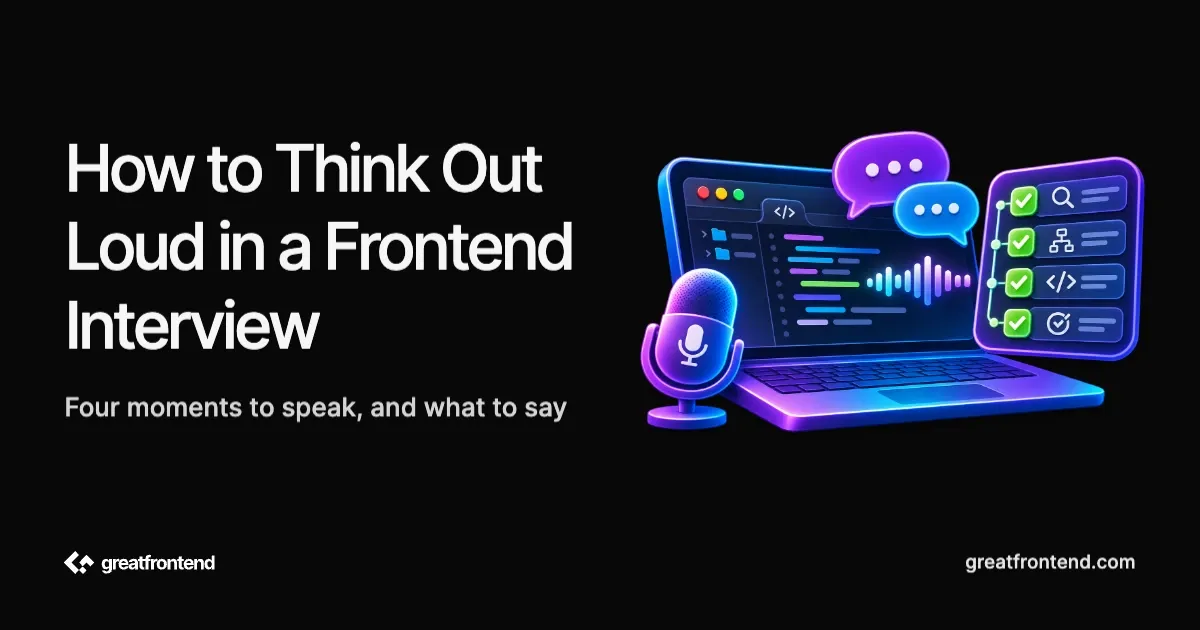
You understand the problem. You know how to solve it. You start writing code.
Ten minutes later, the interviewer asks, "Can you walk me through your approach?"
You've made progress, but they haven't heard why you chose that approach, what alternatives you considered, or which edge cases you've thought about.
This is why thinking out loud matters in coding interviews.
It doesn't mean explaining every line of code. It means making your reasoning visible so the interviewer can understand how you approach problems, make decisions, and handle challenges.
Here's how to think out loud in a frontend interview without talking constantly or losing focus on the code.
Why thinking out loud matters
Frontend coding interviews assess more than whether you can produce a working solution.
Interviewers may also evaluate your problem-solving approach, technical decisions, communication, and ability to verify your work.
For example, consider two candidates who implement the same search component.
Both use debouncing to reduce unnecessary API requests. Both produce working code.
But one candidate writes silently and says, "It's done."
The other explains why debouncing is useful, mentions the possibility of stale API responses, and tests how the component behaves when requests finish out of order.
Even if both implementations are correct, the second candidate has given the interviewer more evidence of their technical understanding.
The goal isn't to sound knowledgeable. It's to help the interviewer follow your reasoning.
This is consistent with the communication and problem-solving criteria described in the Tech Interview Handbook's coding interview guidance.
When should you think out loud?
You don't need to narrate everything you do. Focus on four moments:
1. Clarify the problem
Before coding, explain how you understand the requirements and ask questions that could change your implementation.
Suppose the interviewer asks you to build a searchable dropdown.
Instead of immediately creating components, you could say:
"Just to confirm, should the search filter an existing list or call an API? And should users be able to navigate the results using the keyboard?"
These questions matter because they affect the component's design.
Other useful things to clarify include loading and error states, empty results, selection behavior, and any restrictions on libraries.
You don't need to ask every possible question. Prioritize the ones that affect your approach.
2. Explain your plan
Once the requirements are clear, describe how you'll approach the task before writing code.
For example:
"I'll start by rendering the dropdown with some sample data. Then I'll add filtering and selection, followed by keyboard navigation. Once the main interactions work, I'll test the empty state and edge cases."
This gives the interviewer an overview of your approach and an opportunity to raise concerns before you've written too much code.
If you're choosing between two approaches, explain the trade-off briefly.
For example:
"I could manage the selected value inside the dropdown, but I'll make it controlled so the parent component can use the selected user."
You don't need a lengthy architecture discussion. A few sentences are usually enough.
3. Explain important decisions while coding
This is where candidates often struggle.
You need to concentrate on implementation, so it's natural to go quiet. That's fine. You don't have to speak continuously.
Instead, explain decisions when something meaningful happens.
For example:
"I'm using a button for the dropdown trigger because it already supports keyboard interaction."
Or:
"I'm keeping the search query separate from the selected value because typing shouldn't change the current selection."
Or:
"I'm adding a cleanup here because an older API response shouldn't overwrite results for the latest query."
These statements tell the interviewer why you're writing the code a particular way.
Avoid explaining obvious syntax.
Saying "I'm declaring a variable" or "Now I'm adding an event handler" doesn't reveal much about your understanding.
4. Explain how you're testing the solution
Don't finish coding and immediately say, "Done."
Walk through the important cases and explain what you're checking.
For a searchable dropdown, you might say:
"The basic selection works. I'll check what happens when there are no matches, whether Escape closes the dropdown, and whether I can navigate the options with the keyboard."
If something fails, explain what you observed and how you'll investigate it.
For example:
"The highlighted option isn't resetting when the query changes. I think the active index is being preserved from the previous result set. I'll check where that state is updated."
You don't need to test every possible scenario during the interview. But demonstrating that you can identify and verify important behaviors is valuable.
If time runs out, mention what remains untested.
What does good communication look like during an interview?
Let's walk through a short example.
Scenario: Build a searchable user picker
The interviewer asks:
"Build a component where users can search for and select someone from a list."
Here's how the conversation might progress.
Interviewer: "How would you approach this?"
Candidate: "First, is the user list already available, or should the component fetch it? And is this single-select or multi-select?"
Interviewer: "The data is already available. Single-select is fine."
Candidate: "Okay. I'll render the input and filtered list first, then add selection and keyboard behavior. I'll keep the selected value in the parent so the component can be reused."
The candidate starts implementing the component.
Candidate: "I'm filtering the list based on the input value. I'll make the comparison case-insensitive so searching for 'ada' also matches 'Ada Lovelace'."
A few minutes later, the interviewer asks:
Interviewer: "What happens if the user types something that doesn't match anyone?"
Candidate: "Right now, the list would be empty. I'll add a 'No users found' message so that state is clear."
After implementing selection:
Candidate: "The main flow works. I'll check that clicking an option selects it, then test keyboard navigation and closing the popup with Escape."
Interviewer: "Would you build all the keyboard handling yourself?"
Candidate: "Not necessarily. For a production component, I'd first consider an accessible combobox implementation from a library. Since we're building this from scratch here, I'd make sure the expected keyboard interactions are covered. Given the time limit, I'd confirm which interactions you want prioritized."
This is the kind of communication that makes a coding session easier to follow.
The candidate isn't describing every keystroke. They're clarifying requirements, explaining decisions, responding to questions, and testing the result.
They also recognize when a production implementation might require a different approach.
What should you say when things don't go smoothly?
You won't always know the answer immediately. You might get stuck, misunderstand a requirement, or realize that your approach isn't working.
Those are moments when clear communication matters most.
| Situation | What you could say |
|---|---|
| You need time to think | "Give me a moment to work through the edge cases, then I'll explain the approach." |
| You're stuck | "I expected this state to update, but it isn't. I'll check whether the handler is firing first." |
| You realize you're wrong | "I missed that case. The current approach won't handle it, so I'll adjust this part." |
| You don't remember an API | "I don't remember the exact API signature. I'd normally check the documentation. Can I look it up?" |
| You disagree with a suggestion | "I see why that would work. My concern is how it handles this case. Could we compare the two approaches?" |
| Time is running out | "The main interaction is working. I'll use the remaining time to test it and summarize what's missing." |
You don't need to memorize these phrases.
The important part is explaining what you're thinking or investigating instead of going silent without context.
What should you avoid?
1. Narrating every line of code
The interviewer can already see the code. Explain decisions and reasoning, not syntax.
2. Talking without making progress
Thinking out loud shouldn't turn into a long monologue about every possible implementation.
State your plan, make progress, and discuss alternatives when they matter.
3. Constantly apologizing
Instead of saying, "Sorry, I'm probably doing this wrong," explain what you're uncertain about and how you'll check it.
4. Pretending you understand something
If you're unfamiliar with a browser API or unsure about an implementation detail, say so.
Explaining how you'd verify an assumption is more useful than confidently guessing.
5. Ignoring the interviewer
If the interviewer asks a question or suggests an alternative, stop and engage with it.
Thinking out loud is still a conversation, not a presentation.
How to practice thinking out loud
You can improve this skill without preparing dozens of new coding problems.
Practice with problems you already know
Start with a familiar JavaScript utility or UI component.
Because you already know the solution, you can concentrate on explaining the important decisions.
Use the four stages:
- Clarify the requirements.
- Explain your plan.
- Narrate meaningful decisions.
- Verify the result.
Record yourself solving a problem
Record your screen and voice while completing a small frontend exercise.
When you watch it back, notice where you stopped communicating, explained obvious details, or skipped important reasoning.
The goal isn't to eliminate every silence. It's to make your explanation easier to follow.
Practice with another person
Ask a friend or colleague to observe while you solve a problem.
Have them interrupt with questions such as:
- "Why did you choose that approach?"
- "What happens when the input is empty?"
- "How would you test this?"
- "What would you change if this component needed to support thousands of items?"
This helps you become comfortable explaining decisions while someone is watching.
You can also use a frontend mock interview to practice under realistic time constraints.
Frequently asked questions
Should I talk throughout the entire interview?
No. It's normal to be quiet while reading, thinking, or writing code.
Focus on explaining your plan, important decisions, trade-offs, and tests. If you need an extended moment to think, tell the interviewer what you're working through.
What if I explain things better after writing code?
That's fine. You can briefly say what you're implementing, work quietly for a moment, and then explain the result.
The goal is to communicate your reasoning, not to force yourself to talk while typing every line.
What if I realize my approach is wrong?
Explain what you discovered, why the approach doesn't work, and what you'll change.
Correcting your own mistakes is a normal part of software development. The important thing is demonstrating that you can recognize and address them.
Does this apply to pair programming interviews?
Yes, but the interaction is more collaborative. In a pair programming interview, the interviewer may actively discuss approaches, suggest changes, or participate in the implementation.
See the frontend pair programming interview guide for more on that format.
Conclusion
Thinking out loud in a frontend coding interview doesn't mean talking constantly. It means helping the interviewer understand how you approach the problem.
Clarify the requirements, explain your plan, communicate important decisions while coding, and show how you verify your work.
To think out loud in a frontend interview, you don't need to be a natural speaker. You need a habit: say what you understand, what you plan to do, why you chose it, and what you checked. Interviewers can only evaluate the reasoning they can hear, so a short sentence at each of those moments usually does more than a long explanation at the end.
You don't need polished speeches or memorized phrases. Practice explaining your reasoning while solving familiar problems, then gradually introduce harder tasks and interview-style interruptions.
The goal is simple: make your engineering judgment visible, not just your final code.
Related articles
 Learn what a frontend pair programming interview is, how it differs from other coding rounds, what interviewers evaluate and how to prepare, with a worked example.
 How frontend interviews are scored: the criteria, what each round focuses on, what a strong signal looks like, and how to self-score a mock interview.
 Learn what to expect in a frontend code review interview, how to evaluate unfamiliar code, prioritize issues, give feedback, and prepare with a practical example.
 Frontend take-home assignment guide: what reviewers check, how long to spend, AI rules, a worked example, a three-hour plan, a README template and common mistakes.
 Learn how to explain your projects in a frontend interview: a simple answer structure, a worked example, the technical follow-ups to expect and mistakes to avoid.