Frontend Development for Beginners: Where to Start in 2026
Start frontend development in 2026 with a beginner-friendly path through HTML, CSS, JavaScript, Git, React, projects, accessibility, and interview basics.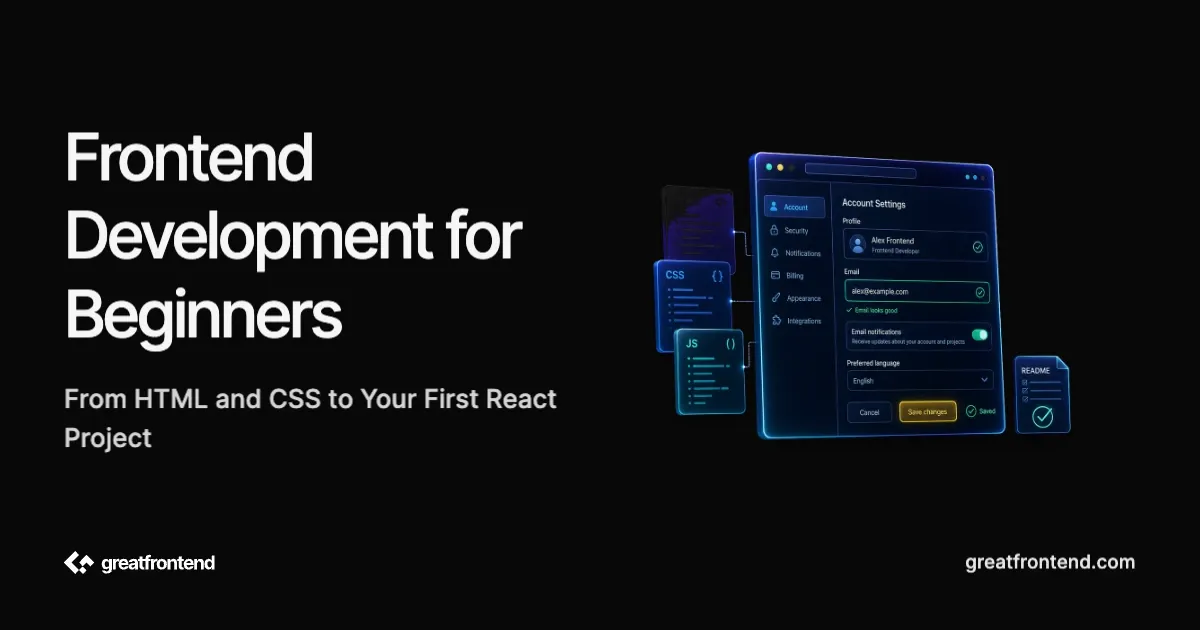
Frontend development for beginners should start with the browser and end with one project another developer can inspect. Learn HTML, CSS, JavaScript, DevTools, and basic accessibility first; then rebuild one completed flow in React or another framework.
The goal is not to memorize every tag, CSS property, array method, and framework option. The goal is to build a small interface that survives normal product conditions: small screens, invalid input, slow requests, empty results, keyboard navigation, and a README that explains how the project works.
MDN Learn web development and the MDN Curriculum are good official references for the browser path. Use Frontend Developer Roadmap when you want the larger skills map, and use Best Resources to Learn Frontend Development when you want a curated resource list. This guide is narrower: it shows what a beginner should build first and how to know it is good enough to move on.
What frontend development means for beginners
Frontend development is the part of web development users see, click, type into, read, and navigate. For a beginner, that means six practical skills:
- Structure content with semantic HTML.
- Make layouts work across screen sizes with CSS.
- Add behavior with JavaScript.
- Fetch and display data without breaking the page.
- Make forms, errors, and interactive components usable with a keyboard.
- Explain the project clearly enough that someone else can run it.
That last point matters. A project hidden in a messy GitHub repo is hard to evaluate. A smaller project with a clean README, visible states, and clear decisions teaches more and gives you better proof.
Follow the beginner order
Frameworks sit on top of browser behavior. If you skip the browser, React state, form bugs, layout issues, and accessibility problems feel mysterious later.
| Stage | Learn | Build | Ready when |
|---|---|---|---|
| Setup | Editor, browser, folders, Git, GitHub | One local page in a repository | You can edit, run, commit, and publish small changes |
| HTML | Headings, links, buttons, forms, labels, lists, tables, landmarks | Profile page and contact form | The page has meaningful structure without CSS |
| CSS | Box model, cascade, Flexbox, Grid, responsive layout, focus states | Settings page or pricing page | It works at mobile, tablet, and desktop widths |
| JavaScript | Values, functions, arrays, objects, DOM, events | Tabs, modal, filter, form validation | User actions update the UI predictably |
| Async UI | fetch, promises, JSON, loading, empty, error, retry | API-backed search page | Failed and slow requests have visible states |
| Accessibility | Labels, keyboard flow, focus, errors, color contrast | Form-heavy flow | The main task works without a mouse |
| Framework | Components, props, state, lists, forms, effects | Rebuild one browser project in React | Components make the flow clearer, not more confusing |
| Proof | README, screenshots, demo link, tradeoff note | Reviewable portfolio project | Another developer can run and inspect the work |
Do not treat this as a list to finish before building. Each row should produce a small working piece.
Start with one inspectable project
Pick one project and keep improving it for several weeks. A repeated project teaches more than five tutorial clones because every new skill has to fit into an existing flow.
Good first project choices:
- Account settings page.
- Product search page.
- Booking form.
- Issue tracker.
- Habit tracker.
The best beginner project is boring in a useful way. It has forms, layout, state, errors, and data. It does not need authentication, payments, complex animation, or a custom backend.
Example project: account settings flow
Build an account settings page for a fictional product. Start with static HTML and CSS. Then add JavaScript. Later, rebuild the same flow in React.
| Requirement | What to build | What it proves |
|---|---|---|
| Page structure | Heading, profile section, email field, password section, notification preferences | You can write semantic HTML |
| Responsive layout | Single column on mobile, two-column layout on wider screens | You understand spacing, width, and overflow |
| Form behavior | Required fields, invalid email message, disabled save button while saving | You can handle common form states |
| Async behavior | Load saved settings from a JSON file or mock API | You can use fetch and render data |
| Failure state | Show an error message and retry button when loading fails | You do not build only the happy path |
| Accessibility | Labels, visible focus, keyboard access, error text tied to fields | The flow can be used without a mouse |
| Project proof | README, screenshots, run commands, known limitation | Someone else can review the project quickly |
This one project can teach HTML, CSS, JavaScript, async UI, accessibility, GitHub hygiene, and React. You are not starting over each week; you are adding a more demanding constraint.
Build product states, not only screens
A beginner project becomes valuable when it handles what users actually experience. A static screen is a design copy. A frontend project has states.
| State | What to practice |
|---|---|
| Initial | What does the user see before doing anything? |
| Loading | What appears while data is being fetched or a form is being saved? |
| Empty | What appears when search returns no results or no preferences exist yet? |
| Invalid | How does the form explain what needs to change? |
| Error | What happens when the request fails? |
| Success | What confirms the user completed the task? |
| Disabled | Which controls should pause during saving or loading? |
| Keyboard | Can the user complete the main task with Tab, Enter, Space, and Escape where appropriate? |
| Mobile | Does the same flow work on a narrow screen? |
This is where frontend development starts to feel like engineering. You are deciding how the interface behaves when the world is not perfect.
Learn DevTools from the start
DevTools should not wait until something is broken. Use it while building so browser behavior becomes visible.
| Tool | Use it for | Beginner exercise |
|---|---|---|
| Elements | Inspect HTML, CSS, layout, spacing, and focus styles | Find why a button is misaligned |
| Console | Read JavaScript errors and test small expressions | Fix one broken event handler |
| Network | Inspect request status, payload, response, and timing | Debug a failed fetch request |
| Performance | Record a slow interaction when the page feels laggy | Compare before and after a rendering fix |
Chrome's Network panel docs and Performance panel docs are worth bookmarking, but do not try to learn every panel at once. Start with Elements, Console, and Network.
Practice accessibility as normal frontend work
Accessibility is not an advanced specialization for later. It starts with the elements you choose and the way your UI responds to input.
The W3C Web Accessibility Initiative explains accessibility as making websites and tools usable by people with disabilities. For beginners, the first practical layer is simple:
- Use a real
<button>for actions and a real<a>for navigation. - Connect every input to a visible label.
- Keep heading order meaningful.
- Make focus visible.
- Do not rely on color alone for errors.
- Put error text close to the field it describes.
- Test the main flow with the keyboard.
- Use ARIA patterns only when native HTML is not enough.
If you build tabs, a modal, or an accordion, compare your keyboard behavior with the ARIA Authoring Practices Guide. The lesson is not "add more ARIA." The lesson is to match the expected behavior of the component.
Learn React after the browser version works
React is a practical default for many frontend learners, but it should organize knowledge you already started building. It should not hide weak HTML, CSS, JavaScript, or debugging habits.
Before React, you should be able to:
- Build a form with labels and validation.
- Change the UI when a user clicks, types, or submits.
- Render a list from an array.
- Show loading, empty, error, and success states.
- Debug a failed request in the browser.
- Explain why a layout breaks on mobile.
Then React becomes easier to learn. The official Thinking in React guide teaches the habit of breaking UI into components, describing visual states, and connecting data flow. That lands better after you have already built a small browser version.
When you rebuild your settings page in React, learn these ideas in order:
| React idea | What it should help you do |
|---|---|
| Components | Split the page into meaningful pieces |
| Props | Pass data into child components |
| State | Store values that change because of user actions or requests |
| Derived values | Calculate values during render instead of storing duplicates |
| Lists and keys | Render repeated rows or settings predictably |
| Forms | Keep input, validation, disabled, and error states understandable |
| Effects | Synchronize rendering with an external system, such as a browser API or network connection |
Avoid adding a state library, component library, or full app framework before you can explain where state belongs in a small React app.
Use an eight-week build path
This is a starter path, not a deadline. Spend longer on any week if you cannot explain what you built.
| Week | Output | Acceptance test |
|---|---|---|
| 1 | Static account settings page | HTML structure makes sense with CSS turned off |
| 2 | Responsive layout | No horizontal scroll at common mobile, tablet, and desktop widths |
| 3 | JavaScript interactions | Tabs, toggles, validation, and saved messages work without a framework |
| 4 | Form states | Invalid, disabled, saving, success, and error states are visible |
| 5 | Data loading | Settings load from JSON or a mock API with loading, empty, error, and retry states |
| 6 | Accessibility and debugging pass | Main flow works with keyboard and DevTools can explain one bug |
| 7 | React rebuild | Components, props, state, and effects make the same flow easier to reason about |
| 8 | Review pass | README, screenshots, demo link, and tradeoff note are ready for another person |
By the end, the project is small but inspectable. That is better than a large app where every page works only because a tutorial told you what to type.
Know when to move on
Move to the next topic when you can build the current one from a blank file, explain the failure states, and debug one broken version.
| Skill | Move on when you can |
|---|---|
| HTML | Build a form with labels, buttons, useful link text, and ordered headings |
| CSS | Fix overflow, spacing, responsive columns, and focus styles |
| JavaScript | Update UI from events without losing track of state |
| Async UI | Show loading, empty, error, retry, and success states |
| React | Split a flow into components with clear props and state ownership |
| Portfolio proof | Explain what broke, what changed, and how someone can run it |
If you cannot explain why the layout breaks, why the request fails, or why state is stale, spend another small project on that topic before adding a new framework.
Avoid beginner traps
Most beginner delays come from switching too early, not from choosing the wrong first resource.
| Trap | Better move |
|---|---|
| Learning five frameworks | Pick one after browser and JavaScript basics |
| Copying projects line by line | Change one requirement and rebuild the feature |
| Ignoring CSS | Practice layout, overflow, focus, and responsive behavior |
| Building only happy paths | Add invalid, loading, empty, error, and retry states |
| Treating AI output as proof | Explain and modify the code without the chat open |
| Skipping GitHub cleanup | Add README, screenshots, run commands, and known limitations |
| Starting with a big app | Keep one small flow and make it more complete |
The course loop is especially common. Courses are useful for structure, but they become a trap when every lesson resets the project. Keep one project alive. Add routing, then forms, then API data, then accessibility checks, then a React rebuild.
Use AI without outsourcing learning
AI can explain errors, suggest edge cases, compare approaches, and help you write tests. It should not be the only reason your project works.
After using AI:
- Close the chat and explain the code line by line.
- Change one requirement and update the solution yourself.
- Ask why an alternative would fail.
- Remove code you cannot explain.
- Write a short note about the bug or tradeoff you learned.
If you cannot modify the project without AI giving you the next step, the project is not ready as portfolio proof.
Make the project reviewable
A beginner project becomes more valuable when someone else can inspect it quickly. GitHub's README guidance says a README should explain what a project does, why it is useful, and how people can get started. For a beginner frontend project, include:
- What the app does.
- What you built yourself.
- How to run it locally.
- A live demo link or screenshots.
- The main states you handled.
- The hardest bug you fixed.
- One limitation you would improve next.
Do not hide weak code behind a large project name. Make the work easy to review.
What to ignore in the first month
In month one, ignore advanced state libraries, design systems, server infrastructure, custom build-tool tuning, complex animation systems, micro-frontends, and framework debates.
Spend that time on browser basics: forms, layout, events, fetch, errors, keyboard behavior, and debugging. The first month should produce small working pages, not a perfect stack.
Common questions
Should beginners learn React first?
Learn enough HTML, CSS, JavaScript, browser behavior, and DevTools before relying on React. You do not need to master every browser API first, but you should know what React is helping with: rendering, components, state, forms, effects, and updates.
Do beginners need TypeScript?
Learn JavaScript first. Add TypeScript when your project has data shapes worth protecting: API responses, form values, component props, table rows, or reusable helpers. If TypeScript errors feel random because JavaScript still feels random, wait a little longer.
How do you know a resource is working?
A resource is working when it changes what you can build without copying. If you finish a lesson but cannot change the requirements, the next step is not another resource. Rebuild the same idea in your own project with one new constraint.
How should you choose between frameworks?
Choose from the roles, teams, and projects you are targeting. If those signals do not favor a framework, React is a reasonable default because its official learning path is extensive and the same component, state, and data-flow lessons transfer elsewhere. The first framework matters less than your ability to ship and explain a complete flow.
When are you ready for job-oriented practice?
You are ready when one small project is inspectable: working link, readable code, visible states, keyboard-safe main flow, and a README that explains how to run it. From there, add interview practice with JavaScript interview questions, React interview questions, and UI coding questions.
Start with the browser. Build one small flow until it handles the messy parts. Then add framework depth. That path feels slower in week one, but it saves months of scattered learning.
相关文章
 Learn how to become a frontend developer in 2026 with a staged roadmap covering web foundations, React, TypeScript, production skills, projects, and expert tracks.
 A detailed frontend developer roadmap for 2026 covering the skills, tools, projects, milestones, and interview practice needed for modern frontend roles.
 Learn JavaScript in 2026 with a practical roadmap covering syntax, DOM, async code, browser APIs, projects, testing, and interview practice.
 Learn React in 2026 with a practical roadmap covering components, JSX, state, effects, forms, data fetching, routing, TypeScript, and interview practice.
 A practical 2026 look at whether frontend development is still a good career, what changed, and what skills make the path worth choosing.