How to Learn JavaScript in 2026: The Step-by-Step Guide for Beginners
Learn JavaScript in 2026 with a practical roadmap covering syntax, DOM, async code, browser APIs, projects, testing, and interview practice.
The best way to learn JavaScript in 2026 is to learn the language, then use it in the browser, then practice enough small programs that callbacks, promises, objects, arrays, and DOM updates stop feeling separate.
Do not start by memorizing every method on Array. Start by learning what runs, when it runs, what data changes, and what the page should show after each change.
JavaScript learning roadmap
| Stage | What to learn | What you should be able to build |
|---|---|---|
| 1 | Syntax, values, variables, functions | Small console programs |
| 2 | Arrays, objects, strings, dates, maps, sets | Data transformation utilities |
| 3 | Control flow and error handling | Input validation and retry logic |
| 4 | DOM, events, forms, accessibility basics | Interactive browser widgets |
| 5 | Async JavaScript, promises, fetch() | API-backed pages |
| 6 | Modules, tooling, linting, tests | Maintainable mini apps |
| 7 | Interview patterns and debugging | Explain and fix unfamiliar code |
MDN's JavaScript Guide is the best primary reference for the language because it covers grammar, control flow, functions, objects, promises, modules, and browser-facing usage in one place. Use it as reference material, not as a book you must finish before building.
Step 1: Learn the core language first
Start with JavaScript as a programming language before jumping into React, Next.js, or Node.js.
Learn these topics in order:
- Values: strings, numbers, booleans,
null,undefined, objects, arrays - Variables:
const,let, scope, reassignment - Expressions and operators: comparisons, logical operators, ternary expressions
- Control flow:
if,switch, loops, early returns - Functions: parameters, return values, arrow functions, callbacks
- Objects and arrays: reading, writing, copying, destructuring
- Errors:
try,catch, throwing useful errors
The goal is not trivia. The goal is to predict what a piece of code will do without running it.
For example, a beginner should be able to explain why this produces a new array and does not mutate prices:
const prices = [100, 200, 300];const discounted = prices.map((price) => price * 0.9);
That skill matters more than knowing ten array methods by name.
Step 2: Practice arrays, objects, and strings every day
Most frontend work is data shaping. You receive API data, user input, configuration, or component props, then turn it into UI.
Practice with small exercises:
- Convert an array of products into a list of product names
- Group transactions by month
- Remove duplicate users by ID
- Count how many tasks are complete
- Normalize messy input such as
" React Developer "into"react developer" - Sort records without mutating the original array
This is where methods like map, filter, find, some, every, reduce, sort, slice, toSorted, and Object.entries become useful.
Two details matter while practicing:
- Prefer immutable updates when the original data is still needed. Use
toSorted()where your browser support target allows it, or copy with[...items].sort(...)before sorting. - Learn equality and coercion deliberately. In application code,
===is usually the default;==has coercion rules that are useful to understand but easy to misuse.
Use GreatFrontEnd JavaScript interview questions when you want targeted practice. Interview-style questions are useful even before interviews because they force you to reason through edge cases.
Step 3: Learn the browser, not only JavaScript syntax
Frontend JavaScript runs inside a browser. That means you need the DOM, events, forms, accessibility, layout interactions, storage, network requests, and browser limitations.
Build these without a framework first:
- Counter with increment, decrement, and reset
- Todo list with add, complete, edit, delete, and filter
- Searchable list with empty and loading states
- Form with client-side validation and accessible error messages
- Tabs where keyboard users can move between panels
- Modal with focus management and Escape-to-close behavior
The important part is the connection between state and UI. When data changes, what should change on the page? When the user clicks, types, submits, or presses a key, which code should run?
Do not skip accessibility while learning DOM work. A button should be a button. A label should be connected to its input. Error text should be reachable by assistive technology. These habits are easier to learn early than to patch later.
Step 4: Learn async JavaScript with real failure states
Async JavaScript is where many beginners get stuck because the code does not run top to bottom in the way they expect.
Learn these concepts together:
- The call stack
- Tasks and microtasks at a high level
- Promises
asyncandawaitfetch()- Request cancellation with
AbortController - Loading, success, empty, and error states
- Race conditions from multiple requests
Build a search page that calls an API when the user submits a query. Then add:
- A loading indicator
- An empty result state
- An error message
- A disabled submit button while a request is pending
- A stale-response guard so an older request cannot overwrite a newer result
- Request cancellation when the user starts a newer search
That one project teaches more useful async JavaScript than many syntax-only exercises.
For example, a plain JavaScript search flow can combine AbortController with a current-request check:
let currentController;async function runSearch(query) {currentController?.abort();const controller = new AbortController();currentController = controller;try {const response = await fetch(`/api/search?q=${encodeURIComponent(query)}`, {signal: controller.signal,});const results = await response.json();if (controller !== currentController) {return;}renderResults(results);} catch (error) {if (error.name !== 'AbortError') {renderError('Search failed. Try again.');}}}
This is not only an API trick. It teaches the habit of asking which async result is still allowed to update the UI.
Step 5: Learn modules and tooling when repetition hurts
Do not install a build tool on day one. Wait until you feel the problem it solves.
You are ready for tooling when:
- One file is too large
- You want imports and exports across files
- You want TypeScript or JSX
- You want tests
- You want formatting and linting
- You want a local dev server with fast refresh
At that point, learn npm scripts, package installation, ES modules, Prettier, ESLint, and a test runner such as Vitest. You do not need to become a tooling expert, but you should understand what runs when you type npm run dev, npm test, or npm run build.
Step 6: Build projects that prove specific skills
A good beginner project proves behavior, not only visual polish.
| Project | Skills it proves |
|---|---|
| Expense tracker | Forms, arrays, derived totals, validation |
| Weather app | fetch(), loading, errors, empty states |
| Kanban board | Drag behavior, state updates, persistence |
| Product filter page | URL state, sorting, filtering, responsive UI |
| Quiz app | Timers, scoring, state transitions |
| GitHub profile viewer | API calls, error handling, conditional rendering |
For each project, write a short README with:
- What it does
- How to run it
- One edge case you handled
- One thing you would improve
That README trains you to explain technical work, which helps in interviews and portfolio reviews.
Add one small testable rule to every project. For an expense tracker, test that deleting an item updates the total. For a search page, test that the empty state appears when the API returns no results. You do not need a giant test suite as a beginner, but you should learn that behavior can be checked without clicking through the whole app by hand.
Step 7: Add React only after JavaScript feels useful
You do not need to master all JavaScript before React, but you should be comfortable with functions, arrays, objects, modules, async code, and DOM events first.
If you start React too early, every problem feels like a React problem. Many are JavaScript problems:
- Data is shaped incorrectly
- A callback closes over old data
- A promise resolves later than expected
- A list key is unstable
- An object was mutated by accident
JavaScript gives you the mental model. React gives you a component model for building larger interfaces.
A 12-week JavaScript study plan
| Weeks | Plan | Output |
|---|---|---|
| 1-2 | Syntax, functions, arrays, objects | 30 small console exercises |
| 3-4 | DOM, events, forms | Counter, todo app, form validation |
| 5-6 | Async JavaScript and APIs | Search page with loading and error states |
| 7-8 | Modules, tooling, tests | Refactor one project into modules and add tests |
| 9-10 | Browser APIs and accessibility | Modal, tabs, local storage, keyboard behavior |
| 11-12 | Interview-style practice and portfolio cleanup | Two polished projects and JavaScript question practice |
Adjust the pace if you work or study full time. The sequence matters more than the calendar.
Common mistakes beginners make
The first mistake is copying tutorials without changing the requirements. After finishing a tutorial, add one feature without instructions.
The second mistake is learning syntax without debugging. Use browser DevTools, breakpoints, console inspection, network logs, and error messages. Debugging is part of learning the language.
The third mistake is skipping edge cases. A form with only the happy path is unfinished. What happens with empty input, slow network, invalid data, duplicate clicks, or a user using only the keyboard?
The fourth mistake is treating interviews as separate from learning. Many interview questions test the same habits you need in product code: data transformation, async control, DOM behavior, and careful explanation.
When are you ready to move on?
You are ready for React, TypeScript, or deeper frontend work when you can:
- Build a small browser app without a tutorial
- Explain the difference between mutation and copying
- Use
map,filter, andreducewithout guessing - Fetch data and handle loading, empty, and error states
- Debug a failing event handler
- Split code into modules
- Write a few useful tests
- Explain your code out loud
Learning JavaScript in 2026 is not about finishing every topic. It is about building the mental model that lets you read unfamiliar code, predict behavior, and turn browser events into correct UI.
Related articles
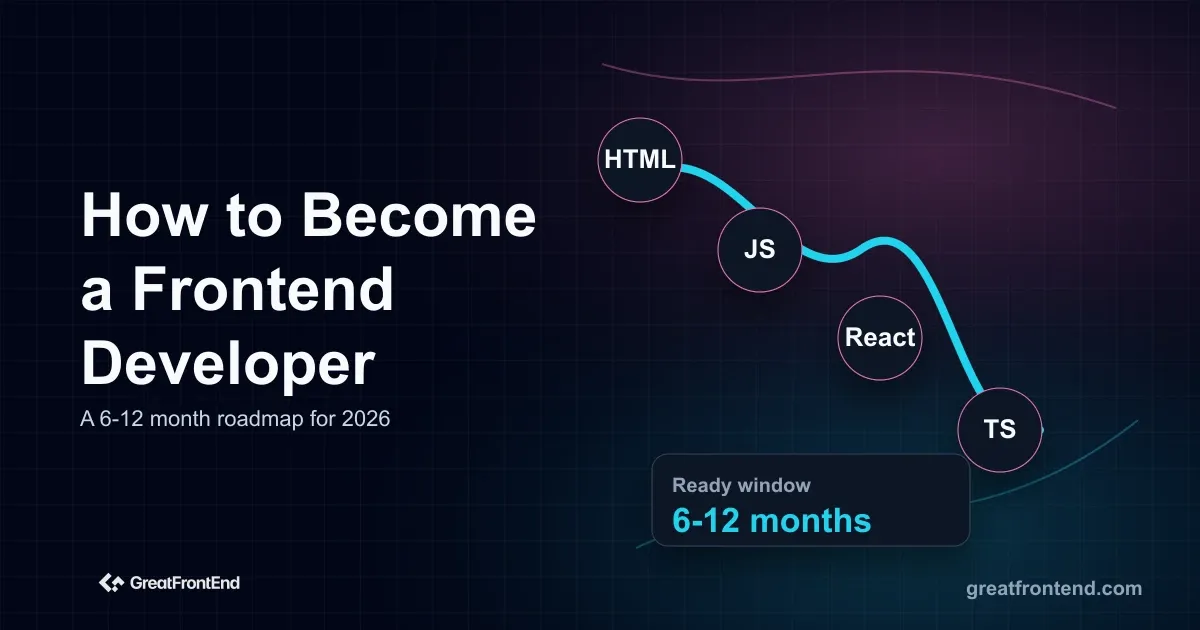 Learn how to become a frontend developer in 2026 with a staged roadmap covering web foundations, React, TypeScript, production skills, projects, and expert tracks.
 A detailed frontend developer roadmap for 2026 covering the skills, tools, projects, milestones, and interview practice needed for modern frontend roles.
 Brush up on fundamental JavaScript skills with these essential interview questions and answers. Perfect for freshers preparing for junior developer roles.