How Long Does It Take to Become a Frontend Developer?
A realistic, data-backed timeline for how long to learn frontend development, comparing bootcamp and self-taught pace with a stage-by-stage time budget.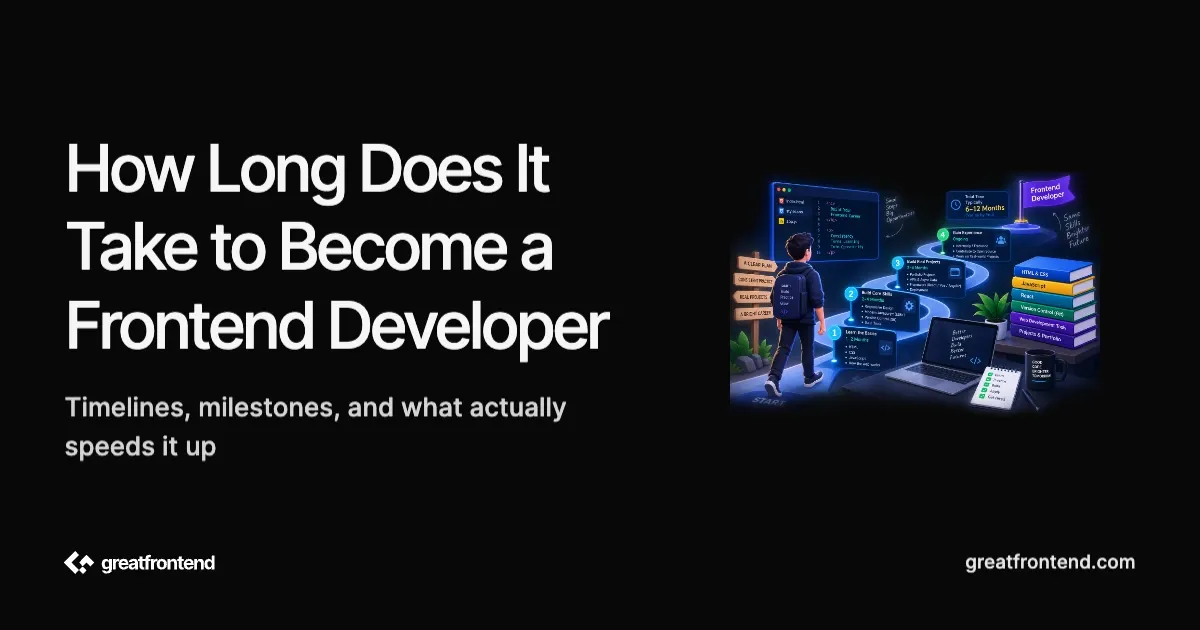
Search for this question and you will find answers ranging from a few weeks to two years, often on the same page. If you're trying to figure out how long to learn frontend development, the honest answer is that it depends on three variables, not one number: how many hours a week you can put in, whether you follow a structured program or teach yourself, and what "become a frontend developer" actually means to you, writing your first component or being ready to interview for a job.
This article does not invent a single answer, because the data does not support one. Instead, it lays out what the two most common paths actually cost in time, using real bootcamp outcomes data and a large self-taught learner survey, then breaks the work itself into stages so you can build your own estimate instead of trusting someone else's.
The real answer: it depends on pace, format, and your target
Three variables drive the estimate more than anything else.
Pace. Someone studying 20 hours a week will get through the same material several times faster than someone studying 5 hours a week around a full-time job. This sounds obvious, but most timeline claims you'll find online quietly assume a specific pace without saying so, which is why a "3 month" claim and an "8 month" claim can both be true for different people covering similar ground.
Format. A structured, paid program compresses the timeline by making every decision for you, what to learn, in what order, with a deadline attached. Self-directed learning removes that structure, which is cheaper but adds time spent figuring out what to learn next, correcting course when you pick the wrong resource, and staying motivated without an external deadline.
Target. "Frontend developer" is not one skill level. Being able to build a static page with HTML and CSS is a real milestone, reachable in weeks. Being able to build a production React application with TypeScript, tests, and accessible markup, the level most junior job postings actually expect, is a different and much larger milestone. Most of the wildly different timeline claims you'll see online are actually answering different versions of this question without saying so.
Bootcamp timelines: the fastest, structured path
Coding bootcamps sell speed, and the data backs that up, within limits. According to Course Report, which compiles outcomes data reported by participating bootcamp providers each year, the average bootcamp runs about 14 weeks, roughly three and a half months, though individual programs range from 6 to 28 weeks depending on depth and pacing.
The format matters as much as the headline number:
- Full-time immersive programs run 2 to 7 months elapsed, typically 40 or more hours a week.
- Part-time programs run 6 to 9 months elapsed, structured as 6 to 15 hours a week in class plus another 10 to 15 hours a week of outside work, closer to 20 to 30 hours a week total once you add it up.
One trend worth noting: bootcamp length has been growing, not shrinking. Course Report's own historical data shows the average program grew from just under 11 weeks in 2015 to just over 15 weeks in 2019. As the field matured, providers extended programs rather than compressing them further, which is a signal that the earlier, shorter timelines were probably too optimistic about what a beginner can absorb.
Treat Course Report's figures as self-reported survey data, not as an independently audited dataset. Its graduate outcomes surveys collect responses directly from bootcamp graduates, so the results still deserve the same read-with-context treatment as any self-reported industry survey.
Self-taught timelines: slower, free, and highly pace-dependent
Most aspiring frontend developers do not attend a bootcamp. One of the largest datasets on people learning to code outside traditional CS programs is freeCodeCamp's 2021 New Coder Survey, with more than 18,000 respondents. Two numbers from it matter here.
First, the median self-taught learner in that survey studies 8 hours a week. That is roughly a third of what a full-time bootcamp student puts in, which is the single biggest reason self-taught timelines run longer, not a difference in ability or resources.
Second, among respondents who had been coding for under 5 years, the median time they had already spent coding was 3 months, with an average of 9.5 months (the average is pulled higher by a smaller group who had been at it much longer). It's worth being precise about what this number does and does not say: it measures how long these learners had already been coding at the moment they took the survey, not a measured time to job readiness. A meaningful share of self-taught learners are still mid-journey at the 3 to 9 month mark, which is informative about pace even though it isn't a finish-line measurement.
The same survey found that at least 45% of respondents were already working in some capacity while learning, showing that a large share of learners are fitting this in around an existing job or other responsibilities, which is exactly why the 8 hour a week median matters more than any single "time to become a developer" headline.
A stage-by-stage time budget to learn frontend development
Rather than trust a single number from either path, it helps to break the actual work of learning frontend development into stages and estimate each one. GreatFrontEnd's roadmap for becoming a frontend developer lays out the order in detail; this section focuses on the time each stage tends to take, not the curriculum itself. Bootcamps sequence their own curricula in roughly this same order for a reason: fundamentals first, then a framework, then production skills, because each stage depends on the one before it holding up.
Stage 1: Web fundamentals. HTML as structure, CSS as a layout system (box model, flexbox, grid, responsive design), and JavaScript deep enough to build interactive pages (values, scope, closures, events, promises, fetch). This is the foundation everything else sits on, and rushing it tends to cost more time later, in the form of bugs and confusion that trace back to a shaky fundamental. GreatFrontEnd's JavaScript learning guide covers this stage in depth.
Stage 2: Building without a framework. A handful of small projects in plain HTML, CSS, and JavaScript, before reaching for React. This stage is often skipped, which tends to show up later as a developer who can use React but cannot explain what React is actually doing underneath it.
Stage 3: A framework, typically React, plus TypeScript. GreatFrontEnd's React learning guide and TypeScript learning guide cover this ground. This is usually the longest single stage for a self-taught learner, since it introduces a large surface area (components, state, hooks, a type system) on top of fundamentals that may still be settling in.
Stage 4: Production skills and a portfolio. Testing, accessibility, performance, and enough real projects to show a hiring manager actual working code, not just tutorial completions. This stage has no fixed length. It expands or contracts based on how much feedback you get and how honestly you assess whether a project is actually portfolio-quality or just finished.
A bootcamp compresses all four stages into its fixed schedule, with instructors and a cohort keeping pace consistent. Self-taught learners move through the same four stages at whatever pace their available hours allow, which is why the freeCodeCamp data above shows such a wide spread.
What the data doesn't tell you about learning frontend development: the job search
Every timeline discussed so far covers skill-building, not the job search itself. This research deliberately does not state a specific job-search-duration number. Several sources claim precise figures (a specific number of months, a specific application count), but none trace to a named, checkable study, they read as plausible-sounding numbers on marketing pages rather than actual research, which is exactly the kind of unsourced claim worth being skeptical of. What can be stated with a real source behind it: a Stanford Digital Economy Lab study, analyzing large-scale US payroll data, found that employment among workers aged 22 to 25 in highly AI-exposed occupations was roughly 19% below where it would have been if it had kept pace with similarly aged workers in less AI-exposed occupations. That is a real, sourced signal that the entry-level market has gotten harder, not a reason to skip learning frontend development, but a reason to expect the job search itself to be a separate and possibly longer stage than the skill-building timelines above.
So how long does it actually take?
Putting the pieces together: a full-time bootcamp path, for someone who can commit 40 or more hours a week for three to seven months, is the fastest structured route to junior-developer-level skills, though it comes at real financial cost and doesn't include the job search afterward. A part-time bootcamp, at 20 to 30 hours a week combined, runs 6 to 9 months for the same destination. Self-taught is harder to put a number on, and it's worth being clear that no study measured this directly. What you can do is the arithmetic. An average full-time bootcamp is roughly 14 weeks at 40 or more hours a week, which is somewhere around 560 hours of structured study. Covering that same ground at freeCodeCamp's median self-taught pace of 8 hours a week would take about 70 weeks, so well over a year. Treat that as a rough order of magnitude rather than a target: it assumes your self-directed hours are as well spent as a structured curriculum's, which is exactly the thing that varies most between learners, depending on how efficiently you sequence the four stages above and how much time you lose to trial and error.
None of these numbers is a promise. They are the best available real data on pace and format, which is a more useful starting point than a single invented number. The honest answer to how long to learn frontend development is a range shaped by your own hours per week, not a fixed date on a calendar. If you want a faster path than pure self-teaching without a bootcamp's cost, the highest-leverage move is treating stage 4, production skills and a real portfolio, with the same seriousness a bootcamp forces on you, since that stage is where self-taught timelines tend to expand the most.
A hybrid approach is also common in practice, though it wasn't the subject of a dedicated study found in this research: use free or low-cost self-taught resources for stages 1 through 3, then pay for a shorter, focused bootcamp or cohort program specifically for stage 4, production skills and portfolio review, where structured feedback matters most and self-teaching tends to stall. This isn't a finding from Course Report or freeCodeCamp's surveys, it's a reasonable inference from what each path is actually good at: self-teaching is cheap for content you can absorb alone, and a paid program earns its cost most clearly when you need a second pair of eyes on your work.
Frequently asked questions
Can I become a frontend developer in 3 months? Only at a fast, focused pace, close to full-time hours, and only if "become a frontend developer" means reaching junior-level fundamentals rather than a fully portfolio-ready, job-search-ready state. Course Report's data puts the average full-time bootcamp in the 2 to 7 month range for that level, so 3 months sits at the faster end but is not unusual for an intensive, full-time program.
Is self-taught slower than a bootcamp? Usually, mainly because of hours per week rather than any difference in what self-taught learners are capable of. freeCodeCamp's survey median of 8 hours a week for self-taught learners is roughly a third of a full-time bootcamp's pace, so the same material naturally takes proportionally longer.
Does the timeline include getting a job, or just learning the skills? The stage-by-stage estimates above cover skill-building only. The job search is a separate, highly variable stage, and this article deliberately avoids stating a specific duration for it since no credible, checkable source with an actual figure was found in this research.
What if I already know some HTML and CSS? Subtract time from stage 1 proportionally, but be honest about the gap between "I can write HTML and CSS" and "I understand the box model, the cascade, and responsive layout well enough to build a real interface." The second is closer to what stage 1 actually requires.
Does it matter what age I start at? Not in any way the data found here can speak to directly, but it's worth knowing that freeCodeCamp's 2021 survey put the median age of self-taught new coders at 25, and 45% of respondents were already working in some capacity while learning. Learners with existing jobs and responsibilities are not an edge case in this population, which is part of why the realistic weekly-hours figure sits at 8 rather than something closer to full-time.
Is a computer science degree required first? No path described in this article assumes one. Neither self-taught learning nor a coding bootcamp requires a computer science degree, and the stage-by-stage skills above, HTML, CSS, JavaScript, a framework, and production skills, can all be learned without one.
Related articles
 Learn React in 2026 with a practical roadmap covering components, JSX, state, effects, forms, data fetching, routing, TypeScript, and interview practice.
 Learn how to become a frontend developer in 2026 with a staged roadmap covering web foundations, React, TypeScript, production skills, projects, and expert tracks.