Frontend Developer Demand in 2026: A Job Market Reality Check
Frontend developer demand in 2026, the real data behind the market: a Stanford study on entry-level hiring, a genuine senior scramble, and what it means for you.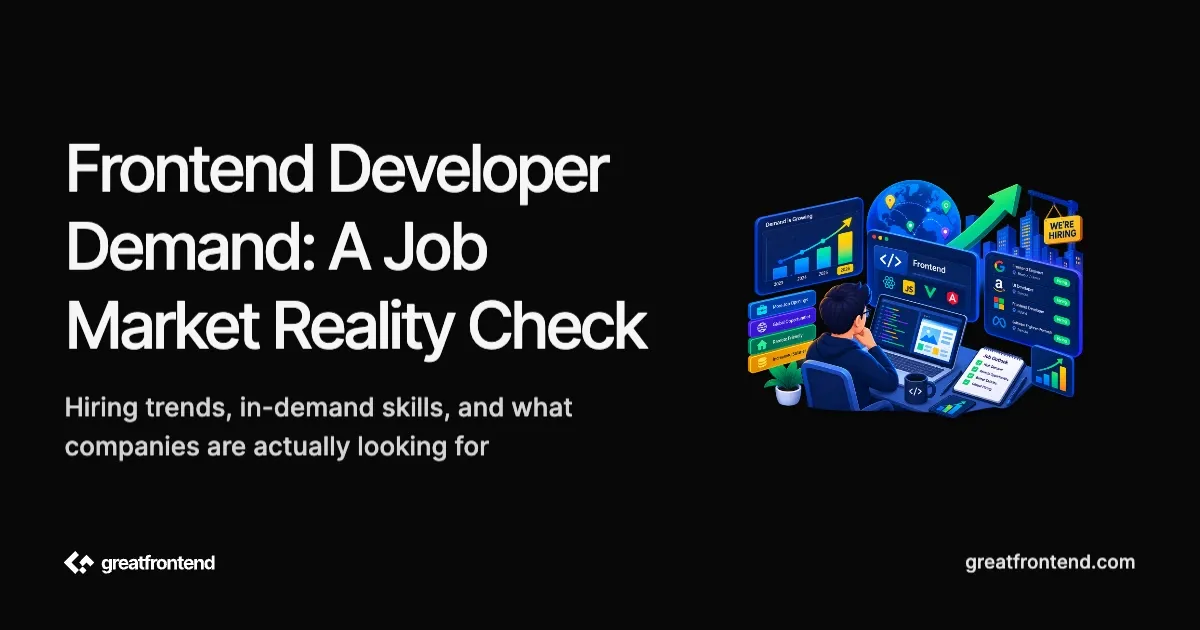
If you're trying to work out frontend developer demand 2026 from headlines alone, you'll find two contradictory stories. One says frontend is dying, AI writes the components now. The other says nothing has changed, keep grinding LeetCode. Neither is accurate. The real data points to something more specific: aggregate demand for software developers is still growing, but the market has split by seniority in a way that matters directly for how you should be spending your prep time right now.
The study behind the headline
The most concrete evidence here isn't an aggregator blog post, it's a working paper from Stanford's Digital Economy Lab, "Canaries in the Coal Mine? Six Facts about the Recent Employment Effects of Artificial Intelligence," by economists Erik Brynjolfsson, Bharat Chandar, and Ruyu Chen. The study analyzed payroll records from ADP, the largest payroll processor in the US, covering millions of workers, not a survey sample.
The finding: in the study's August 2026 update, employment among early-career workers aged 22 to 25 in highly AI-exposed occupations was about 19% below where it would have been if it had kept pace with employment among similarly aged workers in less AI-exposed occupations. Software development and customer service are among the occupations where this divergence is especially visible. Older workers in the same AI-exposed occupations did not show the same decline relative to their less-exposed peers. The important distinction is that this is a relative employment gap, not a claim that employment for young software engineers simply fell 19% in absolute terms.
The researchers' explanation is worth understanding, not just the number. Older workers carry tacit knowledge, the kind that never gets written down anywhere an AI model could learn it from. That knowledge is what AI can't replicate yet, and it's exactly what junior workers haven't had time to accumulate. Entry-level work is disproportionately the routine, well-documented, codifiable kind of work, which is precisely the kind AI coding assistants handle well today.
What the growth numbers actually say
It's worth holding two true things at once here, because most coverage of this topic picks one and ignores the other.
The US Bureau of Labor Statistics projects 15% employment growth for software developers from 2024 to 2034, well above the average for all occupations. That's a real, structural, long-run number. It is not in tension with the Stanford finding, they're measuring different things: BLS is projecting aggregate long-run demand, Stanford is measuring a specific short-run bifurcation by career stage that's happening inside that aggregate growth.
The uncomfortable number sits alongside the growth projection. Recent-graduate unemployment, per Federal Reserve Bank of New York data, running noticeably higher than the general population for exactly the majors that feed into frontend roles: computer engineering at 7.5%, computer science at 6.1%, information systems and management at 5.6%. Growth at the aggregate level and a rough entry-level market can both be true simultaneously, and right now, they are.
The barbell: where the actual demand is
Industry hiring commentary converges on a consistent shape, even though it comes from recruiter and aggregator sources rather than a single named study, so treat this section as a widely reported pattern rather than a hard statistic.
The market has bifurcated into what's commonly described as a barbell: heavy weight at the junior end (an oversupplied pool of generalist frontend talent whose core value, implementing routine UI, is exactly what AI coding assistants now do well) and heavy weight at the senior end (a tight, competitive market for engineers who can architect systems, own ambiguity, and bring specialized depth). The middle of the bar, the generalist mid-level developer hired purely to add headcount, is the segment companies appear most reluctant to invest in right now, because AI already makes their existing senior staff more productive without adding a body.
| Segment | Demand | Why |
|---|---|---|
| Junior / generalist | Oversupplied, high competition | Routine UI work overlaps heavily with what AI coding assistants already do |
| Mid-level generalist | Softest hiring appetite | Companies prefer scaling senior output with AI over adding headcount for capacity alone |
| Senior / architecture-capable | Tight, competitive for employers | Can own ambiguity, design systems, and judgment AI can't yet replicate |
| Specialist depth (performance, accessibility, design systems) | In demand even at mid-level | Depth that's hard to fake and hard for AI to substitute for |
Full-stack ownership, a frontend engineer who can own a feature end to end rather than working only in the UI layer, is increasingly preferred over narrow frontend-only generalists, unless that frontend specialist brings the kind of specialized depth named above.
AI adoption versus AI integration: a distinction most coverage misses
The JetBrains "State of Developer Ecosystem 2025" survey, 24,534 developers across 194 countries, is one of the largest and most methodologically transparent developer surveys running, and it surfaces a gap worth naming precisely: 85% of developers use AI tools regularly, but only 44% report AI is fully or partially integrated into their actual workflow. That's a meaningfully different number than the 85% headline most coverage repeats, and it matters for how you read every other AI-and-hiring claim in this space: high adoption does not automatically mean AI has restructured how teams actually build software yet. 62% of developers rely on at least one AI coding assistant, agent, or editor, and 68% expect AI proficiency to become an explicit job requirement, which is itself a signal about where the bar is moving even before it's fully arrived.
Skills that show up across the demand data
TypeScript is increasingly treated as a baseline expectation for production frontend work rather than a nice-to-have, reported to correlate with higher compensation than plain JavaScript roles, though the specific dollar figures circulating in aggregator salary guides don't trace back to a single checkable primary survey, so treat any specific premium number you see quoted elsewhere as directional, not precise. React remains the most in-demand framework by job-posting volume across most regions surveyed.
The pattern reported consistently across sources: a core layer of HTML, CSS, and JavaScript or TypeScript, a framework (most often React, sometimes Angular or Vue), Git fluency, and then a differentiating layer, CI/CD familiarity, testing discipline, or a rendering-strategy specialty like Next.js, once the core layer is assumed rather than assessed. Within that differentiating layer, three areas recur often enough to be worth calling out specifically: automated testing depth beyond a handful of unit tests (integration and end-to-end coverage that actually catches regressions), familiarity with a CI/CD pipeline well enough to reason about what a failing build actually means, and comfort choosing between rendering strategies (client-side, server-side, or a hybrid framework's default) based on what a given product actually needs rather than defaulting to one approach everywhere.
Where the demand actually is geographically
Frontend hiring is not evenly distributed, and knowing the shape of that distribution matters if you're weighing where to focus a job search or how much to read into a slowdown at one company as a market-wide signal. Reported postings data puts the US at roughly 37% of global frontend developer job postings, the largest single share by a wide margin, followed by India at around 11%, then Germany, Canada, and the UK each in the low single digits. Because the US carries such a disproportionate share of postings, US-specific hiring news, a single company's layoff announcement, a single state's tech-sector report, gets amplified into "the market" far more than its actual weight in a genuinely global hiring picture would justify. A slowdown reported at one or two large US employers is real information, but it is not the same claim as "frontend hiring is slowing everywhere," and conflating the two is one of the most common ways this kind of data gets misread.
How to read frontend job-market data without getting misled
A few patterns are worth naming explicitly, because they're exactly where most coverage of "is frontend dying" goes wrong in one direction or the other.
A single company's layoffs are not the market. Individual company hiring decisions get reported as trend pieces constantly, but one employer's headcount reduction reflects that employer's specific financial or strategic situation as much as any broader signal. The Stanford study's value is precisely that it isn't one company, it's payroll data across millions of workers.
"AI tool adoption" and "AI replacing engineers" are different claims. The JetBrains data above shows why this distinction matters: 85% adoption with only 44% real workflow integration is not evidence of wholesale replacement, it's evidence that the majority of surveyed teams are still figuring out how AI actually fits into how they build software. Treat any claim that conflates high tool usage with job displacement as underspecified until it names a mechanism, not just a correlation.
Aggregate growth and individual difficulty can coexist. This is the core tension this guide opened with, and it's worth restating directly: BLS projecting 15% structural growth through 2034 and the Stanford paper finding a real 19% relative employment gap for early-career software workers in the same field are not contradictory findings that cancel out. They describe the same market from two different altitudes, and a useful read of "frontend developer demand 2026" has to hold both at once rather than picking whichever one fits a narrative.
What this means for how you prepare
None of this changes the fundamentals you need. It changes where the marginal value of your prep time sits.
If you're early-career, the Stanford data is a real signal, not a reason to panic. It means the bar for standing out among junior candidates has moved higher precisely because the pool competing for those routine-UI-adjacent roles is larger and the roles themselves are scarcer. Depth beats breadth here: being able to demonstrate you can own a feature, reason about edge cases, and write code an interviewer would trust in production is worth more than a longer list of frameworks you've touched briefly.
If you're mid-level, the softness in generalist hiring is the argument for building toward one of the specialist lanes named above, performance, accessibility, or design-system depth, rather than staying a horizontal generalist. That's not a claim that generalist roles disappear, it's a claim that the market is pricing specialization higher right now.
If you're senior, the data is straightforwardly favorable, but the bar for what counts as senior judgment in an interview has moved too. GreatFrontEnd's guides on tech-lead and principal-level machine coding and the broader shift in what changes moving from frontend developer to tech lead both cover the specific judgment senior interviews now test for, architecture, ownership, and defending trade-offs, not just shipping a working component.
Frequently asked questions
Is frontend development still a good career path in 2026? The aggregate data says yes, BLS's 15% growth projection through 2034 is real and structural. What's changed is the shape of who's finding roles easily: the squeeze is specific to entry-level and generalist mid-level positions, not the field as a whole.
Should I avoid becoming a frontend specialist because AI writes UI code now? The pattern doesn't support avoiding frontend, it supports avoiding staying purely generalist. Specialists with performance, accessibility, or design-system depth are in demand even where generalist hiring has softened.
Is the 19% employment gap from the Stanford study specific to frontend, or software engineering broadly? The study names software development broadly, not frontend specifically, as one of the occupations (alongside customer service) where this relative gap is especially visible. Frontend roles sit inside that broader software development category, and the hiring-pattern shift toward full-stack ownership is consistent with the same finding applying within frontend specifically, but the study itself doesn't break out frontend as its own line item.
How much should I trust the specific salary and premium figures circulating in aggregator articles? Treat them as directional, not precise. Several of the salary and pay-premium figures reported in recruiter and aggregator content don't trace back to a single named, checkable primary survey the way the Stanford employment data or the JetBrains adoption survey do. The employment-share and adoption-percentage figures cited in this guide come from named, sourced studies specifically because that distinction matters, and it's the same standard worth applying to any other claim about frontend developer demand 2026 you read elsewhere: ask whether it names a study, or just a headline.
Related articles
 Get a frontend developer job with no experience by building proof, choosing beginner-friendly roles, preparing projects, fixing GitHub, and applying strategically.
 Prepare for a frontend developer job at FAANG with a practical plan for coding, UI, JavaScript, React, frontend system design, resume proof, and mocks.