How to Get a Frontend Developer Job With No Experience in 2026
Get a frontend developer job with no experience by building proof, choosing beginner-friendly roles, preparing projects, fixing GitHub, and applying strategically.
To get a frontend developer job with no experience in 2026, you need to replace missing job history with proof a reviewer can inspect. That means deployed projects, readable code, clear project notes, a targeted resume, and a job-search loop that tells you where the funnel is failing.
No experience does not mean no evidence. It means your evidence must come from projects, open-source contributions, freelance or volunteer work, coursework, internships, bridge roles, and interview explanations.
Use the MDN Curriculum and React Learn for fundamentals. Then build proof that looks like frontend work, not only tutorial completion.
Build a proof stack before volume-applying
You do not need a large portfolio. You need a convincing one.
| Proof item | Minimum bar |
|---|---|
| Portfolio page | Target role, best projects, GitHub, resume, contact |
| Best project | Deployed, complete states, README, screenshots, clear tradeoffs |
| Second project | Different signal from the first: API, form, dashboard, or layout |
| GitHub profile | Pinned repos, setup commands, no secrets, readable commits |
| Resume | Project bullets that describe behavior, not only tools |
| Interview script | Clear explanation of what you built and why |
If a recruiter opens your links, they should know within a few minutes that you can finish frontend work.
Choose projects that answer hiring doubts
Hiring teams are not asking, "Did this person watch enough tutorials?" They are asking whether you can contribute to a product.
| Hiring doubt | Project proof that answers it |
|---|---|
| Can this person build UI? | Responsive page with semantic HTML and clean CSS |
| Can this person handle data? | API-backed search, table, dashboard, or listing |
| Can this person handle failure? | Loading, empty, error, invalid, unauthorized, and retry states |
| Can this person debug? | README bug note or issue showing the failure and fix |
| Can this person explain work? | Short case study with constraints, decisions, and limitations |
One complete project with these states beats five clone projects with missing buttons.
Make one project interview-deep
Pick your strongest project and upgrade it until it can survive a technical conversation.
| Area | Upgrade to add |
|---|---|
| User flow | A clear goal such as search, checkout, booking, tracking, editing |
| State coverage | Loading, empty, error, invalid, success, and mobile states |
| Code quality | Clear components, simple state ownership, no giant mixed file |
| Accessibility | Labels, heading order, keyboard behavior, visible focus |
| Performance | Avoid obvious over-rendering, oversized images, and blocking work |
| Documentation | Setup commands, screenshots, decisions, known limitations |
This becomes your main interview story.
Write stronger resume bullets
Weak bullets name tools. Strong bullets show decisions and behavior.
| Weak bullet | Better bullet |
|---|---|
| Built a React app | Built a React issue tracker with filters, URL state, and empty/error handling |
| Used APIs | Integrated a public API with loading, retry, stale-result protection, and errors |
| Made a responsive website | Converted a desktop design into mobile, tablet, and desktop layouts |
| Created a form | Built validation, server-error display, and focus recovery for a signup form |
| Used GitHub | Documented setup, screenshots, known limitations, and project decisions |
If a bullet does not create an interview question, it is probably too vague.
Apply to the right role lanes
Search wider than "frontend developer."
| Role lane | Good when | Watch out for |
|---|---|---|
| Frontend developer fresher | You have projects and can explain fundamentals | Fake training programs with fees |
| UI developer | You are strong in HTML, CSS, JS, responsive work | Only static slicing with no growth path |
| Web developer | You can handle pages, forms, CMS, and basic deployment | Mostly content entry or plugin configuration |
| React developer intern | You need a bridge into production work | Unpaid trial work with no mentorship |
| QA automation | You can write browser tests and learn product flows | No path into frontend code |
| Support engineer | You debug user issues and inspect browser/network state | Role becomes only ticket routing |
A bridge role is useful only if it creates frontend evidence for the next role.
Run the job search as a funnel
Do not measure only applications sent. Measure where the process breaks.
| Funnel stage | Symptom | Fix |
|---|---|---|
| Search | You apply to roles above your level | Narrow role titles and read requirements before applying |
| Resume/profile | Few views or callbacks | Move the closest proof into the top third |
| Project proof | Recruiters click but do not respond | Improve README, live demo, screenshots, and state coverage |
| Technical round | Same topic fails repeatedly | Practice that exact topic for a week |
| Final round | Feedback mentions depth or fit | Prepare project stories with constraints and tradeoffs |
If you send 100 applications with the same weak proof, you mostly learn that weak proof does not work.
Add outreach that points to proof
Cold applications work better when someone can quickly inspect your work.
Hi [Name],I am applying for [junior/frontend/web developer role].My strongest project is [project], where I built [specific frontend behavior].Live: [link]GitHub: [link]Resume: [link]If this role is not the right fit, I would appreciate any pointer to the right team or application path.Thank you,[Name]
Keep it short. The goal is not to impress with effort; it is to make review easy.
Prepare for beginner-friendly interviews
Expect fundamentals and project explanation in many early-career interviews, but use the job description and recruiter screen to confirm the actual format.
Prepare these:
- Explain event bubbling with a UI example.
- Explain
map,filter,reduce, and when not to use them. - Build a form with validation.
- Fetch data and show loading, error, empty, and success states.
- Explain how your project stores state.
- Explain one bug you fixed without copying a solution.
- Explain how your layout behaves on mobile.
- Explain what you would improve if hired.
Use frontend interview tips for freshers and frontend testing interview questions for freshers if interviews are your current bottleneck.
Do not fake seniority
No-experience candidates lose trust when they oversell.
Avoid:
- Claiming advanced React or TypeScript if you cannot explain your own code.
- Listing every library you touched once.
- Claiming the project is job-quality without tests, error states, deployment, or monitoring.
- Hiding broken links.
- Showing projects with placeholder pages and dead buttons.
- Saying "team project" without naming your contribution.
It is better to say, "I built a small app and handled these states," than to pretend you built a full product.
Use a 30-day plan
| Week | Output |
|---|---|
| 1 | Pick one project and add missing loading, empty, error, and mobile states |
| 2 | Rewrite README, screenshots, project notes, and top resume bullets |
| 3 | Start a manageable batch of targeted applications and proof-based outreach; track responses instead of chasing a universal quota |
| 4 | Run mock interviews based on the first rejection pattern |
Do not pause applications until everything is perfect. Improve proof while the market gives you signal.
Common questions
Can you get a frontend job with no experience?
Yes, but not with "I know HTML, CSS, JavaScript, React" as the whole pitch. You need visible proof that you can build, debug, explain, and improve frontend work.
How many projects do you need?
There is no required count. Two or three finished projects can be enough if each proves a different skill, one supports a detailed technical discussion, and the work matches the role.
Should you apply before learning React?
If the role asks for React, you need enough React to build and explain components, props, state, effects, forms, and API calls. If your fundamentals are not ready, apply to web/UI roles while improving React.
What if you get no callbacks?
Check the top third of your resume, portfolio first screen, pinned GitHub repos, project relevance, and role targeting. No callbacks usually means the proof is hard to see or mismatched to the role.
What should be true before you apply
You do not need a perfect profile. You need enough proof that a reviewer can trust you with junior frontend work.
Before sending applications, check that:
- Your strongest project has loading, empty, error, invalid, mobile, or unauthorized states.
- The live link, repo, and screenshots work.
- The README explains one decision or bug you handled.
- Your resume has at least one bullet about behavior, not only tools.
- You can walk through the code without pretending it is more advanced than it is.
- You are tracking applications so rejection patterns become useful feedback.
The first frontend job comes from reducing doubt. Make it easy to see that you can build small product UI, explain your decisions, and learn from feedback.
Related articles
 Learn how freshers can get frontend developer jobs in 2026 with a practical skill path, portfolio projects, resume proof, GitHub cleanup, and interview prep.
 Learn how freshers can build a frontend developer portfolio with no experience using beginner-friendly projects, GitHub, case studies, and clear proof.
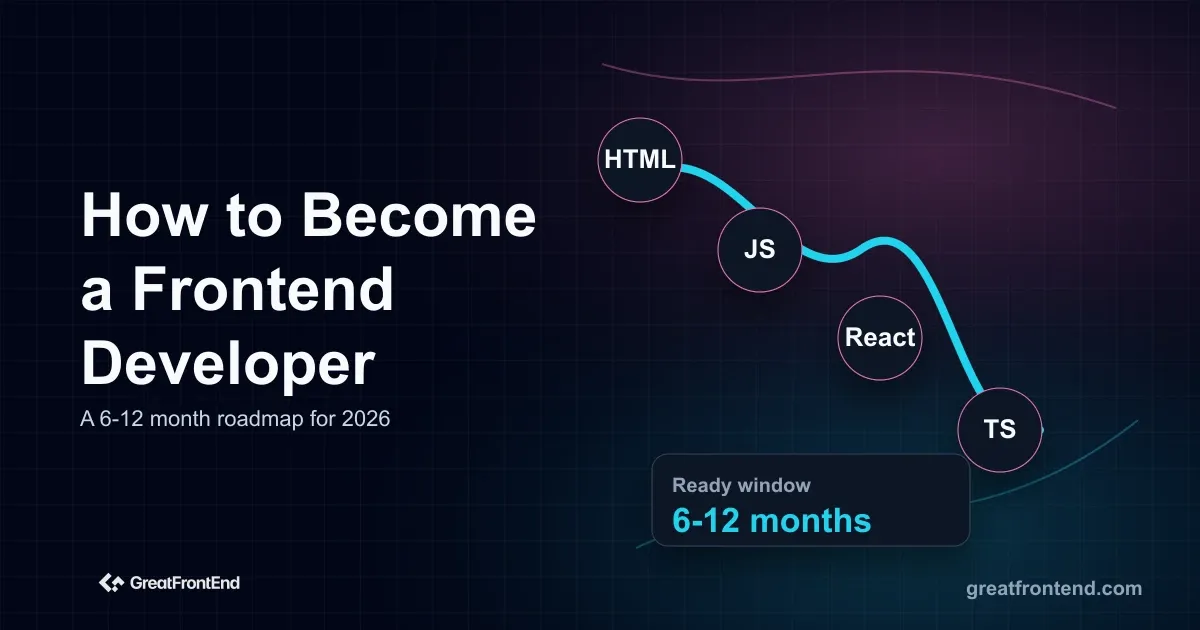 Learn how to become a frontend developer in 2026 with a staged roadmap covering web foundations, React, TypeScript, production skills, projects, and expert tracks.
 A detailed frontend developer roadmap for 2026 covering the skills, tools, projects, milestones, and interview practice needed for modern frontend roles.
 Learn what to build for a frontend developer portfolio in 2026, how to structure case studies, and how to prove frontend skill beyond screenshots.