Frontend Developer Portfolio: What to Build and How to Stand Out in 2026
Learn what to build for a frontend developer portfolio in 2026, how to structure case studies, and how to prove frontend skill beyond screenshots.
A frontend developer portfolio should prove that you can build useful interfaces, explain your decisions, and handle the messy parts of frontend work: state, data, accessibility, performance, errors, and product tradeoffs.
The goal is not to collect pretty screenshots. A strong portfolio makes it easy for a hiring team to see what you can be trusted to own next.
If you have no experience yet, start with How to Build a Frontend Developer Portfolio With No Experience. This guide is for the main portfolio decision: what to build, what to show, and how to stand out once you have projects, internships, freelance work, open-source work, or professional experience to present.
A useful portfolio also avoids a trap: it does not turn every project into a perfect success story. Reviewers trust portfolios that explain constraints, tradeoffs, bugs, and follow-up work. Perfect narratives sound less believable than specific ownership.
What a strong frontend portfolio must prove
Your portfolio should answer these questions:
| Question | Weak answer | Stronger proof |
|---|---|---|
| What kind of frontend work do you do? | "I build web apps" | product frontend, design systems, platform, performance, or UI engineering examples |
| What scope can you own? | "I worked on features" | scoped feature, product flow, migration, shared component, or cross-team project |
| How do you make decisions? | list of tools | tradeoffs around state, data, performance, accessibility, and maintainability |
| How do you handle quality? | "I write clean code" | tests, review notes, accessibility checks, performance measurements, bug prevention |
| How do you work with teams? | "team player" | examples of design, backend, product, QA, or stakeholder collaboration |
Do not use the portfolio only as a visual resume. Use it as evidence of your judgment. A reviewer should leave with a clear idea of your likely level: junior feature contributor, mid-level feature owner, senior product engineer, design-system specialist, platform engineer, or lead.
Recommended structure
Keep the site simple. Many candidates overbuild the shell and under-explain the work.
Use this structure:
| Section | What it should do |
|---|---|
| Home | state your frontend lane, seniority, strongest work, and contact links |
| Selected work | 2-4 detailed case studies |
| Technical notes | short notes on architecture, performance, accessibility, or testing |
| Code samples | public repos, open-source work, or simplified demos |
| Experience | roles, product areas, scope, and stack |
| Contact | email, LinkedIn, GitHub, resume |
Do not bury the case studies behind animations. A hiring manager or engineer may only spend a few minutes on the site before deciding whether to talk to you.
Put the best case study above any long bio. The first click should answer: what did you own, what was hard, and why does this work matter?
Choose a portfolio lane
Your portfolio should match the next role you want.
| Target role | What to emphasize | What to avoid |
|---|---|---|
| Senior frontend engineer | ownership, tradeoffs, code quality, mentoring, product flows | only pretty screenshots |
| Product frontend engineer | user flows, API states, UX details, release decisions | isolated components with no product context |
| Design systems engineer | component APIs, accessibility, docs, adoption, migration | a random set of UI elements with no usage examples |
| Frontend platform engineer | tooling, build speed, testing infrastructure, migrations | only app feature work |
| Performance-focused frontend engineer | measurement, diagnosis, render cost, loading strategy | vague claims about speed |
| Remote frontend engineer | async docs, case studies, self-directed delivery | portfolio with no written explanation |
| Lead frontend engineer | technical direction, review quality, cross-team decisions | only individual implementation details |
This does not mean you need seven portfolios. It means your homepage and selected work should point toward one main story. If you want senior frontend roles, do not lead with a landing page clone. If you want design-system roles, do not hide component API decisions behind screenshots.
Case studies beat project cards
Project cards say what you built. Case studies show how you think.
Use this case study structure:
Problem:What product or engineering problem existed?Context:What team, user, system, or constraint mattered?My role:What did I personally own?Frontend decisions:State, data fetching, component boundaries, routing, accessibility, performance, testing.Tradeoffs:What did I choose not to do and why?Quality:How did I check the work?Result:What changed for users, the team, or the codebase?Next:What I would improve with more time.
You can write a good case study even if you cannot share numbers. Be precise about the shape of the work.
Weak:
Built a dashboard using React and TypeScript.
Better:
Owned a customer operations dashboard with URL-based filters, paginated API data, row-level actions, and retry handling. Split table state from server state so filters could be shared through links and restored after refresh.
What to show if your company work is private
Most experienced developers cannot share private code. That is normal.
Use one of these options:
| Constraint | Portfolio solution |
|---|---|
| Cannot show code | write an anonymized case study |
| Cannot show screenshots | recreate a simplified UI with fake data |
| Cannot name company | describe the domain and team size generally |
| Cannot share metrics | describe the user or engineering problem that improved |
| Work was team-owned | state your exact contribution honestly |
| Work was internal tooling | explain workflow, users, and constraints |
Do not invent impact. Hiring teams can usually spot inflated stories. Honest, specific ownership is stronger than fake numbers.
Better than a fake metric:
- "Reduced duplicate validation logic across three related forms."
- "Moved filters into the URL so support teammates could share exact table views."
- "Documented modal focus behavior after two regressions in related flows."
- "Split a large component after review showed unrelated state updates were causing slow interactions."
Public demos frontend developers can build
If you need public proof, build demos that mirror professional frontend challenges.
Data-heavy dashboard
Include:
- Search, filters, sorting, pagination
- URL state
- Loading, empty, error, and retry states
- Details drawer
- Keyboard-accessible row actions
- TypeScript models
- Tests for core behavior
Explain state ownership and API assumptions. Include at least one failure path; experienced frontend work is often judged by what happens when the data is late, missing, invalid, or unauthorized.
Design system slice
Include:
- Button, input, select, modal, tabs, toast, and data table primitives
- Variants and disabled/error/loading states
- Keyboard behavior notes
- Usage examples
- Token or theme explanation
- Migration note for adopting the components
Explain component API decisions. This is where experienced frontend judgment shows. For example, state which props are intentionally supported, which variants you rejected, and how keyboard behavior is handled.
Performance case study
Build or document:
- A slow table, carousel, image grid, or dashboard
- The measurement method
- The bottleneck
- The fix
- The tradeoff
- The result
Do not say "optimized." Say what was slow, how you measured it, and how you changed it.
Frontend architecture note
Write a short technical note about:
- Server state versus client state
- URL state for filters
- Form state modeling
- Component composition
- Design-system component APIs
- Handling partial API failures
- Avoiding duplicate state
Technical writing can be portfolio proof if it shows practical judgment.
What code samples should show
Your code samples do not need to be huge. They need to be reviewable.
Good code samples show:
- Clear naming
- Small components with a reason to exist
- State that has an owner
- Typed inputs and outputs
- Error handling
- Tests where behavior matters
- No unnecessary abstractions
- README with setup, decisions, and known limitations
Avoid:
- A giant repo with no entry point
- A demo that only works on your machine
- Private repos with no alternative
- Over-engineered architecture for a tiny app
- Random snippets with no context
A strong portfolio should show that you can keep code boring where boring is better. If a sample uses an abstraction, explain the repeated problem it solves.
Add quality signals
Quality separates useful portfolios from project galleries.
| Area | Portfolio evidence |
|---|---|
| Accessibility | keyboard path, labels, focus management, semantic HTML, modal behavior |
| Performance | what you measured, what was slow, what changed |
| Testing | which behavior deserved tests and why |
| Maintainability | component boundaries, naming, data flow, documentation |
| Product thinking | empty states, permission states, recovery paths, error copy |
| Review | how you split work, handled feedback, or improved a pattern |
You do not need to show all of this in every case study. Pick the details that matter for the work. One strong accessibility note beats a generic claim that the whole site is accessible.
Homepage copy that stands out
Your homepage should be direct.
Good:
Senior frontend engineer focused on React, TypeScript, design systems, and data-heavy product UI.
Good:
Frontend engineer building accessible dashboards, form-heavy workflows, and maintainable component systems.
Weak:
I create beautiful digital experiences that delight users.
The weak version could describe almost anyone. The good versions help a hiring team place you.
Portfolio review checklist
Before sharing the portfolio:
- Are the best 2-4 pieces easy to find?
- Does each case study state your actual role?
- Are private details anonymized cleanly?
- Do screenshots include meaningful UI states?
- Do demos work on mobile?
- Do code samples have setup instructions?
- Are there broken links?
- Does the homepage say what role you want next?
- Does the portfolio show judgment, not only output?
Send the portfolio to one engineer and ask: "What role do you think this portfolio is targeting?" If they cannot tell, tighten the story.
Common portfolio mistakes
Avoid:
- Listing every project from your career
- Showing screenshots without decisions
- Hiding your actual contribution
- Using too many animations before the content loads
- Treating private work as an excuse to show nothing
- Claiming team impact as personal impact
- Over-indexing on visual polish while ignoring engineering proof
- Making contact links hard to find
The point is not to impress everyone. It is to make the right hiring team trust you faster.
Final sanity check
Before sending the portfolio, read it like a skeptical interviewer:
- Can I tell what level this person is targeting?
- Can I identify their personal contribution?
- Can I see how they handle imperfect requirements?
- Can I inspect a live demo or code sample without guessing how to run it?
- Can I find contact links without hunting?
- Is any claim bigger than the evidence shown?
A frontend developer portfolio should prove scope. Show what you owned, how you made decisions, how you checked quality, and why your frontend work made the product, user flow, or codebase better.
Related articles
 Learn how freshers can build a frontend developer portfolio with no experience using beginner-friendly projects, GitHub, case studies, and clear proof.
 Learn the senior frontend developer skills that matter in 2026, from UI architecture and accessibility to performance, testing, judgment, and AI verification.
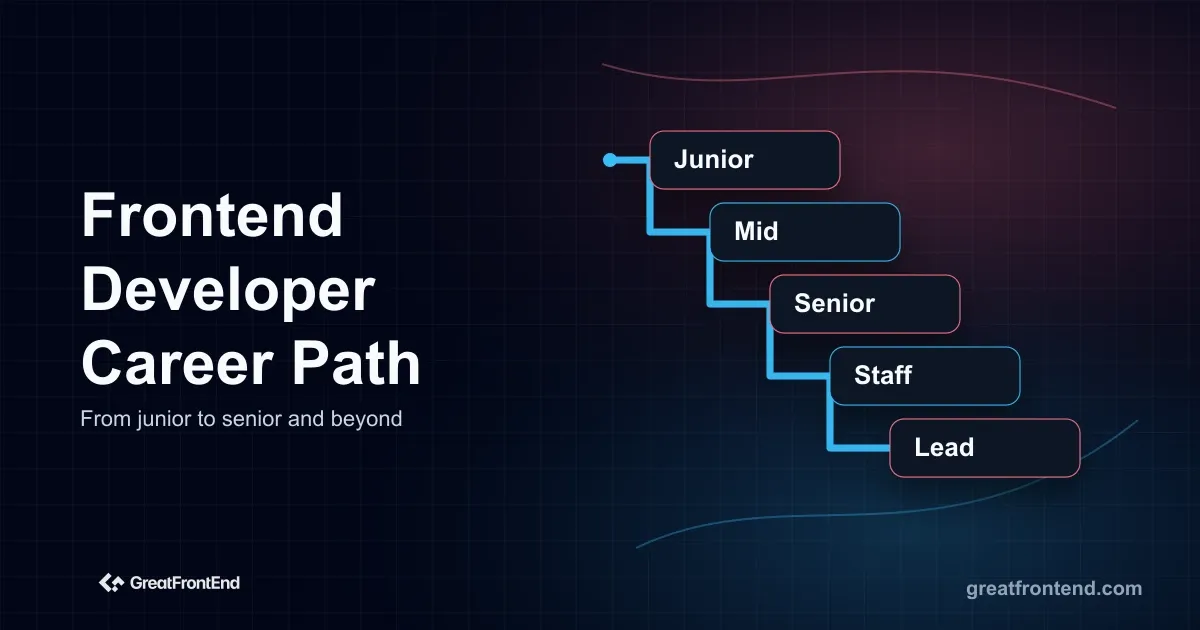 Map the frontend developer career path in 2026 from junior to mid-level, senior, staff, lead, specialist, and manager roles.