Frontend Developer Jobs for Freshers: How to Get Your First Role in 2026
Learn how freshers can get frontend developer jobs in 2026 with a practical skill path, portfolio projects, resume proof, GitHub cleanup, and interview prep.
Frontend developer jobs for freshers are possible in 2026, but a certificate is not enough. You need finished projects, clean GitHub repos, interview basics, and proof that you can complete small UI tasks.
The fresher market is crowded because many candidates look identical on paper: HTML, CSS, JavaScript, React, one course certificate, two cloned projects. Your job is to make the hiring team believe you can be onboarded into a real codebase and improve with review.
That does not require pretending to be senior. It requires specific proof. A hiring team should be able to open your portfolio and see, within two minutes, that you can build a form, handle data, write readable code, and explain one project without hiding behind course language.
The stack does not need to be exotic. The 2025 Stack Overflow Developer Survey still shows JavaScript, HTML/CSS, TypeScript, React, Next.js, and Angular as widely used among professional developers. For a fresher, that is a reason to learn the web basics deeply before chasing every new library.
What companies expect from freshers
Most fresher frontend roles do not expect architecture ownership. They expect a beginner who can learn quickly and avoid careless mistakes.
| Expectation | What it means in practice | How to prove it |
|---|---|---|
| HTML and CSS basics | Can build a page from a design and make it responsive | Build a polished responsive page with forms and states |
| JavaScript basics | Can handle user interaction and data changes | Build search, filter, timer, and API widgets |
| Framework basics | Can write simple React, Angular, or Vue components | Build a small product flow, not only a counter app |
| GitHub hygiene | Can share code for review | Add READMEs, live links, and clean project structure |
| Debugging attitude | Can inspect errors instead of guessing | Use DevTools and explain one bug you fixed |
| Communication in review | Can ask questions and respond to feedback | Write clear project notes and resume bullets |
Freshers lose interviews when they list too many tools and cannot explain the basics. Keep your skill list honest. If you wrote a project by following a tutorial, be ready to explain what you changed and which part you would rebuild differently.
Choose the right first-role lane
Your first frontend role may not be titled exactly "frontend developer." Search across related titles.
| Role title | Good fit if | What to prepare |
|---|---|---|
| Frontend Developer Fresher | You have HTML, CSS, JS, and one framework project | portfolio, JavaScript basics, React or Angular basics |
| Frontend Intern | You are still learning and need supervised work | clean projects, learning attitude, availability |
| Web Developer Fresher | You are good with HTML, CSS, basic JS, CMS, or websites | responsive pages, forms, visual polish |
| UI Developer Trainee | You like layout and implementation from designs | CSS, browser behavior, accessibility basics |
| React Developer Intern | You have React projects and can explain state | React forms, lists, effects, API states |
| Full Stack Fresher | You know some backend too | basic frontend plus API and database fundamentals |
Do not reject a good internship because the title is not perfect. Your first role is about getting credible experience, feedback, and team exposure. A paid internship with code review can be more useful than a "frontend developer" title where nobody reviews your work.
The skill path freshers should follow
Use this order. It keeps you from building a React app while still being weak at browser basics.
| Stage | Learn | Practice task |
|---|---|---|
| 1 | HTML structure, forms, labels, buttons, links, tables | build an accessible contact or signup form |
| 2 | CSS layout, Flexbox, Grid, responsive design, focus states | recreate a dashboard or settings page |
| 3 | JavaScript values, functions, arrays, objects, DOM, events | build search, filter, modal, tabs, accordion |
| 4 | Async JavaScript, fetch, promises, errors | build an API-backed search page |
| 5 | React or Angular basics | build a form-heavy product flow |
| 6 | Git, GitHub, deployment, README | publish projects and make them reviewable |
| 7 | Interview practice | solve JavaScript and UI tasks under time |
Use How to Become a Frontend Developer if you need a full roadmap before this job-search plan.
Build a fresher portfolio with three projects
Do not build ten small clones. Build three projects that prove different frontend skills. Each project should have a deployed link, a GitHub repo, a README, and one short note explaining a decision you made.
Project 1: Multi-step form
Build one of these:
- Job application form
- Course enrollment form
- Event registration form
- Profile setup flow
Include:
- 3-4 steps
- Required fields
- Inline validation
- Review screen
- Back and next buttons
- Disabled submit while invalid
- Success state
- Responsive layout
- Accessible labels and error text
What it proves: forms, validation, state, accessibility, and attention to user mistakes.
What interviewers may ask:
- Why did you validate on this step instead of only on submit?
- What happens if the user goes back and changes an earlier answer?
- How would the backend return validation errors?
Project 2: API-backed search page
Build one of these:
- Movie search
- Recipe finder
- Product catalog
- GitHub profile finder
- Job tracker with mock API
Include:
- Search input
- Loading state
- Empty state
- Error state
- Retry button
- Detail view
- Mobile layout
What it proves: async JavaScript, API handling, state changes, and user feedback.
What interviewers may ask:
- What happens if two searches finish out of order?
- How do you show no results versus a failed request?
- Why did you choose this API or mock-data shape?
Project 3: Stateful product flow
Build one of these:
- Shopping cart
- Expense tracker
- Appointment booking
- Habit tracker
- Reading list
Include:
- Add, edit, delete, or select actions
- Derived totals or summary
- Confirmation before destructive action
- Local persistence if useful
- Empty state
- Responsive UI
What it proves: state modeling, derived values, and product behavior.
What interviewers may ask:
- Which values are stored and which are calculated?
- How do you prevent accidental delete?
- What breaks if local storage has old or invalid data?
Read How to Build a Frontend Developer Portfolio With No Experience (2026) for a deeper portfolio guide.
GitHub checklist before applying
A fresher with clean GitHub is easier to review because many beginner repos are hard to run.
For each project:
- Add a live demo link.
- Add screenshots.
- Add install and run commands.
- Explain features.
- Explain one tradeoff or limitation.
- Remove unused files.
- Remove API keys or secrets.
- Use clear folder names.
- Pin your best projects.
README structure:
# Project NameShort description.## Live demoLink## Features- Search by keyword- Loading and error states- Responsive layout## Tech stackReact, TypeScript, CSS## Run locallynpm installnpm run dev## What I learnedOne or two specific lessons.
If your repo has no README, a reviewer has to work too hard. Do not make that their first impression. Also check that npm install and the documented run command work from a fresh clone; broken setup quietly kills many beginner applications.
Resume format for freshers
Keep the resume simple and proof-heavy.
Recommended order:
- Name, location, email, phone, GitHub, LinkedIn, portfolio
- One-line headline
- Skills grouped by confidence
- Projects
- Internship, freelance, college, or open-source work if relevant
- Education
Good headline:
Frontend developer fresher with React projects, JavaScript practice, and deployed UI work.
Weak headline:
Highly motivated individual seeking an opportunity.
Project bullet formula:
Built [project] using [stack] with [specific frontend behavior].
Examples:
- Built a React onboarding form with step validation, review screen, saved progress, and responsive layout.
- Created an API-backed product search page with debounced search, loading state, no-results state, and error recovery.
- Built an expense tracker with category filters, derived totals, local persistence, and mobile-friendly UI.
How to apply as a fresher
Do not rely only on job boards.
Use five channels:
| Channel | How to use it |
|---|---|
| Job boards | Apply to fresher, intern, trainee, web developer, UI developer, and React intern roles |
| Company career pages | Apply directly when the role matches your project proof |
| Referrals | Send a specific project link and resume, not a vague request |
| LinkedIn posts | Reply early with a short note and portfolio link |
| Local/startup communities | Look for internships and small product teams |
Application note:
Hi [Name],I am applying for the frontend intern role. I built a React onboarding form with validation, review step, and responsive layout: [link].My portfolio and GitHub are here: [links].
Keep it short. The project link does the work. Do not attach five projects. Send the one that matches the role and make the next click obvious.
Interview prep for freshers
Prepare for four types of questions.
JavaScript basics
Practice:
- Variables, types, equality
- Arrays and objects
- Functions and scope
- Closures
- DOM events
- Promises
async/await- Fetch
- Error handling
CSS basics
Practice:
- Box model
- Flexbox
- Grid
- Media queries
- Positioning
- Specificity
- Focus states
- Responsive forms
Framework basics
For React:
- Components and props
- State
- Forms
- Effects
- Lists and keys
- Conditional rendering
- Controlled inputs
For Angular:
- Components
- Templates
- Inputs and outputs
- Services
- Forms
- Routing basics
Project discussion
Prepare answers for:
- Why did you build this project?
- What was the hardest bug?
- How does state move through the app?
- What happens when the API fails?
- What would you improve next?
- Which part did you write yourself?
Practice JavaScript interview questions, React interview questions, Contact Form, Tabs, and Accordion.
A 60-day first-role plan
| Days | Work |
|---|---|
| 1-7 | Fix HTML, CSS, JavaScript basics with small exercises |
| 8-18 | Build multi-step form and deploy it |
| 19-30 | Build API-backed search page and deploy it |
| 31-40 | Build cart, booking, or expense tracker |
| 41-45 | Clean GitHub, READMEs, screenshots, and live links |
| 46-50 | Build portfolio site and write project notes |
| 51-55 | Rewrite resume and LinkedIn profile |
| 56-60 | Apply daily and practice interview questions |
After day 60, do not disappear into another course. Keep applying, review interview feedback, and improve the weakest part of your proof.
Add one maintenance habit while applying: every Friday, open your own live links, run the projects locally, and fix one confusing README or UI state. A small broken detail can make a careful beginner look careless.
Mistakes that hurt freshers
Avoid:
- Only building tutorial clones
- Listing tools you cannot explain
- Ignoring CSS
- Not deploying projects
- Having broken live links
- Writing no README
- Applying with one generic resume
- Saying "I know React" but failing state and forms
- Practicing only theory and no UI coding
Your first job search is not about proving you know everything. It is about proving you can learn inside a team and finish small frontend work carefully.
Frontend developer jobs for freshers go to candidates who make their ability visible. Build three finished projects, clean up GitHub, write concrete resume bullets, and practice the basics until you can explain your own code calmly.
相关文章
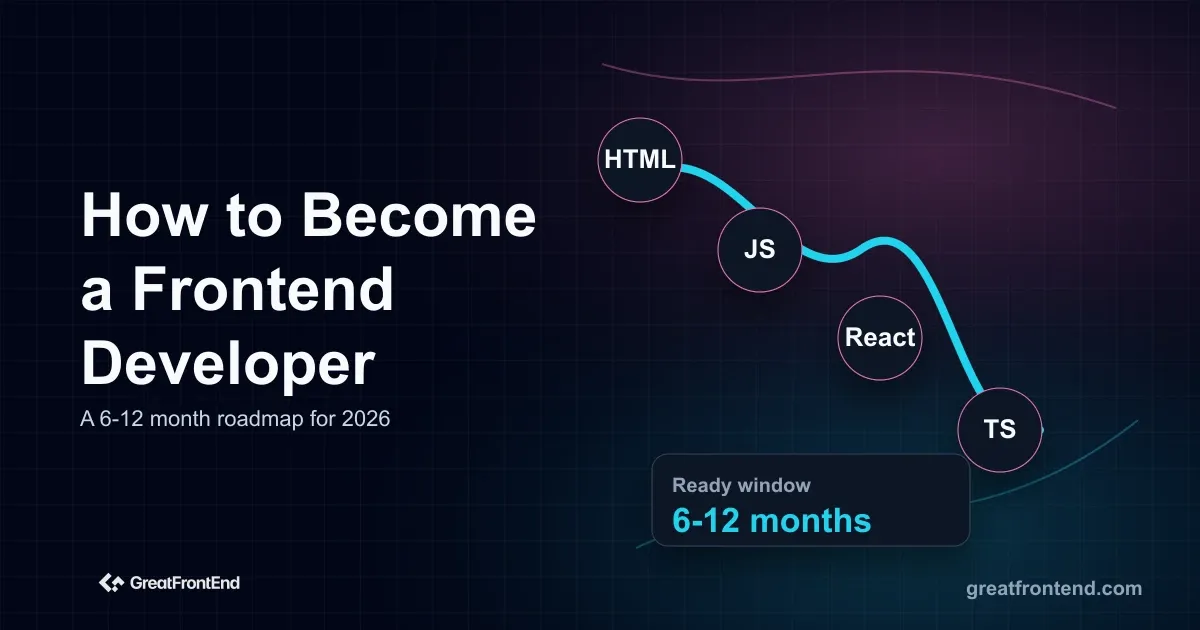 Learn how to become a frontend developer in 2026 with a staged roadmap covering web foundations, React, TypeScript, production skills, projects, and expert tracks.
 A detailed frontend developer roadmap for 2026 covering the skills, tools, projects, milestones, and interview practice needed for modern frontend roles.
 Learn how freshers can build a frontend developer portfolio with no experience using beginner-friendly projects, GitHub, case studies, and clear proof.