Senior Frontend Developer Skills: What You Need to Land the Role in 2026
Learn the senior frontend developer skills that matter in 2026, from UI architecture and accessibility to performance, testing, judgment, and AI verification.
A senior frontend developer is not measured by component speed alone. In 2026, seniority means better judgment: you can own ambiguous UI work, verify AI-assisted code, prevent regressions, and make product interfaces reliable.
The bar has moved. Code generation is cheaper. Correctness, taste, tradeoffs, and ownership matter more.
What senior frontend means
A junior developer is usually trusted with well-scoped tasks. A mid-level developer can own features with some guidance. A senior frontend developer can take unclear product goals, break them into technical work, identify risks, coordinate with other functions, and ship something the team can maintain.
That does not mean seniors stop coding. It means their code sits inside a larger responsibility.
Senior frontend engineers are expected to answer questions like:
- What should happen when the API is slow or wrong?
- Which behavior belongs in the component, route, state layer, or backend?
- How will this work for keyboard and screen reader users?
- What can break when another team reuses this component?
- Which test protects the important behavior?
- What tradeoff are we making by adding this dependency?
- Is AI-generated code correct, accessible, and maintainable here?
Senior skill map
| Area | Mid-level habit | Senior signal |
|---|---|---|
| Component work | Builds components from designs | Designs component APIs that are hard to misuse |
| State | Makes the current feature work | Chooses state boundaries that survive future changes |
| CSS | Fixes layout bugs | Prevents layout classes, overflow, and responsive bugs through better structure |
| Accessibility | Runs a checklist near the end | Builds keyboard, semantics, labels, focus, and contrast into the design of the UI |
| Performance | Reacts when the app feels slow | Measures cost and removes waste before it becomes user pain |
| Testing | Adds tests when requested | Protects critical flows with the right level of tests |
| APIs | Consumes endpoints | Negotiates contracts, loading states, failure states, and data shape changes |
| AI tools | Accepts useful output | Reviews generated code like a risky pull request |
| Leadership | Helps when asked | Creates clarity for other engineers without taking over everything |
1. Browser and rendering depth
Senior frontend developers understand that the browser is the runtime. React does not replace HTML, CSS, layout, rendering, networking, and accessibility.
You should be comfortable with:
- DOM structure
- Event propagation
- CSS cascade, specificity, Grid, Flexbox, and positioning
- Layout shifts and overflow
- Rendering and repaint costs
- Image and font loading
- Network waterfalls
- Browser DevTools
Many frontend incidents are not framework problems. They are browser problems wearing framework clothing.
2. Component and interface design
A senior frontend engineer designs components that other people can use safely.
Good component design includes:
- Clear props
- Predictable state ownership
- Accessible defaults
- Escape hatches only when needed
- Useful composition
- Stable visual behavior
- Documentation through examples
- Tests for important variants
A clever abstraction is not the aim. The aim is to reduce repeated decisions and prevent repeated bugs.
3. TypeScript judgment
Senior frontend developers use TypeScript to model risk, not to decorate JavaScript.
You should know how to:
- Model API responses safely
- Use discriminated unions for UI states
- Avoid unsafe casts
- Narrow unknown data
- Write generic components only when they remove real duplication
- Read complex library types
- Keep types helpful instead of theatrical
Use TypeScript interview questions for senior frontend developers as a calibration point.
4. Accessibility as product quality
Accessibility is not a bonus skill for senior frontend roles. It is part of building usable software.
Senior engineers catch issues such as:
- Divs pretending to be buttons
- Missing labels
- Broken tab order
- Invisible focus states
- Modals that trap users incorrectly
- Menus that do not announce state
- Error messages that are not tied to inputs
- Color contrast failures
AI-generated markup can look fine visually while failing semantic and keyboard behavior.
5. Performance measurement
Senior frontend developers do not guess about performance for long. They measure.
Useful areas include:
- Bundle analysis
- Core Web Vitals
- Render profiling
- Memoization tradeoffs
- Image optimization
- Font loading
- Hydration cost
- Caching behavior
- Slow API handling
Performance is product quality. Users do not care whether the slowness came from JavaScript, a large image, hydration, or an API. They only experience a slow product.
6. Testing and release confidence
Senior engineers know that not every bug needs the same test. They choose the test based on risk.
Typical coverage choices:
- Unit tests for pure logic
- Component tests for UI behavior
- Integration tests for state and API boundaries
- End-to-end tests for critical flows
- Visual checks where layout regressions are expensive
The senior skill is knowing what must not break and putting protection there.
7. API and product boundary fluency
Frontend engineers do not need to become backend specialists, but senior frontend developers should understand the API boundary well.
You should be able to discuss:
- Data shape
- Pagination
- Caching
- Loading states
- Retry behavior
- Error contracts
- Permissions
- Rate limits
- Backward-compatible changes
REST knowledge matters because frontend decisions often depend on API contracts. Review REST API interview questions for frontend developers if you want to test that boundary.
8. AI-assisted development verification
In 2026, a senior frontend developer must know how to work with AI tools without lowering the team's quality bar.
AI usage is already common. Stack Overflow's 2025 Developer Survey reported broad AI-tool usage and also found that 66% of respondents were frustrated by AI solutions that were "almost right." DORA's 2025 AI-assisted software development report described AI as an amplifier of an organization's existing strengths and weaknesses.
For senior frontend work, that means AI helps more when the engineer already knows what good UI, safe state, accessible markup, and maintainable component design look like. If the engineer cannot review the output, AI can hide risk instead of removing it.
When reviewing generated frontend code, ask:
- Does this match the product requirement?
- Does it handle empty, loading, and error states?
- Is the accessibility correct?
- Does it introduce layout risk?
- Is the state model too complex?
- Are the types honest?
- Are tests protecting behavior or only snapshots?
- Did it add a dependency for a small problem?
The senior skill is not refusing AI. It is making sure the team remains responsible for what ships.
9. Technical leadership
Senior frontend developers create clarity. They do not need a staff title to do that.
Useful senior behaviors include:
- Breaking vague work into reviewable steps
- Naming risks early
- Writing short technical proposals
- Reviewing code with context
- Mentoring without creating dependency
- Aligning with design and backend partners
- Making tradeoffs visible
- Leaving the codebase easier to change
Many mid-level developers get stuck here. They can finish their own work, but they do not yet improve the work around them.
How to prepare for senior frontend roles
Build evidence, not a skill list.
For your next few projects or work items, capture:
- A performance issue you measured and fixed
- An accessibility problem you prevented
- A component API you improved
- A flaky flow you made testable
- A backend contract you clarified
- A technical decision you documented
- A junior or peer you helped unblock
Use GreatFrontEnd's TypeScript interview questions, React interview questions, UI coding questions, and front end system design questions to pressure-test senior readiness. Good senior practice problems include Data Table, File Explorer, and Autocomplete.
Those stories are stronger in interviews than saying you know React, TypeScript, and testing.
What senior interviews usually look for
Senior frontend interviews often test the gaps between coding skill and ownership.
Expect questions such as:
- How would you design a reusable table, form, or modal system for several teams?
- How would you handle accessibility for a custom combobox or menu?
- How would you reduce bundle size without breaking product behavior?
- How would you debug a slow dashboard?
- How would you migrate a large codebase from one pattern to another?
- How would you review a junior engineer's solution when it works but is hard to maintain?
- How would you decide whether a bug belongs in frontend, backend, data, or product logic?
Useful answers are specific. Name the constraints, name the risk, make a tradeoff, and explain how you would verify the result.
What to remember
Senior frontend developer skills in 2026 are about judgment under product constraints. You still need HTML, CSS, JavaScript, TypeScript, React, accessibility, performance, and testing. But the senior signal is how you use them to reduce risk and increase team output.
Senior work is less about writing more code and more about making the right frontend work happen.
Related articles
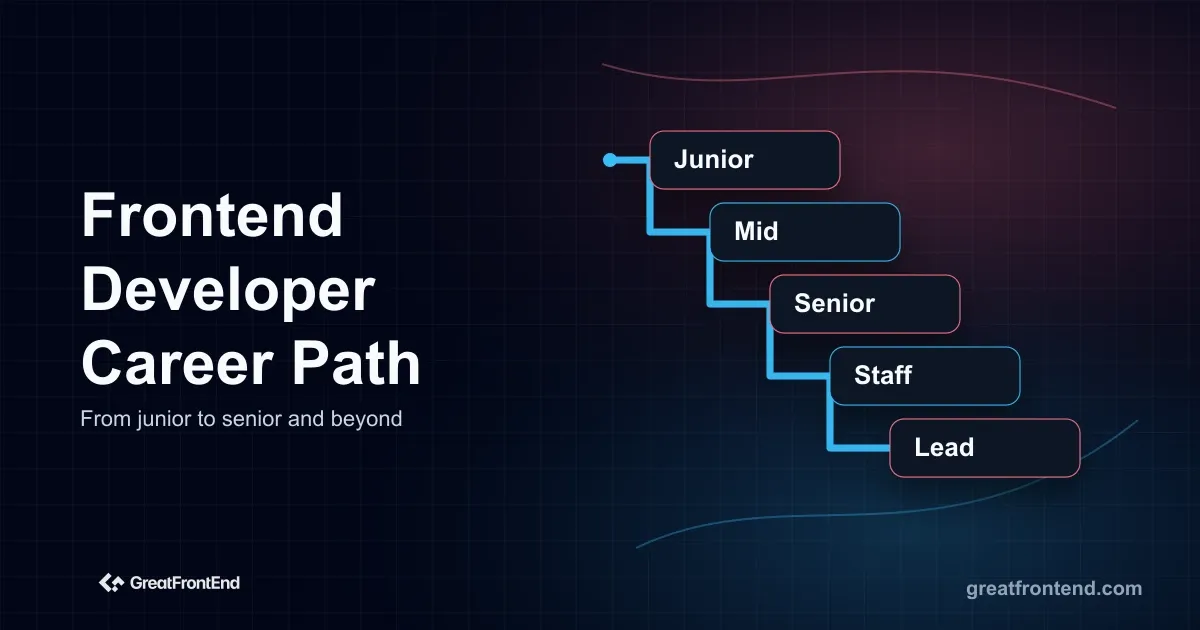 Map the frontend developer career path in 2026 from junior to mid-level, senior, staff, lead, specialist, and manager roles.
 A practical set of TypeScript interview questions for senior frontend developer interviews, with coding problems on generics, unions, utility types, and React TypeScript.