How to Switch from Backend to Frontend Developer in 2026
Switch from backend to frontend with a practical plan for browser fundamentals, CSS, accessibility, React, portfolio proof, and interview positioning.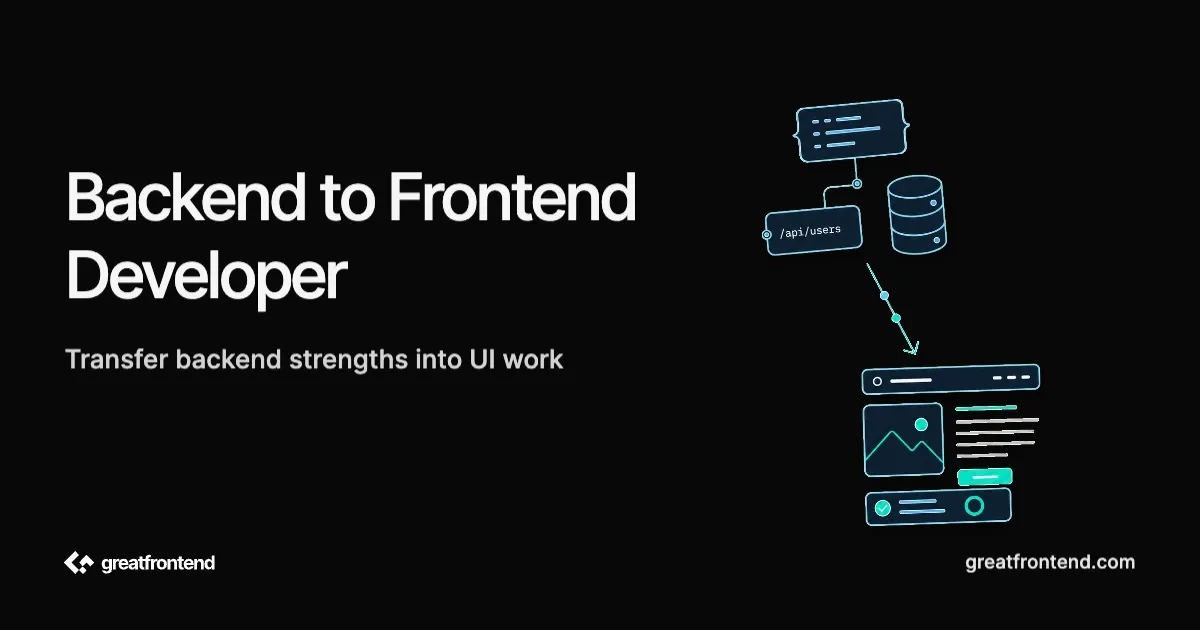
To switch from backend to frontend developer in 2026, do not throw away your backend experience. Use it to build better API-backed user interfaces, then deliberately close the browser gaps: HTML semantics, CSS layout, accessibility, rendering performance, client state, and product UI judgment.
The weak version of this switch is "I learned React." The stronger version is "I can turn unreliable data, permissions, latency, and user input into a clear interface that works across states."
What actually changes when you move frontend
Backend work asks whether the system is correct, secure, observable, and reliable. Frontend work still needs those instincts, but the proof is user-visible. A correct API response is not enough if the UI loses focus, hides the error, shifts layout, blocks typing, or makes the next action unclear.
| Backend habit | Frontend translation | What to prove |
|---|---|---|
| API contract design | Loading, empty, error, permission, retry, and partial-data states | A flow that does not collapse when the API is slow or incomplete |
| Data modeling | Server state, local state, URL state, derived state, and cache shape | State that has a clear owner and survives navigation where needed |
| Security thinking | XSS, CSRF, cookies, tokens, auth UI, and unsafe HTML | No secret leakage, no unsafe rendering, clear session states |
| Observability | Web Vitals, frontend logs, breadcrumbs, and user-impact debugging | A before/after measurement or a debugging note |
| Testing discipline | User flows, accessibility checks, visual states, and network failures | Tests or screenshots for the states reviewers usually miss |
| Incident thinking | Graceful degradation, rollback, feature flags, and recovery UI | A plan for what the user sees when something breaks |
Your advantage is not that frontend will be easy. Your advantage is that you already know software breaks at boundaries. Frontend has more boundaries than it first appears: browser to network, API to cache, design to implementation, keyboard to component, mobile to desktop, and expectation to actual behavior.
The 2026 reality check
The frontend stack is still built on the web platform. In the 2025 Stack Overflow Developer Survey, professional developers reported heavy use of JavaScript, HTML/CSS, and TypeScript, and React remained one of the most-used web frameworks. Treat that as a stack signal, not a complete learning plan.
The learning plan should start closer to MDN's core frontend modules: HTML, CSS, JavaScript, accessibility, browser APIs, and web standards. React matters, but React does not remove the need to understand what the browser is doing. The React docs are useful once you can already reason about markup, events, data, and state.
Google's Core Web Vitals currently measure loading, interactivity, and visual stability through LCP, INP, and CLS. They are user-experience metrics with recommended thresholds, not service-level objectives by themselves. A team can turn them into route- and device-specific SLOs with an owner and measurement window.
Skills backend developers usually under-practice
Most backend developers switching to frontend do not fail because JavaScript is impossible. They fail because the browser has product-facing details backend work did not force them to practice.
| Skill gap | Why it matters | Practice target |
|---|---|---|
| HTML semantics | Buttons, links, forms, headings, labels, and tables carry behavior and meaning | Build a form without replacing native controls unnecessarily |
| CSS layout | Real content wraps, overflows, resizes, and stacks under pressure | Recreate a settings page at mobile, tablet, and desktop widths |
| Accessibility | Keyboard users and assistive technology need usable state, names, focus, and errors | Complete a modal or form without a mouse |
| Browser events | Clicks, input, focus, scroll, and submit events have default behavior | Debug a form submission and a keyboard shortcut conflict |
| Client state | UI state is not all the same kind of state | Separate local, server, URL, derived, and persisted state |
| Rendering cost | Work on the main thread competes with user input | Measure a slow interaction and remove unnecessary rendering |
| Product copy | Users need recovery, not stack traces | Rewrite API errors into next actions |
The accessibility gap deserves special attention. W3C's accessibility introduction frames accessibility as access for people with diverse abilities and contexts. In daily frontend work, that turns into practical checks: correct elements, labels, focus order, keyboard behavior, color contrast, reduced motion, and clear errors.
Do not start with a clone app
Clone apps often hide the exact skills you need to show. A streaming homepage clone may look impressive in a screenshot while saying little about forms, state, accessibility, errors, data freshness, auth, or performance.
Build transition projects that connect backend judgment to frontend behavior.
| Project | What to build | What it proves |
|---|---|---|
| API-backed admin table | Filters in URL, pagination, sorting, loading, empty, error, permission, and export states | You can make data usable, not only fetch it |
| Account settings flow | Profile edit, password change, two-factor setup, destructive action, session timeout | You understand forms, auth, validation, recovery, and security UX |
| Search or autocomplete | Debounce, stale-response protection, keyboard navigation, highlighting, cache, empty state | You can handle async UI without race-condition bugs |
| Design-system slice | Button, input, modal, toast, tabs, and form field with states and docs | You can design component APIs and accessibility defaults |
| Performance repair | Measure one slow page, reduce JavaScript or rendering cost, document the before/after | You can connect frontend work to user experience metrics |
One polished project with state coverage is better than five shallow demos. A hiring manager should be able to open the project and see how you handle the uncomfortable states: no data, too much data, invalid data, slow data, expired session, denied permission, failed request, mobile layout, keyboard navigation, and repeated submission.
A practical 90-day switch plan
Use this as a working plan, not a certificate path. If you already know some pieces, compress them and spend more time on proof.
| Weeks | Focus | Build | Keep as evidence |
|---|---|---|---|
| 1-2 | Browser and HTML | A responsive form-heavy settings page | Semantic structure, labels, validation, screenshots |
| 3-4 | CSS layout | Rebuild the same page without a UI library | Mobile/desktop screenshots, overflow fixes, focus states |
| 5-6 | JavaScript and APIs | Add fetch, loading, error, retry, cancellation, and stale-response handling | Network-state notes and bug examples |
| 7-8 | React or target framework | Turn the flow into components with clear state ownership | Component boundaries and state map |
| 9-10 | Accessibility and testing | Add keyboard checks, form tests, and user-flow tests | Test output and manual accessibility checklist |
| 11-12 | Performance and interview proof | Measure one slow interaction and write project stories | Before/after metric, README, interview notes |
Do not wait until the end to write. Each week should leave behind a short note: what broke, what you changed, why you chose it, and how you verified it. That habit turns learning into interview material.
How to use your backend experience
Backend experience becomes credible frontend experience when you translate it into the user's path.
| Backend story | Weak frontend translation | Strong frontend translation |
|---|---|---|
| "I built REST APIs." | "I can call APIs from React." | "I design UI states around latency, validation, permissions, pagination, and retries." |
| "I worked on auth." | "I know login." | "I can handle expired sessions, protected routes, token refresh, logout, and sensitive UI state." |
| "I optimized queries." | "I care about performance." | "I can measure page load and interaction delays, then reduce unnecessary data, rendering, or JavaScript work." |
| "I wrote tests." | "I will test components." | "I test user flows across success, validation, failure, and recovery states." |
| "I debugged production issues." | "I use DevTools." | "I can trace a user-visible failure through the browser, network, API, logs, and release history." |
That last row is the switcher advantage. Many frontend bugs cross the frontend/backend boundary. Someone who can debug both sides calmly is useful on product teams.
What to learn in React
React is still a practical default for many frontend roles, but learn it through product behavior rather than isolated hooks trivia.
Prioritize:
- Components, props, lists, keys, and conditional rendering.
- Controlled and uncontrolled form inputs.
- Local state, derived state, and state lifting.
- Effects, cleanup, request cancellation, and response-order guards. Aborting an old request saves work when cancellation succeeds; a query identity check still prevents an obsolete result from replacing newer state.
- Context only when data genuinely belongs above many components.
- Refs for focus and DOM escape hatches.
- Error boundaries for render failures, plus explicit request-error and event-handler recovery. React error boundaries do not catch every async or event-handler exception.
- TypeScript props, API response types, and discriminated unions for UI states.
For a backend switcher, the useful mental model is: React renders a description of the UI for the current state. Your job is to make the possible states explicit enough that the UI does not surprise users.
type RequestState<T> =| { status: 'idle' }| { status: 'loading' }| { status: 'success'; data: T }| { status: 'empty' }| { status: 'error'; message: string; canRetry: boolean };
This kind of type is not fancy. It prevents the common bug where a component accidentally tries to be loading, empty, and failed at the same time.
Interview positioning for backend-to-frontend switchers
Do not apologize for switching. Explain the direction clearly and show the work you have done to fill the gaps.
I am moving from backend to frontend because I want to work closer to product behavior.My backend background helps with API contracts, auth, debugging, and reliability.I have been filling the browser-specific gaps through projects focused on CSS layout,accessibility, React state, performance measurement, and API-backed UI states.
Prepare examples for these questions:
- What frontend problem did your backend background help you solve?
- Which browser behavior surprised you when you started?
- How do you decide whether state belongs in the URL, server cache, component state, or persistent storage?
- What happens in your UI when a request fails after the user edits a form?
- How do you make a modal, menu, or form keyboard accessible?
- What did you measure before claiming a frontend performance improvement?
- How do you prevent stale API responses from overwriting newer user input?
Answer with a specific project. Avoid broad claims like "I understand fullstack." A switcher is more convincing when the story includes a constraint, a tradeoff, and a verification step.
What your portfolio README should include
The README is where backend switchers can stand out. Do not only list the stack.
Include:
- The user flow and why it matters.
- The API states you handled.
- A state ownership map: server, URL, local, derived, and persisted.
- Accessibility checks you performed.
- Performance measurement or a note about what you would measure next.
- Screenshots for loading, empty, error, mobile, and success states.
- One tradeoff you intentionally made.
Example:
Tradeoff:I kept filters in the URL so the table state can be shared and restored.I kept the open row menu in component state because it is temporary UI state.I did not persist the selected rows because bulk actions should reset after navigation.
That note says more about frontend judgment than another badge in the tech stack list.
Common mistakes
Learning React before HTML and CSS feel normal
React can organize UI, but it cannot rescue weak markup and layout. If every project depends on a component library, you will struggle when a design breaks outside the happy path.
Treating frontend as "backend with pixels"
Frontend work has data problems, but it also has perception problems. Users notice delay, focus loss, layout shifts, unclear copy, tiny hit targets, missing disabled states, and forms that erase input.
Building only happy paths
A polished success state is table stakes. Your switch becomes credible when the project handles failure, latency, empty data, permissions, mobile layout, and keyboard use.
Ignoring design collaboration
Frontend developers work at the boundary between engineering, design, product, support, and users. You do not need to become a designer, but you do need language for spacing, hierarchy, affordance, motion, and interaction states.
Overselling fullstack instead of proving frontend depth
Backend experience is a strength, but the target role is frontend. Lead with frontend evidence, then use backend experience as the reason you are better at product boundaries.
GreatFrontEnd practice path
Use Frontend Developer Roadmap for the broader skill order. For switchers, a practical GreatFrontEnd path is:
- Practice JavaScript interview questions until async behavior and data transformations feel explainable.
- Add React interview questions for state, rendering, effects, forms, and component design.
- Work through UI coding questions with keyboard behavior and edge states, not only the default visual state.
- Read REST API interview questions for frontend developers to translate your backend knowledge into frontend interview answers.
- Practice system-design prompts that are frontend-heavy, such as autocomplete, feeds, dashboards, and design systems.
The goal is not to collect practice topics. The goal is to build proof that you can make user-facing software reliable.
What proves the switch
The switch is not complete when your resume says "frontend." It is complete when your work shows user-facing judgment without needing a long explanation.
Good proof looks like this:
| Claim | Weak proof | Strong proof |
|---|---|---|
| I can build frontend UI | A React app with a happy path | A flow with loading, empty, error, permission, mobile, and keyboard states |
| I understand APIs | Fetching JSON into a component | UI behavior designed around latency, validation, stale data, and retry |
| I know accessibility | A Lighthouse score | Correct elements, labels, focus behavior, keyboard checks, and readable errors |
| I care about performance | A fast local demo | A measured before/after improvement or a clear profiling note |
| I bring backend experience | A list of backend tools | A frontend decision that is better because you understand contracts, auth, data, or failure modes |
That is the real transition: from system-facing correctness to user-facing correctness. Backend experience helps, but only when it becomes visible in the browser, the product flow, and the way you explain tradeoffs.
Related articles
 Compare frontend and backend developer careers in 2026 by work style, learning curve, risk, market signal, and long-term growth.
 Compare frontend and fullstack developer paths in 2026, including work style, hiring signal, learning curve, and which path fits your goals.
 Learn how to become a frontend developer in 2026 with a staged roadmap covering web foundations, React, TypeScript, production skills, projects, and expert tracks.
 A detailed frontend developer roadmap for 2026 covering the skills, tools, projects, milestones, and interview practice needed for modern frontend roles.
 Prepare for REST API interview questions as a frontend fresher with answers on HTTP methods, status codes, fetch, CORS, auth, caching, pagination, errors, and API contracts.