Frontend Developer to Full Stack Developer: How to Make the Move
Frontend developer to full stack developer: what the role adds, survey and pay data, the meta-framework route, security basics to learn, and how interviews change.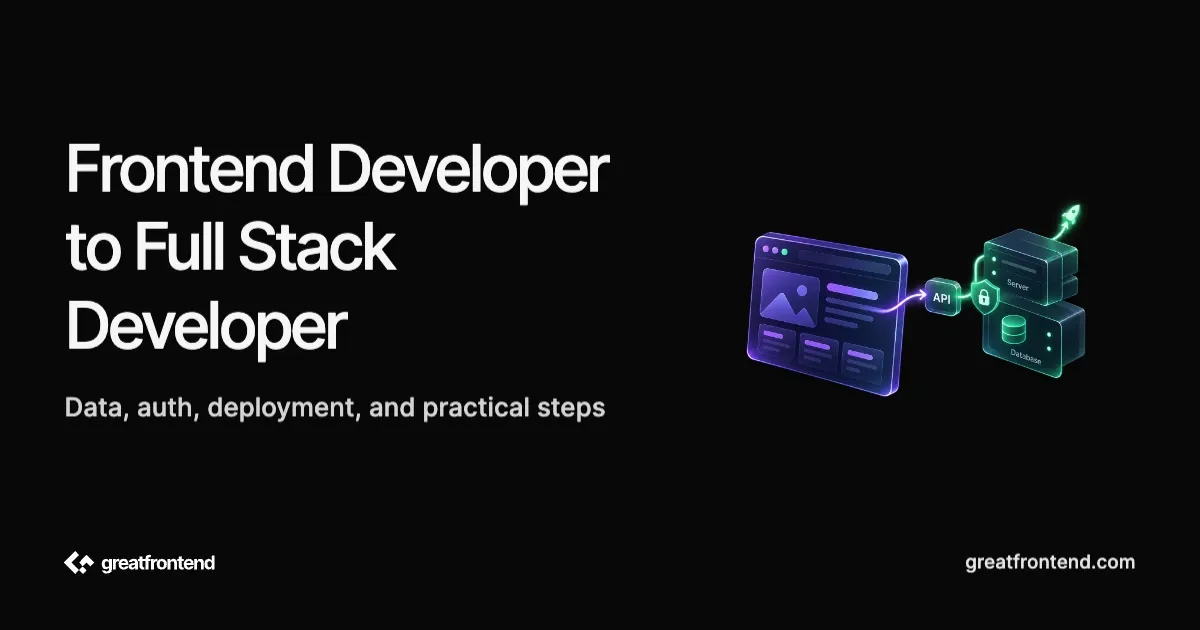
Moving from frontend developer to full stack developer is less about learning a second language and more about taking responsibility for what happens after the browser sends a request: where the data lives, who is allowed to see it, and how the code gets to production. This guide covers what "full stack" means, what the survey and pay data can and cannot tell you, the skills a frontend developer needs to add, the meta-framework route that many frontend developers take in, and what changes in interviews. It deliberately avoids repeating GreatFrontEnd's comparison in frontend vs fullstack developer, which covers how to choose between the two paths.
What "full stack developer" means
Different sources define it differently, which is the first thing to know.
The roadmap.sh full stack roadmap describes a full stack developer as someone who can work on both the front end and the back end of an application, and adds that they also take care of what is needed to push the product into production. Its learning tracks cover frontend, backend and DevOps topics. It calls the role a "jack of all trades" who may not be an absolute expert in each technology but can fill gaps in a team, and its own FAQ says three months is only realistic if you already know one half.
For frontend developers, the biggest shift is understanding what happens on the server. As MDN explains in its server-side programming guide, server-side code handles tasks such as retrieving data from databases, processing user input, and managing authentication and sessions. Moving into full-stack development means learning how these backend responsibilities connect with the frontend to deliver a complete application.
Full-stack responsibilities vary between companies. Some developers work equally across frontend and backend systems, while others specialize in one area and contribute to the other. The important thing is understanding which parts of the application you are expected to build, maintain, and operate. GreatFrontEnd's own comparison makes a point that matches this: a full stack developer is not simply a frontend developer who also knows Node.js, because the job includes the API contract, database changes, authentication, validation, deployment and basic monitoring.
So the first interview answer is a definition with its limits: full stack usually means owning a feature from the UI to the data and into production, and employers draw the line in different places. Ask what the line is before you accept or reject a role.
How common is full stack, and what do the numbers say?
Be careful with the data, because it is easy to over-read.
The Stack Overflow 2026 Developer Survey asked respondents which of a list of roles best describes their current role, or the role they held longest in the past year. Of 25,767 respondents to that question, 7,042 (27.3 percent) chose full-stack developer, 3,473 (13.5 percent) back-end developer and 933 (3.6 percent) front-end developer. The 2025 survey showed the same shape, with full-stack at 27 percent and front-end at 4.3 percent, per its developer profile page.
Three limits apply. The survey is self-selected, promoted through Stack Overflow's own channels, so say "27 percent of survey respondents", not "27 percent of developers". The role question is single choice, so a frontend-leaning engineer may well tick "full-stack". And the figures describe titles people chose, not hiring demand or pay.
For pay and outlook, the US Bureau of Labor Statistics does not give full stack its own category; the word does not appear on the pages I read. Its web developers and digital designers page lists a median pay of $99,520 for 2025 and 5 percent projected growth from 2025 to 2035. Its software developers, QA analysts and testers page lists $135,980 for software developers alone and 10 percent projected growth. Those are two occupation groups, not a measure of what a frontend developer earns after becoming full stack. I found no primary data showing a full stack pay premium, so do not promise one. Ask for the actual band for the role you are considering.
What you already have, and what you add
A frontend developer already owns the half that users see: the interface, state, browser behavior, accessibility and performance. What the move adds is a set of responsibilities on the server. Each of them has a primary source worth reading.
Data
Most applications need a database, and a relational one is a reasonable first choice to learn. The PostgreSQL architectural fundamentals page describes it as a relational database management system and explains that data is stored in relations, which is essentially a mathematical term for a table. You do not need to master it first. You need to be able to model a few tables, write queries, and understand why a migration is a deployable change.
Authentication and sessions
This is where a frontend developer's assumptions are most likely to be wrong, so use the OWASP cheat sheets as a checklist. The Authentication Cheat Sheet says, for example, that login pages must be accessed exclusively over TLS, that authentication flows should return a generic error whether the ID or password was wrong or the account does not exist, which prevents account enumeration, and that the maximum password length should be at least 64 characters so passphrases work. The Password Storage Cheat Sheet says never to store passwords in plaintext and to use a strong, slow hashing algorithm such as Argon2id, bcrypt or PBKDF2 with a unique salt.
The Session Management Cheat Sheet matters especially if you are used to keeping tokens in the browser. It says session identifiers must have at least 64 bits of entropy from a cryptographically secure generator, should be meaningless values with no user data in them, and should be sent in cookies with the Secure and HttpOnly attributes. It also says not to store session identifiers or JWTs in localStorage or sessionStorage, because a cross-site scripting bug exposes everything stored there.
Access control
The OWASP Top 10 for 2025 ranks Broken Access Control first, Security Misconfiguration second and Software Supply Chain Failures third. Access control is the item a frontend developer most needs to absorb, because hiding a button in the UI does not stop a request. The server must check, on every request, that this user may do this thing to this record.
API semantics
Know the HTTP method rules the server side depends on. RFC 9110 defines a method as safe if its semantics are essentially read-only, and idempotent if several identical requests have the same intended effect as one. PUT, DELETE and the safe methods are idempotent by definition. POST is not guaranteed to be idempotent, although an API can implement idempotent POST operations, for example by using idempotency keys. This distinction matters when deciding whether a failed request can be safely retried.
Deployment and configuration
GitHub's Actions documentation describes the platform as continuous integration and continuous delivery that automates your build, test and deployment pipeline, with workflows defined as YAML files in the repository. The Twelve-Factor App principle on config says to store configuration in the environment, that storing it as constants in code is a violation, and offers a test: could the codebase be open-sourced at any moment without exposing credentials?
The meta-framework route
Many frontend developers meet the server through a framework they already use. The documentation for each shows where server code can sit, and it also shows what you become responsible for.
In Next.js, the Server and Client Components guide says layouts and pages are Server Components by default, so they fetch data and render on the server. Its Mutating Data guide describes a Server Function as an asynchronous function that runs on the server, called from the client through a network request, with a Server Action being a Server Function used for form submissions and mutations. Then comes the important warning: Server Functions are reachable through direct POST requests, not just through your application's UI, and the docs say to always verify authentication and authorization inside every Server Function. The data security guide repeats it and recommends a data access layer, the server-only package, and keeping secrets in environment variables, noting that variables prefixed NEXT_PUBLIC_ are exposed to the client.
That is the access-control lesson from the OWASP list, appearing in framework documentation. Read this as a warning, not as a claim that Server Actions are unsafe: the docs say the opposite problem exists, that it is easy to forget the check because the function looks like a normal import.
Route Handlers are the other server entry point, defined in a route file with the standard Request and Response APIs. Other frameworks have equivalents. React Router's framework mode runs loaders for data and actions for mutations, and its docs say route actions are only called on the server. In Nuxt, files in the server/api directory become API routes.
None of those pages says the framework makes you a full stack developer. They show where server code can live. What turns a frontend developer into a full stack one is the responsibility for the data, the checks and the deployment around it.
The backend-for-frontend route
Another way in is owning a thin server layer for your own client. Microsoft's Backends for Frontends pattern describes a layer that holds requirements specific to one interface between the client and the backend, with one per interface when you support several. It lists benefits, including that a frontend team can control its language choice, release cadence and prioritization. It also lists costs: more services to operate, an extra network hop that can add latency, code duplication as a probable outcome, and the time the team spends learning and building new backend systems, which can create technical debt. It says cross-cutting features such as monitoring and authorization should be abstracted out and not live in the BFF, and that the pattern may not suit cases where interfaces make the same or similar requests or only one interface uses the backend.
For a frontend developer this can be a contained first step, because the surface is small and tied to a client you already understand. The same cautions apply, and the authentication and access-control rules above still hold.
How interviews change
Full-stack interviews vary by company, but they generally assess a broader range of skills than frontend-only interviews. Depending on the role, you may encounter frontend and backend coding exercises, API design, database questions, system design, and behavioral interviews. Amazon's software development interview page says most technical interviews require coding and system design whiteboarding exercises, and its preparation material includes behavioral questions tied to its Leadership Principles. That page covers software development engineers in general, not full stack roles specifically.
A full-stack interview may include separate frontend and backend technical rounds, a system design discussion, and behavioral questions. For frontend developers making the transition, backend fundamentals are particularly important to prepare for, including database design, API development, authentication, and authorization.
The practical preparation follows from the skills above. Expect to be asked to design an API and its data model, to explain how you would authenticate and authorize a request, to handle a failure between the client and the server, and to say how a change reaches production. GreatFrontEnd's REST API interview questions for frontend developers and frontend web security interview questions cover the HTTP and security ground.
Trade-offs to weigh
Going broad has a cost, and the sources are candid about it. Unmesh Joshi, writing on martinfowler.com about expert generalists in 2025, argues that breadth across specialties is a first-class skill, and also says a team of generalists with no deep specialist will still get the job done but significantly slower, and suggests at least one specialist for each core technology. The article does not use the phrase "full-stack"; it is about breadth in general. On the other side, David Heinemeier Hansson of 37signals argues in The One Person Framework that specialisms have become ever narrower and that tools should let one person build a whole product. He created Rails, so he has a stake in that view.
GreatFrontEnd's comparison names a middle path it calls frontend-heavy full stack, and says to learn frontend first and add backend basics. The Stack Overflow survey shows front-end as a small share of titles, but the role question is single choice and self-reported, so it does not show that frontend specialists are disappearing.
Questions to ask yourself: do you enjoy debugging data and permissions problems as much as interface ones, would you rather go deep in rendering and accessibility, and does your employer value breadth or depth when it promotes?
A practical plan
Here is a practical way to build backend experience using the frontend skills you already have.
- Pick one feature you own and follow it to the database. Trace a form submission from the component to the stored row and back.
- Build one small full-stack feature with auth. For example, build a task manager where users can sign in, create tasks, edit them and delete them. Design the database tables, implement API endpoints or Server Actions, validate inputs on the server, and ensure users cannot access or modify another user's tasks. Use a framework you already know, a relational database and secure cookie-based sessions.
- Write the access check first. For each server function or route, write down who may call it and enforce that on the server.
- Put it through a pipeline. Add a CI workflow that tests and deploys it, and move configuration into environment variables.
- Document the trade-offs. In a short README, explain what you chose, what you did not build, and what would break at scale.
- Ask for a bounded internal task. A small backend ticket on your own team teaches more than a course, and it gives you evidence for an interview.
Frequently asked questions
Do I need to learn a new language? Not necessarily. MDN lists JavaScript with Node.js among the server-side options, alongside PHP, Python, Ruby and C#, and a meta-framework lets you keep working in TypeScript. The language matters less than the data, security and deployment concepts.
Will full stack pay more? I found no primary data showing a premium. BLS shows different medians for different occupation groups, which is not the same thing. Ask for the band.
Should I learn SQL or a NoSQL database first? Start with SQL and a relational database like PostgreSQL. You'll learn fundamental concepts such as relationships, joins, constraints, indexes, and transactions. Once you're comfortable with those, explore NoSQL databases like MongoDB to understand when a document-oriented data model might be a better fit.
How long does it take? I found no reliable data. roadmap.sh's FAQ says three months is only realistic if you already know one half of the stack, which is one site's statement, not a benchmark.
Can I stay a frontend specialist? Yes. The survey data does not show a requirement to move, and depth in rendering, accessibility and performance remains a valid path. See GreatFrontEnd's frontend developer career path for the options.
Conclusion
Moving from frontend developer to full stack developer means taking responsibility for the part of the system that users do not see: the data, the checks that protect it and the path to production. The definition varies by employer, the survey data shows that many respondents choose the title but does not show demand or pay, and the safest preparation is concrete: model data, do authentication and sessions by the OWASP guidance, enforce access control on the server, ship through a pipeline, and keep configuration out of code. Whether to go broad or deep depends on what you enjoy and what your employer rewards, and both are legitimate. Check the role's actual boundaries before you commit.
Related articles
 Compare frontend and fullstack developer paths in 2026, including work style, hiring signal, learning curve, and which path fits your goals.
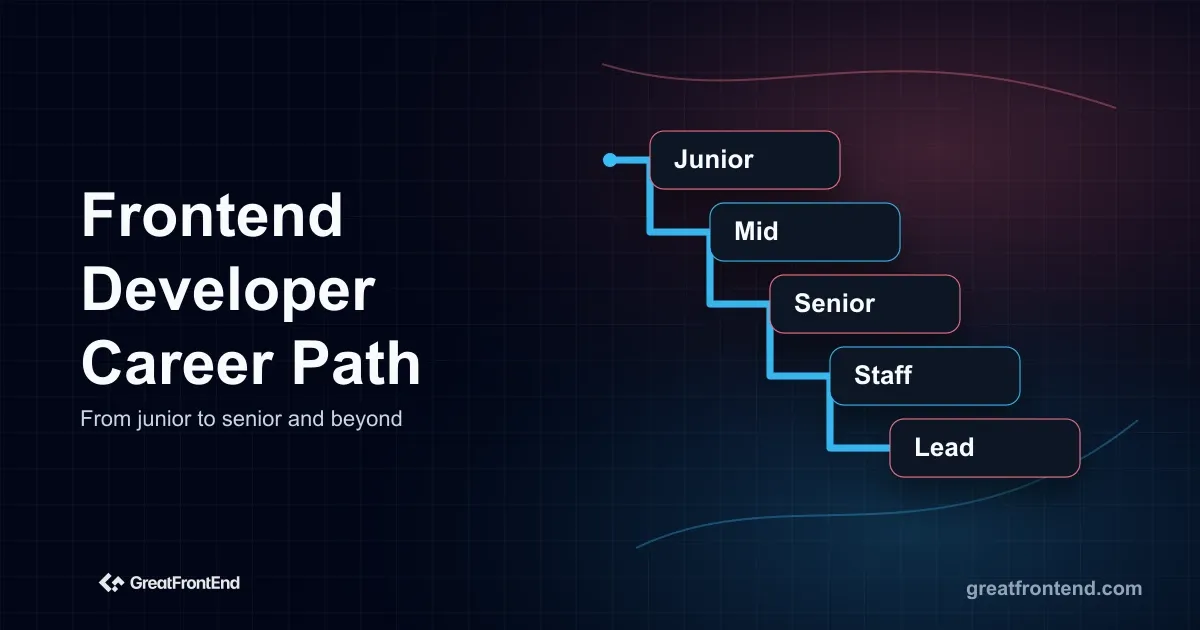 Map the frontend developer career path in 2026 from junior to mid-level, senior, staff, lead, specialist, and manager roles.