Remote Frontend Developer Jobs: How to Find and Land Them in 2026
Learn how to find remote frontend developer jobs in 2026, evaluate good roles, prepare your portfolio, and prove you can work well remotely.
Remote frontend developer jobs are available in 2026, but they are harder to win than local roles. You need frontend skill, written proof, async work habits, timezone fit, and a portfolio that earns trust quickly.
Remote hiring changes the signal. In an office interview, a team may rely on energy, conversation, and local availability. In a remote hiring process, the team looks for proof that you can work without constant supervision: clear writing, small deliverables, good questions, and code that can be reviewed asynchronously.
That matters for frontend because the work sits between product, design, backend, QA, analytics, and users. If your communication is vague, remote frontend work becomes slow quickly.
The opportunity is real, but not evenly distributed. In the 2025 Stack Overflow Developer Survey work section, respondents in India reported a mix of remote, hybrid, flexible, and in-person work rather than a remote-only market. Treat remote as a competitive role type, not as a shortcut around local hiring.
What remote frontend roles usually expect
Remote frontend roles often ask for the same technical stack as local roles, but they add trust signals.
| Area | What companies look for | How to show it |
|---|---|---|
| Framework skill | React, Angular, Vue, Svelte, or Next.js experience | project or case study with complete flow |
| JavaScript and TypeScript | reliable app behavior and safer code | typed API data, state models, fewer assumptions |
| Product UI | forms, dashboards, user flows, API states | deployed demos with loading, empty, error, retry |
| Review habits | code that can be reviewed without a meeting | readable commits, README, pull-request notes |
| Async work | can explain decisions in writing | case studies, technical notes, issue-style project docs |
| Timezone overlap | can collaborate at predictable times | mention preferred overlap and location clearly |
| Ownership | can move work forward when requirements are incomplete | examples of questions, tradeoffs, and follow-through |
Remote does not mean easier. It often means the company has more applicants and less patience for unclear proof. A remote application has to answer doubts before the first call: Can this person write clearly? Can they ship without hand-holding? Can we review their code without a meeting?
Where to find remote frontend jobs
Use more than one source. Remote roles appear and fill quickly.
Search terms:
remote frontend developerremote frontend engineerremote React developerremote Next.js developerremote Angular developerremote UI developerfrontend developer work from homefrontend engineer async remote
Use these channels:
| Channel | How to use it |
|---|---|
| Remote job boards | Apply quickly, but only when the stack and timezone fit |
| Company career pages | Search companies that already hire distributed teams |
| Filter by remote, then verify the company page | |
| Startup platforms | Look for early teams needing product frontend work |
| Communities | React, JavaScript, design-system, and indie-hacker communities |
| Previous network | Ask former coworkers about distributed teams |
Do not spend all day clicking easy-apply buttons. Remote hiring rewards targeted applications. Save the job post, because remote listings are edited or closed quickly and you may need the original requirements while preparing.
Filter remote roles before applying
Some remote roles are excellent. Some are unclear, low-trust, or not truly remote.
| Filter | Good signal | Red flag |
|---|---|---|
| Timezone | clear overlap, such as IST plus Europe or IST plus US morning | "global remote" but no meeting expectations |
| Employment type | full-time, contract, freelance, or internship is explicit | vague role with unclear legal setup |
| Pay | range, band, or early compensation conversation | pay hidden until late rounds |
| Process | written docs, code review, async tools | constant online monitoring |
| Role scope | frontend ownership is described | only a stack list with no work context |
| Assignment | time-boxed and relevant | unpaid product work disguised as a test |
| Communication | official email, normal contract process | personal payment requests or strange onboarding |
If the role is remote but expects you to be online all day with no autonomy, evaluate whether it actually gives you the remote work you want.
Also verify the basics before sharing documents: company domain, recruiter identity, written offer process, payment schedule for contracts, equipment policy, and whether the role is remote from your country or only remote inside one country.
Build a remote-friendly portfolio
A remote portfolio should explain your work even when you are asleep in another timezone.
Include:
- A clear headline: role, stack, and level
- 2-3 case studies
- Live demos
- GitHub repos or code samples
- A short "how I work" section
- Contact links
- Resume link
Your case studies should answer:
- What problem did the UI solve?
- What did you own?
- What data did the UI use?
- What happened during loading, empty, error, and retry states?
- What tradeoff did you make?
- How did you test or check the work?
- What would you improve next?
Add one remote-specific detail to at least one case study: the written issue, handoff note, README, pull-request description, or decision log you would use if teammates reviewed the work later. Remote teams hire for evidence that work can move while people are offline.
For experienced developers, read Frontend Developer Portfolio: What to Build and What to Show in 2026. For freshers, use How to Build a Frontend Developer Portfolio With No Experience (2026).
Prove async communication before the interview
Remote teams judge writing early.
Your proof can include:
- A README that explains setup and decisions
- A case study with constraints and tradeoffs
- A pull-request style project note
- A short technical post
- Good commit messages
- A clear application note
Use this project note structure:
Context:What the feature does and who uses it.Constraints:Time, API shape, device support, or design limits.Decisions:State ownership, component boundaries, data fetching, accessibility, or performance choices.Quality:Tests, manual checks, keyboard checks, known limitations.Next:What you would improve with more time.
This is not extra decoration. It shows how you would work in a distributed team. A short, clear note beats a long case study that never names the constraints.
Application strategy for remote roles
Remote applications need to be more targeted because competition is wider.
Use this process:
- Pick 15-20 roles per week, not 100 random listings.
- Filter by timezone, stack, level, pay, and role scope.
- Match one project or case study to each role.
- Write a short application note.
- Track responses and rejection reasons.
- Improve portfolio weak spots weekly.
Track timezone and country restrictions separately. Many listings say "remote" but require a legal entity, payroll setup, or working-hours overlap that may exclude you.
Application note:
Hi [Name],I am applying for the remote frontend role. The role mentions React, TypeScript, and dashboard work, which matches this project: [link].I built filtered tables, URL-based state, loading/error handling, and a responsive layout. I also wrote a short case study with the main frontend decisions: [link].I am based in [location] and can overlap with [timezone/window].
Customize the middle paragraph. If the job mentions design systems, point to component work. If it mentions SaaS dashboards, point to table and API work. If it mentions e-commerce, point to cart, checkout, and performance.
Remote interview preparation
Prepare your environment and your thinking.
Setup checklist
- Stable internet
- Working camera and microphone
- Clean editor
- Local dev environment ready
- Browser DevTools openable quickly
- Notes file for clarifying questions
- Backup internet option if possible
Technical prep
Practice:
- JavaScript async bugs
- React or Angular forms
- API-backed UI
- CSS layout tasks
- TypeScript props and API data
- Accessibility basics
- Performance debugging
Remote behavior during interviews
Do:
- Repeat the requirement in your own words.
- Ask about empty, loading, and error states.
- State assumptions before coding.
- Keep changes small and explain them.
- Share what you would do next if time allowed.
- Document tradeoffs in the take-home README.
Do not:
- Go silent for 20 minutes in a live round.
- Add unnecessary libraries.
- Ignore the assignment README.
- Submit a project with broken setup.
For take-home assignments, include a short README with scope, run commands, assumptions, tradeoffs, and what you would improve with more time. That README is part of the interview, not paperwork.
Practice front end system design questions, React interview questions, Data Table, and File Explorer.
Remote roles for freshers
Freshers can apply to remote roles, but should be careful. Many remote fresher roles are internships, freelance tasks, or small-company work with limited mentoring.
Before accepting, ask:
- Who will review my code?
- How often will I get feedback?
- What is the expected availability?
- Is this internship paid?
- What will I work on in the first month?
- Is there a written offer or contract?
If you have no experience, a good local or hybrid internship with real mentorship can be better than a poorly managed remote role. Remote fresher work is safest when there is a named reviewer, clear weekly feedback, and a written task process.
Remote roles for experienced developers
Experienced developers should prepare ownership stories.
Show:
- A feature you delivered across time zones or teams
- A written proposal or design note
- A code review habit that improved quality
- A time you clarified ambiguous requirements
- A time you handled a production issue
- A performance or accessibility improvement
Remote senior roles often care less about whether you can write a component and more about whether work moves forward when nobody is sitting beside you.
Good senior proof includes artifacts: a design note, migration plan, incident write-up, performance measurement, accessibility checklist, or pull-request description that shows how you reduce ambiguity for others.
Common remote job mistakes
Avoid:
- Applying without timezone fit
- Sending the same resume to every role
- Having no public proof
- Submitting take-homes without setup instructions
- Treating remote as a lifestyle perk only
- Accepting vague contracts
- Ignoring written communication
- Hiding behind "I am available immediately" instead of showing fit
Remote frontend jobs go to candidates who lower hiring risk.
Remote frontend developer jobs in 2026 require visible trust. Build proof that can be reviewed asynchronously, write clearly, filter roles carefully, and prepare to show how you move frontend work forward without constant supervision.
Related articles
 Learn what to build for a frontend developer portfolio in 2026, how to structure case studies, and how to prove frontend skill beyond screenshots.
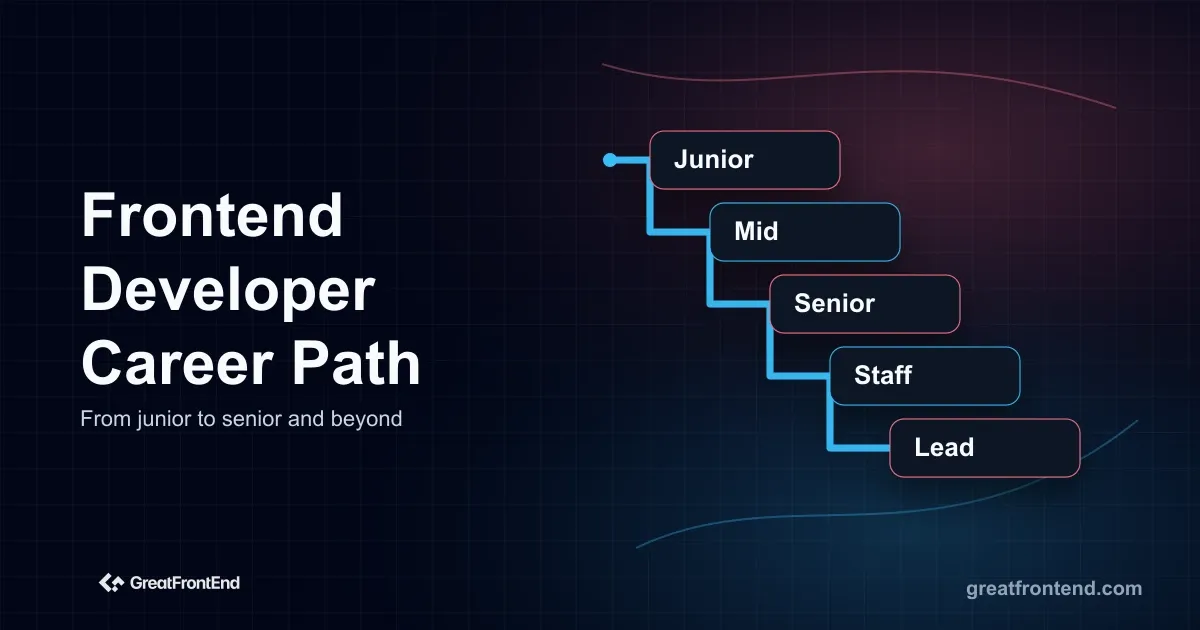 Map the frontend developer career path in 2026 from junior to mid-level, senior, staff, lead, specialist, and manager roles.