Frontend Developer Salary in Hyderabad 2026: Levels and Companies
A crisp 2026 Hyderabad frontend developer salary guide with source caveats, level ranges, GCC and product-company context, and offer comparison advice.
Frontend developer salary in Hyderabad depends on level, company type, fixed pay, role scope, and whether the work is product engineering, GCC platform work, services delivery, SaaS, or startup ownership.
Hyderabad has many GCC, cloud, product, SaaS, and enterprise teams. That can create good frontend opportunities, but the title alone is not enough. A role building maintainable product UI is different from a role doing client-side page delivery.
2026 salary snapshot
Use these numbers as reference points, not as a single truth. Salary sites measure different samples, titles, and compensation types.
| Source | Latest accessible signal | How to use it |
|---|---|---|
| NodeFlair India frontend developer salary | Updated July 12, 2026; median base salary Rs 62,500 per month, with a displayed range of Rs 37,500-Rs 1,87,500 per month | Broad India frontend baseline; not Hyderabad-only |
| Levels.fyi India software engineer salary | Last updated July 12, 2026; India software-engineer median total compensation around Rs 29.7 LPA; Hyderabad listed around Rs 32.9 LPA | Submitted SWE total compensation; not a frontend-only salary band |
| Frontend Developer Salary in India | Compares Glassdoor, PayScale, Indeed, NodeFlair, Adecco, and AmbitionBox with caveats | Use this before deciding whether a Hyderabad offer is below-market, fair, or top-market |
The practical takeaway: Hyderabad can produce high frontend offers, especially in GCC, cloud, SaaS, and product teams. But city averages can mislead if you do not separate frontend title, company type, level, and compensation structure.
Calibrate by level without inventing a city band
Neither source above publishes dependable Hyderabad frontend ranges for each experience band. Do not manufacture them by combining the India frontend median with the Hyderabad SWE median. Use the role's internal level, employer type, current postings, and comparable submitted offers.
| Level | Evidence the role should pay for |
|---|---|
| Entry / early | HTML, CSS, and JavaScript basics; deployed work; debugging; ability to finish a scoped UI task |
| Mid-level | Independent feature delivery, API and form states, tests, and production debugging |
| Senior | UI architecture, accessibility, performance, mentoring, and cross-team ownership |
| Lead / staff | Platform direction, migrations, shared standards, and measurable multi-team impact |
The jump from mid-level to senior depends on scope, not a fixed year count. Ask what the company expects at the offered level and how that differs from the next level.
Read the company type before the title
Two Hyderabad roles can both say "frontend developer" but test and pay for different things.
| Company type | Salary pattern | What to verify before accepting |
|---|---|---|
| GCC or cloud/product center | Stronger pay for system-minded engineers | Level mapping, frontend scope, bonus, promotion path, hybrid policy |
| SaaS or product startup | Wider range and faster ownership | Fixed pay, runway, product maturity, equity terms, manager quality |
| IT services | Structured bands and client-dependent work | Project allocation, tech stack, support load, onsite/client expectations |
| Enterprise product or consulting | Stable work, often form and dashboard heavy | React or Angular depth, release process, testing, API ownership |
| Agency, media, or CMS-heavy team | Variable by client and delivery quality | Fixed pay, design quality bar, code review, maintenance expectations |
Do not compare a services fixed-pay offer with a product-company total-comp number unless you separate base salary, variable pay, equity risk, level, and project scope.
What raises a Hyderabad offer
Higher-paying Hyderabad frontend roles usually pay for maintainable UI inside bigger systems:
- Building dashboards, tables, forms, workflows, and internal tools.
- Handling loading, error, empty, permission, and retry states.
- Working cleanly with APIs, backend teams, QA, and product managers.
- Using TypeScript, tests, and component patterns that survive handoff.
- Improving accessibility and performance in data-heavy interfaces.
- Explaining tradeoffs in code review, architecture discussions, and interviews.
If the role is mostly page slicing, support, or CMS work, judge the salary against that market, not against top-product compensation.
Build your target range
Before a negotiation call, write three numbers:
| Number | What it means |
|---|---|
| Fixed-pay floor | The minimum guaranteed annual cash you are willing to accept |
| Target total compensation | Fixed pay plus realistic bonus, equity, joining bonus, and benefits |
| Walk-away point | The point where salary, commute, manager quality, role scope, or team health is not worth it |
Then write one sentence explaining why your target is fair: level, scope, competing offer, frontend ownership, or the value you can bring in the first 90 days.
Offer comparison worksheet
Use this table when two offers look close.
| Factor | Offer A | Offer B | Why it matters |
|---|---|---|---|
| Fixed annual pay | Predictable income | ||
| Variable bonus | Useful only if recent payouts are consistent | ||
| Equity or stock | RSUs, ESOPs, and options have different certainty | ||
| Level and scope | Affects future salary and promotion path | ||
| Manager and team quality | Changes learning, stress, and execution speed | ||
| Commute or remote policy | Affects daily cost and sustainability | ||
| First review date | Matters when the offer is slightly below target |
Mark each compensation item as guaranteed, likely, uncertain, or risky. This prevents a large headline CTC from hiding weak fixed pay.
Hyderabad offer examples
A GCC role with clear level, high fixed pay, and dashboard or platform ownership can be better than a startup offer with a higher headline CTC but unclear equity value.
A services role can be worth taking if it gives you React or Angular ownership, API-heavy work, and a substantial client project. It is weaker if the project allocation is unclear or the work is mostly maintenance.
For Hyderabad, ask which product flow or UI area you will own. Salary makes more sense once the work, team, level, and compensation certainty are visible.
Questions to ask before accepting
- What is the fixed annual gross compensation?
- What part is variable, and what was the recent payout pattern?
- Are RSUs, ESOPs, or options included, and what is the vesting schedule?
- What level is this offer mapped to?
- What frontend work will I own in the first 90 days?
- Which team or project am I joining?
- When is the first compensation or level review?
Common questions
Should you trust salary websites?
Trust them as directional inputs. Compare multiple sources, then compare the actual offer structure. A salary page cannot tell you whether the project allocation, manager, frontend scope, or equity terms are good.
Is CTC the same as take-home pay?
No. CTC can include fixed salary, variable bonus, employer contributions, insurance, joining bonus, retention bonus, and equity. Monthly take-home depends mostly on fixed pay, deductions, taxes, and how the offer is structured.
What is the best negotiation ask?
Ask for the specific change that matters most: base salary, joining bonus, equity, level, remote flexibility, relocation support, or earlier review timing. A precise ask is easier to approve than a vague request for "better compensation."
For Hyderabad, use salary data to set a range, then use company type, project scope, and compensation certainty to decide where your offer belongs inside that range.
Related articles
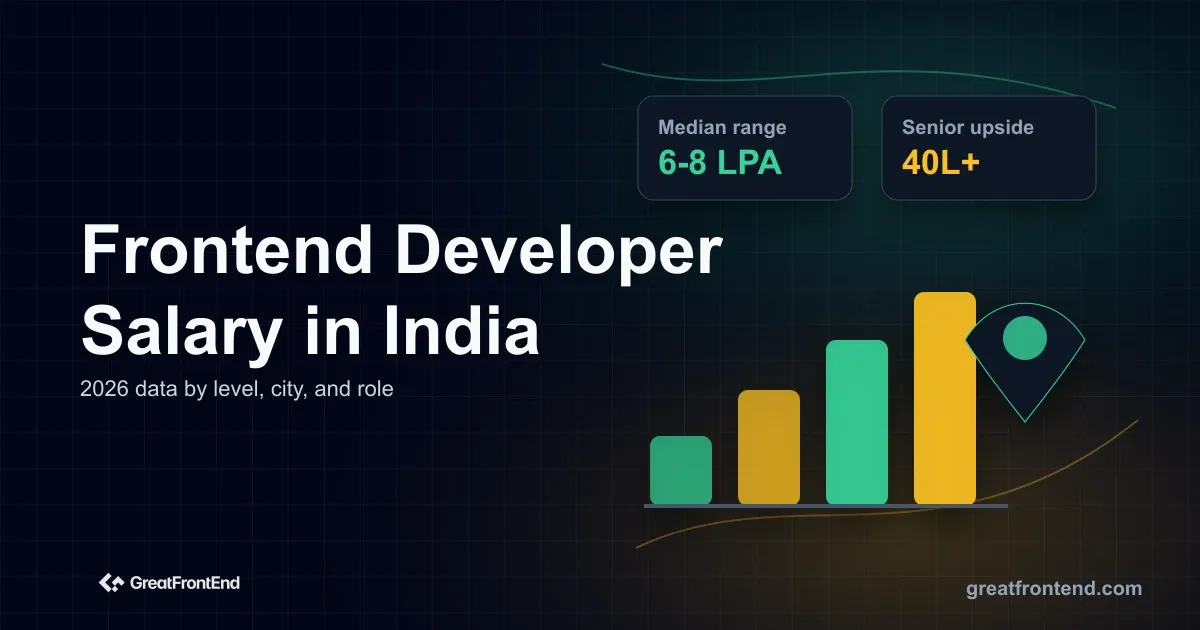 A 2026 India frontend developer salary guide using Glassdoor, PayScale, Indeed, NodeFlair, Adecco, and AmbitionBox data with caveats by level, city, and employer type.
 Negotiate frontend developer salary with a clear target range, offer-stage scripts, frontend impact proof, India CTC checks, and calm counter-offer language.
 Learn how to prepare for frontend developer jobs in Hyderabad in 2026, including company types, skills, portfolio projects, interview rounds, and application strategy.
 Learn the senior frontend developer skills that matter in 2026, from UI architecture and accessibility to performance, testing, judgment, and AI verification.