Frontend Developer Jobs in Hyderabad: Top Companies + How to Prepare (2026)
Learn how to prepare for frontend developer jobs in Hyderabad in 2026, including company types, skills, portfolio projects, interview rounds, and application strategy.
Frontend developer jobs in Hyderabad are a good fit if you can build maintainable web apps, work with backend and design teams, and prove React, Angular, TypeScript, API, and UI debugging skill.
The important word is "maintainable." Hyderabad has startups, service companies, SaaS teams, media companies, fintech teams, cloud products, and large product engineering centers. Many frontend roles sit inside bigger engineering systems, so companies care about code that other people can read, review, test, and extend.
That changes your preparation. A flashy personal site helps only a little. A project that handles form validation, role-based screens, table state, API failures, and responsive layout says much more.
Use global stack data carefully. The 2025 Stack Overflow Developer Survey still shows JavaScript, HTML/CSS, TypeScript, React, Next.js, and Angular as common professional-developer technologies. That supports preparing those skills, but the exact framework still depends on the Hyderabad role: enterprise teams may be Angular-heavy, product teams may be React-heavy, and web roles may still ask for CMS or plain JavaScript work.
What "frontend developer" means in Hyderabad
The same title can hide different jobs. Read the job description before deciding whether to apply.
| Job title pattern | What the work often means | How to prove fit |
|---|---|---|
| Front End Developer | General website or app UI work, often HTML, CSS, JavaScript, Bootstrap, WordPress, React, or Angular | Show polished UI, responsive layout, and basic interaction quality |
| ReactJS Developer | Product screens, dashboards, state, API integration, reusable components | Show React projects with forms, routing, async states, and TypeScript |
| Angular Developer | Enterprise apps, admin tools, forms, services, reusable modules | Show typed forms, validation, API services, and component structure |
| Front-End UI Developer | CSS-heavy implementation, design handoff, browser behavior, layout details | Show pixel-careful pages, responsive states, and accessibility basics |
| Senior Frontend Developer | Architecture, review, mentoring, performance, migration, design system work | Show case studies, tradeoffs, and production ownership |
| Frontend Intern or Fresher | Small components, bug fixes, HTML/CSS/JS tasks, simple framework work | Show two finished projects and clean GitHub repos |
Do not apply to all of these with the same resume. A WordPress-heavy role, a React product role, and an Angular enterprise role need different evidence. The fastest way to waste applications is to send a React-only resume to a UI/CSS role or a beginner project gallery to a maintainability-heavy enterprise role.
Hyderabad company types to target
Think of the city as several markets, not one market.
| Company type | What they usually test | Good candidate signal |
|---|---|---|
| GCCs and multinational product teams | maintainability, code review, TypeScript, process, collaboration | You can explain component boundaries and edge states |
| SaaS and B2B product companies | dashboards, workflows, API integration, customer-facing product UI | You have built product flows, not only landing pages |
| Service companies | adaptability across clients, fast delivery, stack flexibility | You know one framework well and can pick up adjacent tools |
| Media and creator-tech companies | responsive UI, speed, web publishing, visual polish | You can build attractive pages without breaking performance |
| Fintech and operations products | tables, forms, permissions, audit-like flows, reliability | You handle validation, disabled states, and failure recovery |
| Early startups | broad ownership, quick iteration, debugging across the stack | You can clarify requirements and ship a small feature end to end |
If you are a fresher, your first target can be internships, trainee roles, junior UI roles, or small-company frontend roles. If you have 2-4 years of experience, aim for product UI roles where React or Angular is central. If you have 5+ years, look for roles that mention ownership, architecture, performance, design systems, or mentoring.
Companies to research in Hyderabad
The Hyderabad list should not be read as a permanent ranking. It is a practical target map. Check current openings, team scope, and interview expectations before applying.
| Company group | Examples to research | Frontend angle to look for |
|---|---|---|
| Large product and platform companies | Microsoft, Google, Amazon, Salesforce, ServiceNow, Oracle, Qualcomm, Apple | large engineering systems, enterprise UI, internal platforms, cloud tools, product workflows |
| Finance, operations, and enterprise GCCs | Wells Fargo, JPMorgan Chase, Deloitte, EY, UBS, State Street, The Hartford | dashboards, forms, approvals, role-based UI, compliance-heavy workflows |
| SaaS, media, and product engineering teams | ValueLabs, EPAM, OpenText, Model N, Electronic Arts, Ivy | product screens, analytics UI, customer tools, design and backend collaboration |
| IT services and consulting companies | Accenture, Infosys, TCS, Cognizant, Capgemini, Tech Mahindra, Wipro | client apps, migrations, Angular/React delivery, frontend maintenance, broader stack exposure |
| Startups and local product teams | T-Hub ecosystem companies, fintech, healthtech, edtech, creator-tech teams | broader ownership, faster learning, product ambiguity, smaller frontend teams |
For freshers, do not apply only to famous names. Hyderabad has many smaller teams where a junior developer can get more frontend reps. For experienced developers, prioritize teams that mention product ownership, design systems, performance, testing, or platform work.
Before shortlisting a company, check whether the role describes the product surface, review process, and frontend ownership. A job post that says only "React, HTML, CSS, JavaScript" may still be useful, but you need to ask what you will actually build.
Skills to prepare in the right order
Do not begin by collecting every framework name. Prepare the skill stack that appears across many Hyderabad roles.
| Skill | What interviewers may ask | What to build |
|---|---|---|
| HTML and CSS | forms, semantic tags, responsive layout, Flexbox, Grid, specificity, overflow | settings page, pricing page, form flow, dashboard shell |
| JavaScript | arrays, objects, promises, closures, event handling, fetch, timers | search page, filterable table, debounced input, polling widget |
| React or Angular | state, props, effects or lifecycle, forms, routing, reusable components | customer dashboard, ticket system, onboarding form |
| TypeScript | props, API response types, unions, narrowing, event types | typed API client, typed form state, typed table rows |
| APIs | loading, empty, error, retry, auth failure, validation errors | API-backed dashboard with realistic failure states |
| Testing | user behavior, form submission, async UI, simple component tests | tests for filter, form, and save flows |
| Accessibility | labels, focus order, keyboard navigation, modal behavior, error text | keyboard-safe form, dialog, tabs, or menu |
| Performance | large lists, image loading, render cost, network waterfall | table with pagination, optimized image page, measured interaction |
Use the Frontend Developer Roadmap if you need a broader order. For this article, the practical target is simple: be able to build a useful product screen and explain why it works.
How to read a Hyderabad job description
Job descriptions often mix must-haves, nice-to-haves, and recruiter filler. Translate them into actual preparation.
| JD phrase | What it probably means | What to prepare |
|---|---|---|
| "Collaborate with designers and backend developers" | You will receive designs and API contracts that are not always perfect | Practice asking API, loading, validation, and responsive questions |
| "Responsive web applications" | CSS and browser behavior matter | Build layouts that work at mobile, tablet, and desktop sizes |
| "Reusable components" | They care about maintainability | Prepare examples of component props, naming, and composition |
| "React and Next.js" | They may expect routing, rendering, data loading, and app structure | Build a route-based app, not only isolated components |
| "Angular/React" | The team may support older or mixed codebases | Show framework basics plus solid JavaScript |
| "Enterprise user interfaces" | Forms, tables, permissions, audit flows, and long-lived code | Build admin-style workflows with edge states |
| "Performance" | They may have slow pages, large lists, or heavy dashboards | Learn how to inspect renders, bundles, images, and network requests |
If a JD lists 20 technologies, do not panic. Find the work behind the list. Is it product UI? CMS work? enterprise dashboard work? migration work? Your application should answer that need.
Portfolio projects that match Hyderabad roles
Build projects that look like actual frontend work inside teams.
Project 1: Customer operations dashboard
Include:
- Login-like entry state or mocked user role
- Table with search, filters, sorting, pagination
- Details drawer or details page
- Loading, empty, error, and partial-error states
- URL search params for filters
- Responsive layout for smaller screens
- Basic tests for search and filter behavior
Write a project note explaining why filters live in the URL, how you avoid duplicate state, and what happens when the API fails.
Project 2: Multi-step workflow
Good examples:
- Employee onboarding
- Loan application
- Vendor registration
- Course enrollment
- Support escalation
Include:
- Step navigation
- Validation per step
- Review screen
- Save draft or local persistence
- Error summary
- Keyboard-friendly controls
- Clear disabled and success states
This project helps because Hyderabad roles often involve form-heavy enterprise UI. A careful multi-step flow is better than another weather app because it reveals how you handle validation, recovery, keyboard use, and state across screens.
Project 3: Role-based admin screen
Include:
- Admin, editor, and viewer roles
- Disabled actions with visible reason
- Dangerous action confirmation
- Audit-style activity list
- Empty state for new accounts
- Error state for failed save
This shows product judgment. Many candidates can render a button. Fewer can explain who should be allowed to press it and what happens when the save fails.
Resume positioning for freshers, 2-4 years, and senior candidates
Your resume should change with your level.
| Level | What the resume should prove | Example bullet |
|---|---|---|
| Fresher | You can finish small frontend projects and explain them | Built a React onboarding form with validation, review step, saved progress, and mobile layout |
| 1-2 years | You can deliver scoped features with review | Built reusable table filters and API error states for an internal dashboard |
| 3-5 years | You can own a product flow | Owned a customer settings flow across React components, API integration, validation, and release fixes |
| 5+ years | You can reduce technical and product risk | Led a frontend refactor that simplified state ownership and reduced repeated form bugs across three screens |
Weak resume bullets name tools. Better bullets name behavior.
Weak:
- Worked with React, JavaScript, HTML, CSS.
Better:
- Built a React ticket management screen with assignee filters, optimistic status updates, and retry handling for failed saves.
If your resume does not give an interviewer a concrete question to ask, rewrite it.
Interview rounds to expect
Not every company runs the same process, but Hyderabad frontend interviews often include these patterns:
| Round | What they are checking | How to prepare |
|---|---|---|
| Screening call | role fit, salary range, notice period, stack match | Have a 30-second summary and target role clear |
| JavaScript round | language basics and debugging | Practice arrays, promises, closures, object transforms, and async mistakes |
| Framework round | React or Angular depth | Prepare forms, state, lifecycle/effects, routing, reusable components |
| UI coding | can you build under time pressure | Practice forms, tabs, data table, autocomplete, modal, accordion |
| Project discussion | did you actually build the work | Prepare tradeoffs, bugs, constraints, and improvements |
| Hiring manager round | team fit and ownership | Explain how you clarify requirements and handle review feedback |
Practice JavaScript interview questions, React interview questions, and UI tasks such as Data Table, Contact Form, and Transfer List.
If you are targeting Angular roles, practice the same behavior in Angular: forms, validation, API state, component inputs/outputs, services, and routing.
A 30-day preparation plan
Use this if you already know basic HTML, CSS, JavaScript, and one framework.
| Days | Work |
|---|---|
| 1-4 | Fix JavaScript gaps: arrays, objects, promises, closures, fetch, and event handling |
| 5-8 | Build or improve a form-heavy project with validation and accessibility checks |
| 9-13 | Build an API-backed dashboard with filters, loading, empty, error, and retry states |
| 14-17 | Add TypeScript to one project and remove unsafe any |
| 18-20 | Write READMEs and case notes for your best projects |
| 21-24 | Practice UI coding tasks under a timer |
| 25-27 | Rewrite resume bullets for Hyderabad role types |
| 28-30 | Apply to a targeted list and record interview feedback |
If the first two weeks produce no responses, do not add another certificate first. Check whether your strongest project is visible in the first half of the resume, whether the live link works, and whether the bullets match the role type.
Do not wait until day 30 to apply if you already have decent proof. Start applying once your best project is deployed and readable.
Questions to ask before accepting
Ask questions that reveal the actual frontend work:
- Is the frontend team mostly React, Angular, or mixed?
- Will I work on product UI, marketing pages, internal tools, or client projects?
- How are designs and API contracts handed off?
- Are there frontend tests in the codebase?
- Who reviews frontend pull requests?
- Are accessibility and performance part of the release process?
- What would the first 60 days look like?
These questions help you avoid roles where the title sounds good but the work does not match your goal.
Hyderabad frontend developer jobs in 2026 reward candidates who can work inside larger product systems. Prepare the framework, but make your proof about maintainable UI: forms, tables, API states, TypeScript, review-ready code, and clear ownership.
Related articles
 A detailed frontend developer roadmap for 2026 covering the skills, tools, projects, milestones, and interview practice needed for modern frontend roles.
 Map the frontend developer career path in 2026 from junior to mid-level, senior, staff, lead, specialist, and manager roles.
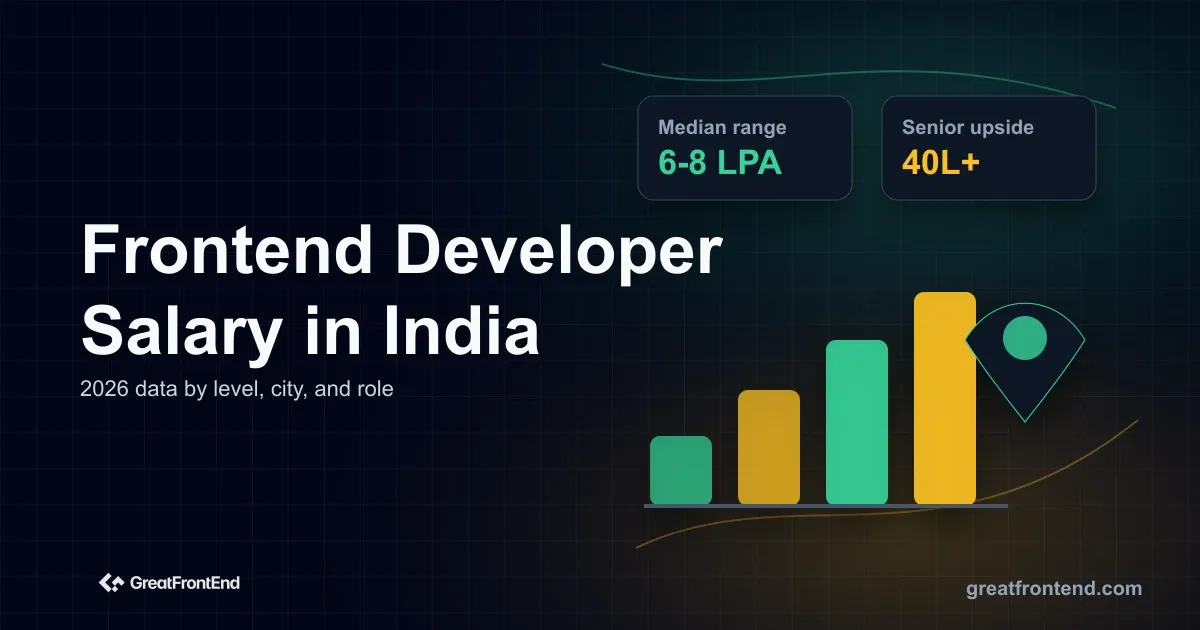 A 2026 India frontend developer salary guide using Glassdoor, PayScale, Indeed, NodeFlair, Adecco, and AmbitionBox data with caveats by level, city, and employer type.