Startup vs FAANG for Frontend Developers: How to Choose in 2026
Choose between startup and FAANG frontend roles with a practical framework for learning, scope, mentorship, compensation, equity, risk, and team quality.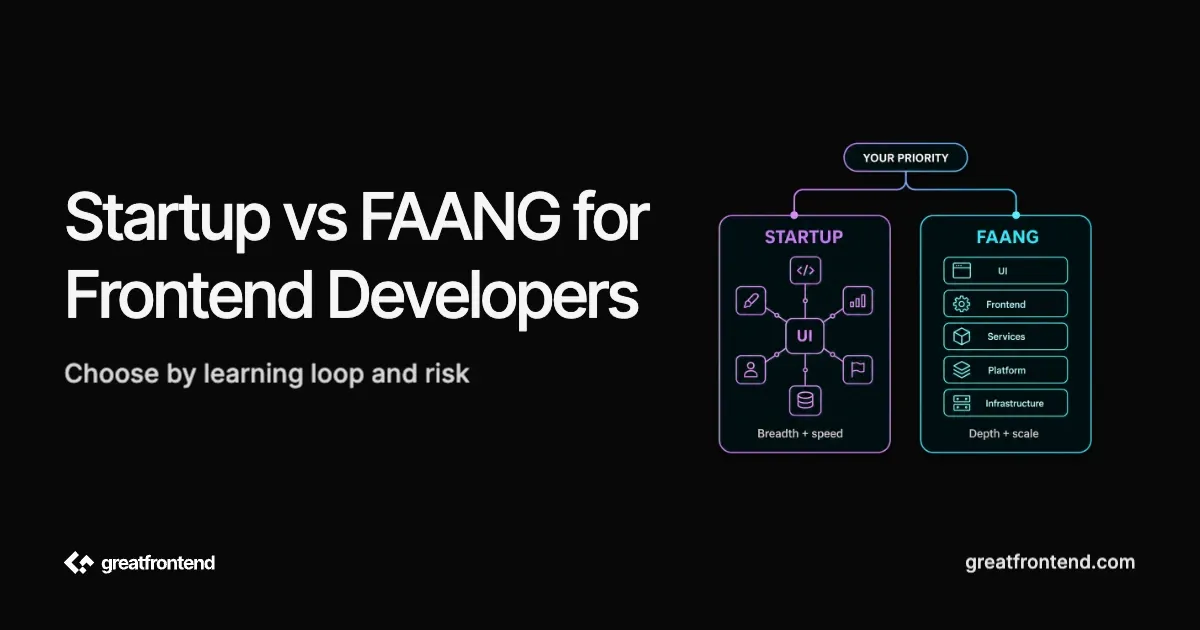
Startup vs FAANG for frontend developers is not a logo question. It is a choice between different learning loops, risk profiles, compensation structures, codebase shapes, and kinds of frontend scope.
Use "FAANG" here as shorthand for large, high-bar tech companies: Google, Meta, Amazon, Apple, Netflix, Microsoft, Nvidia, Stripe-like public or late-stage companies, and similar engineering cultures. The actual team matters more than the category.
Quick answer
Choose the environment where the daily work teaches the next skill you need at a risk level you can afford.
| You need most | Startup may fit better when | FAANG or big tech may fit better when |
|---|---|---|
| Frontend breadth | You can own UI, API edges, analytics, experiments, and product details | The role is too narrow for the breadth you want right now |
| Frontend depth | The product has serious UI complexity and senior frontend mentorship | There are mature design systems, performance tools, accessibility standards, and scale problems |
| Mentorship | The startup has senior frontend engineers who review your work | You need structured feedback, calibration, and established engineering practices |
| Compensation certainty | Cash is strong enough and you can discount private equity heavily | Liquid equity, clearer bands, and predictable benefits matter |
| Career signal | The startup is respected, growing, and gives you visible ownership | The brand, level, and hiring calibration will help your next search |
| Speed | You want fast shipping and direct customer feedback | You want slower but deeper review, reliability, and cross-team systems |
A startup is not automatically high-growth learning. A FAANG role is not automatically deep engineering. A weak startup gives you chaos without mentorship. A weak big-company team gives you process without ownership.
How frontend work differs
The company category changes what "frontend developer" means day to day.
| Frontend area | Startup pattern | FAANG or big-tech pattern |
|---|---|---|
| Product ownership | You may own whole flows, metrics, and experiments early | You may own a smaller slice of a much larger product |
| Design system | Often incomplete, changing, or built while the product ships | More likely to have mature components, tokens, docs, and governance |
| Accessibility | Can be uneven unless leadership values it | More likely to have standards, audits, tooling, and legal/product pressure |
| Performance | You may fix obvious issues with limited tooling | You may work with RUM, budgets, platform teams, and high-traffic constraints |
| Codebase | Smaller, faster to understand, more inconsistent | Larger, more layered, harder to change, better tooled |
| Review culture | Fast, variable, sometimes founder-driven | More structured, sometimes slower, often more calibrated |
| Cross-functional work | Direct access to product, design, support, and customers | More layers, clearer ownership, more stakeholder management |
For frontend developers, the best role is not the one with the most famous company. It is the one where web quality matters to the business. A browser-native product, complex dashboard, editor, collaboration tool, commerce flow, design system, or frontend platform team can create much better frontend growth than a famous company where web is an internal afterthought.
What startups teach well
Startups can expose you to ambiguity early. A 2023 preprint describing a proposed Greenfield Startup Model frames one common tension: release quickly enough to test product direction, then pay down structural shortcuts before growth makes them costly. It is one research model, not evidence that every startup works this way.
For frontend developers, that can be valuable.
You may learn to:
- Turn vague product ideas into shippable UI.
- Work directly with founders, designers, sales, support, and early customers.
- Build flows without waiting for a full design system.
- Make pragmatic calls when data, copy, design, and backend contracts are still changing.
- Own analytics, experiments, onboarding, pricing, checkout, admin tools, and internal dashboards.
- See how frontend decisions affect activation, retention, conversion, support load, and sales demos.
The risk is that "broad" can become "unsupported." If you are the only frontend developer, the company may expect speed while giving you no senior review, no accessibility standards, no design support, no testing culture, and no time to fix the foundation.
What FAANG and big tech teach well
Big-tech teams can teach scale, calibration, and systems that outlive one engineer. Even if your feature slice is smaller, the surrounding machinery may include code review, experimentation, observability, internationalization, accessibility, design systems, security review, launch process, incident response, and long-lived product maintenance. Verify which of those practices the actual team uses.
For frontend developers, that can mean learning:
- How large frontend codebases are organized.
- How design systems migrate without breaking hundreds of screens.
- How performance is measured for real traffic.
- How accessibility is reviewed before launch on teams that make it a release requirement.
- How experiments, feature flags, and metrics shape product decisions.
- How frontend platform teams support many product teams.
- How staff-level frontend engineers communicate tradeoffs across org boundaries.
The risk is that "scale" can become "narrow." You might spend a year on a small part of an internal tool, a migration with little product context, or a product area where frontend is treated as implementation after the real decisions are already made.
Choose by career stage
The same company can be a great choice at one stage and the wrong choice at another.
| Stage | Startup can be strong if | FAANG or big tech can be strong if |
|---|---|---|
| Fresher or junior | You have senior engineers reviewing your code and enough runway to learn | You need structured onboarding, clear expectations, and brand signal |
| Early mid-level | You can own complete product flows and learn from real users | You want stronger engineering habits and larger-system exposure |
| Senior frontend | You can set frontend direction, mentor, and shape quality standards | You want scale, platform depth, compensation liquidity, and cross-team scope |
| Staff-track | The company has enough complexity for frontend architecture to matter | You want multi-team influence, formal ladders, and large migration experience |
| Risk-sensitive | Cash covers your needs even if equity becomes worth little | Predictability matters more than upside |
If you are early career, mentorship should weigh more than speed. If you are senior, scope and decision authority should weigh more than the company label. If you have financial constraints, compensation certainty should weigh more than upside stories.
The frontend team questions that reveal the truth
Ask questions that force the company to describe the actual work.
| Question | Good signal | Warning signal |
|---|---|---|
| What does the frontend team own end to end? | Product flows, UI architecture, performance, accessibility, and release quality | "The backend team owns most decisions; frontend implements screens" |
| Who reviews frontend architecture? | Senior frontend engineers or platform/design-system owners | Only backend reviewers or no clear reviewer |
| What frontend bugs hurt the business recently? | They can name concrete incidents and fixes | They only say "we move fast" |
| How are accessibility and keyboard behavior checked? | Manual checks, automated checks, design review, and ownership | "We will handle that later" |
| How do you measure frontend performance? | RUM, Core Web Vitals, profiling, budgets, or release checks | No measurement beyond "the page feels fine" |
| How mature is the design system? | Clear status, owners, migration path, and escape hatches | Either no system or a rigid system nobody trusts |
| How often do frontend engineers talk to users or support? | Regular product feedback loop | Frontend has no contact with user problems |
| What will I own in the first 90 days? | A specific flow, migration, platform task, or measurable improvement | A vague promise of "lots of exciting work" |
These questions work for both startups and big tech. A good startup can answer them clearly. A famous company can fail them.
Compensation: compare certainty, not headlines
Do not compare offers by one big total-compensation number. Compare guaranteed cash, variable bonus, public equity, private equity, vesting, taxes, liquidity, and downside.
| Component | Big tech pattern | Startup pattern | What to verify |
|---|---|---|---|
| Base salary | Usually clearer bands by level and location | Can be lower, equal, or unusually high in hot areas | Annual gross, location policy, review cycle |
| Bonus | Often target-based and performance/company dependent | Sometimes absent or discretionary | Target, payout history, eligibility date |
| Equity | Often RSUs in public stock or late-stage equity | Often options or private shares | Vesting, strike price, current valuation, liquidity |
| Refreshers | May be part of annual performance cycle | Varies widely | Whether refreshers exist and how they are decided |
| Liquidity | Public equity is easier to value and sell after vesting windows | Private equity may be hard to sell | Secondary policy, IPO/acquisition assumptions |
| Downside | Stock price, performance ratings, layoffs, narrow scope | Dilution, down rounds, shutdown, no liquidity | Your personal cash floor and risk tolerance |
Tax treatment depends on the country, grant type, exercise, vesting, and sale. Ask for the plan documents and use advice that applies to your tax jurisdiction. The practical comparison remains the same: private options are not cash, and a quoted grant value is not guaranteed proceeds.
For a startup offer, ask these in writing:
- What type of equity is this: options, RSUs, restricted stock, or something else?
- What is the number of shares and the fully diluted ownership percentage?
- What is the strike price or purchase price?
- If this is a US option plan, what are the latest 409A and preferred valuations? Otherwise, what valuation is used to set the exercise price and quoted grant value?
- What is the vesting schedule and cliff?
- What happens to vested and unvested equity if I leave?
- What is the post-termination exercise window?
- Has the company raised a down round, repriced options, or changed the option plan?
- Is there any secondary liquidity history or policy?
- What is the runway and next financing plan?
For a big-tech offer, ask:
- What level is the offer mapped to?
- What is the annualized value after year one, not only the signing year?
- Is the equity vesting back-loaded, front-loaded, or even?
- How do refreshers work?
- What is the target bonus and recent payout range?
- When is the first performance review?
- What role scope is expected for this level?
If you cannot explain the offer to another person without hand-waving, you do not understand it yet.
How to compare two offers
Use a written comparison before accepting.
| Factor | Offer A | Offer B | Why it matters |
|---|---|---|---|
| Guaranteed annual cash | Rent, savings, family obligations, visa risk | ||
| First-year total | Signing bonuses can distort the headline | ||
| Recurring total | Year two often reveals the real offer | ||
| Equity liquidity | Public stock and private options are different assets | ||
| Level and scope | A higher title with weaker scope can still be worse | ||
| Frontend mentorship | Review quality shapes growth | ||
| Frontend ownership | The work should match your target direction | ||
| Team health | Manager quality can outweigh brand | ||
| Workload and sustainability | Speed is useful only if you can keep learning | ||
| Regret risk | Name the downside before excitement edits it out |
Mark each compensation item as guaranteed, likely, uncertain, or speculative. Private equity usually belongs in the uncertain or speculative column until there is a real path to liquidity.
Choose startup if
A startup is a strong choice when:
- You want broad frontend ownership across product, data, experiments, and customer feedback.
- The company has at least one senior frontend engineer or strong product engineer you can learn from.
- The product has frontend complexity that matters to revenue or retention.
- You can tolerate ambiguity without turning every missing process into frustration.
- You understand the equity downside and still like the cash offer.
- You want to build a portfolio of shipped decisions, not only polished systems.
The best startup frontend roles make your judgment visible quickly. You can point to a flow, metric, experiment, redesign, migration, or design-system decision and explain what changed.
Choose FAANG or big tech if
A FAANG-style role is a strong choice when:
- You want structured feedback, calibrated expectations, and recognizable brand signal.
- You want to learn how large systems handle performance, accessibility, experimentation, reliability, and release safety.
- Compensation predictability matters.
- You want to see how senior and staff frontend engineers operate across many teams.
- You are aiming for future roles where big-company experience is a useful hiring signal.
- You are willing to trade some breadth for depth, tooling, and scale.
The best big-tech frontend roles expose you to mature engineering practice. You learn why a design-system migration takes quarters, why feature flags matter, why accessibility cannot be left to the end, and why performance work needs measurement instead of vibes.
Avoid these traps
Choosing a startup only for ownership
Ownership without mentorship can teach bad habits quickly. Ask who will review your work and what quality bar you will inherit.
Choosing FAANG only for stability
Big companies still reorganize, cancel projects, change remote policies, and lay off teams. Stability is relative, not guaranteed.
Treating equity as cash
Private startup equity can become valuable, but it can also become diluted, illiquid, expensive to exercise, or worthless. Keep your decision honest by separating cash from upside.
Ignoring whether web matters
Some companies have famous engineering brands but little meaningful frontend work. If mobile, backend, or ML owns the product center, a frontend role may have limited scope.
Confusing speed with learning
Shipping every day is not automatically growth. Growth needs feedback, review, reflection, and harder problems over time.
A decision note you can actually use
Write this before you accept.
Target for the next 2 years:[frontend depth / product ownership / compensation certainty / brand signal / mentorship]Offer summary:[base, bonus, equity type, vesting, level, manager, team, first 90-day scope]What I will learn:[specific frontend skills, not generic growth]What I will risk:[cash, equity, scope, workload, mentorship, commute, visa, market risk]My regret test:If this goes badly, the most likely reason will be [reason].I am accepting because [evidence] makes that risk acceptable.
If the note sounds vague, you need another recruiter or hiring-manager conversation.
Negotiation script
Use a specific ask. Do not argue every component at once.
Thank you for the offer. I am excited about the role because [specific frontend scope].I am comparing the offer by recurring cash, equity liquidity, level, and the first-year scope.Based on the role and market data I am seeing for similar frontend/product engineering roles,I was hoping to get closer to [target].Is there flexibility in base salary, signing bonus, equity, level mapping, or first review timing?
For startups, the negotiation may be about base, equity percentage, exercise window, title, remote flexibility, or review timing. For big tech, it may be base, sign-on, equity, level, or team match. Pick the part that changes your decision.
The decision should survive a bad month
A good career decision still makes sense after the excitement fades. Imagine the first difficult month in each role.
At a startup, that month may include unclear requirements, missing design coverage, changing priorities, and a production bug that needs a fast fix. The role is still worth it if you are getting ownership, useful feedback, direct product learning, and enough support to avoid building bad habits alone.
At FAANG or big tech, that month may include slow review cycles, narrow ownership, migration work, org changes, and more process than you expected. The role is still worth it if you are learning from stronger systems, better engineers, larger-scale frontend problems, and clearer career calibration.
| If the hard part is... | Startup is easier to justify when... | FAANG or big tech is easier to justify when... |
|---|---|---|
| Ambiguity | You get real ownership and fast feedback | You would rather learn inside clearer systems first |
| Narrow scope | The company lets you expand into product and platform work | The narrow work teaches scale, quality, or migration habits |
| Compensation risk | Cash covers your needs and equity is treated as upside | Predictable cash and liquid equity matter more |
| Weak process | You can help create the process with senior support | You need mature practices to learn from |
| Brand signal | The startup's work and trajectory are explainable | The company name and level improve future optionality |
The better choice is the one where the daily work moves you toward the next frontend role you actually want. The logo matters, but the learning loop, team quality, compensation reality, and frontend scope matter more.
相关文章
 Discover the best big tech companies for a great career as a Front End Engineer.
 Discover the best medium-sized tech companies for a great career as a Front End Engineer.
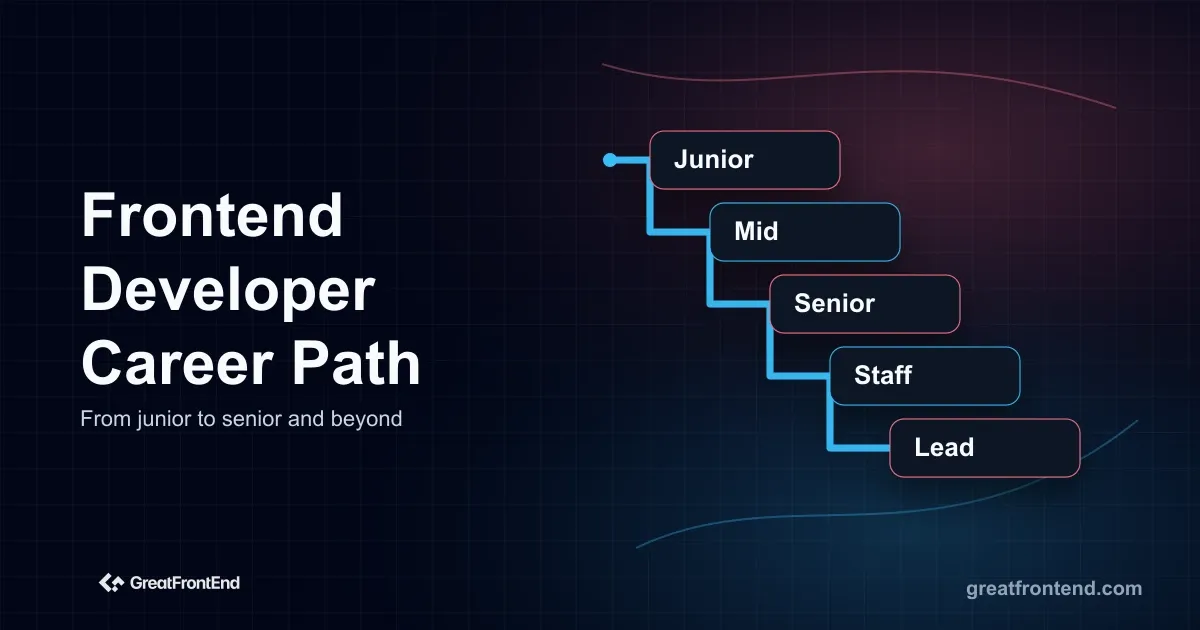 Map the frontend developer career path in 2026 from junior to mid-level, senior, staff, lead, specialist, and manager roles.
 A practical 2026 look at whether frontend development is still a good career, what changed, and what skills make the path worth choosing.