How to Evaluate a Tech Job Offer in India: CTC, Perks and What to Watch (2026)
Evaluate a tech job offer in India by separating fixed pay, variable, PF, gratuity, RSUs, ESOPs, insurance, notice period, tax, role quality, and risk.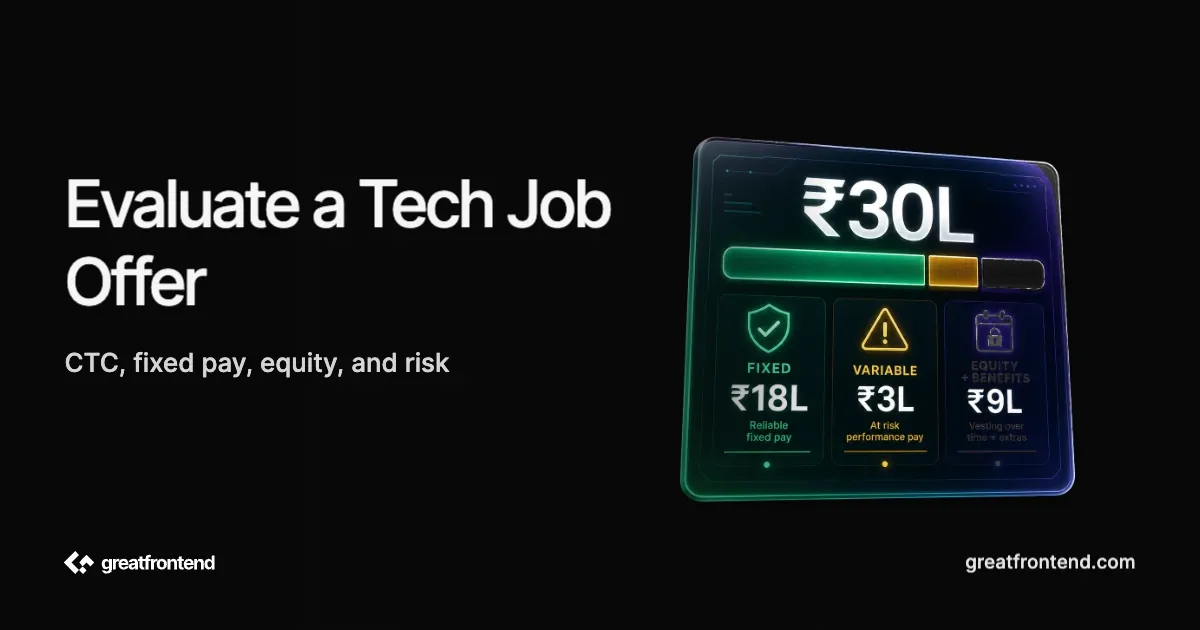
To evaluate a tech job offer in India, do not start with the headline CTC. Start with what you will actually receive, what is conditional, what can disappear, and what the role will do for your next two years.
CTC can include fixed salary, employer PF, gratuity, variable bonus, insurance, reimbursements, joining bonus, retention bonus, RSUs, ESOPs, and benefits. Some of those are cash. Some are deferred. Some are conditional. Some are useful but should not be treated as salary.
Use the EPFO employee resources and the Income Tax Department for official PF and tax references. This guide helps you ask sharper questions; it is not personal financial or tax advice.
Compare five numbers, not one CTC
Write these five numbers before deciding:
| Number | What it tells you |
|---|---|
| Fixed annual gross | Predictable salary before employee deductions and tax |
| Monthly in-hand estimate | Cash flow after tax, PF, professional tax where applicable, and other deductions |
| First-year likely cash | Fixed pay plus likely bonus plus one-time joining bonus if payable |
| Recurring likely annual cash | What year two looks like after one-time items disappear |
| Risk-adjusted upside | Equity, variable bonus, refreshers, and benefits after conditions |
The mistake is treating INR 30 LPA CTC as one number. A fixed-heavy INR 24 LPA offer can be better than a INR 30 LPA offer if the larger offer hides a large variable component, illiquid ESOPs, or a joining bonus with a long clawback.
Break the offer into certainty buckets
Ask the recruiter for a written breakup and place each line item into a bucket.
| Bucket | Examples | How to count it |
|---|---|---|
| Guaranteed cash | Fixed salary, fixed allowances | Core comparison number |
| Payroll deducted | Employee PF, tax, professional tax | Reduces in-hand but may build long-term benefits |
| Employer cost | Employer PF, gratuity, insurance premium | Part of CTC, but not monthly take-home |
| Conditional cash | Variable bonus, performance bonus | Count only after understanding payout history |
| One-time cash | Joining bonus, relocation, retention | Separate from recurring compensation |
| Equity upside | RSUs, ESOPs, options | Value depends on vesting, tax, liquidity, and market |
| Useful benefits | Insurance, learning budget, meals, device | Valuable, but not the same as salary |
If the company cannot explain the breakup clearly, do not rush to resign from your current role. Clarity is part of the offer.
Understand the India-specific line items
Indian tech offers often use compensation words loosely. Ask what each one means in writing.
| Component | What to verify |
|---|---|
| Basic salary | Whether PF, gratuity, HRA, and some allowances depend on this number |
| HRA | Whether it is part of fixed pay and whether it matters under your tax setup |
| Employer PF | Whether it is included inside CTC or paid separately |
| Employee PF | Monthly deduction from salary |
| Gratuity | Whether it is shown in CTC and the service and separation conditions under the applicable law and company policy |
| Variable pay | Target amount, eligibility, prorating, company multiplier, payout history |
| Joining bonus | Payment date, tax treatment, and clawback period |
| Insurance | Coverage amount, parents/spouse/children, exclusions, top-up options |
| Notice period | Buyout support, probation terms, and what happens if joining is delayed |
Do not let a recruiter answer only with "standard as per policy." Ask for the policy or offer-letter clause.
Work through a real comparison
Suppose you are comparing three hypothetical frontend offers:
| Detail | Offer A: startup | Offer B: product company | Offer C: remote services |
|---|---|---|---|
| Headline CTC | INR 28 LPA | INR 24 LPA | INR 22 LPA |
| Fixed annual gross | INR 18 LPA | INR 22 LPA | INR 21 LPA |
| Variable | INR 3 LPA | INR 1 LPA | INR 0 |
| Joining bonus | INR 2 LPA | INR 0 | INR 1 LPA |
| Equity | INR 5 LPA ESOPs | INR 1 LPA RSUs | INR 0 |
| Work mode | Bengaluru office | Hybrid | Remote |
| First project | Unclear | Design-system migration | Client dashboard |
Offer A has the biggest CTC, but the fixed pay is lower and the equity may be illiquid. Offer B has the strongest recurring cash and clearer frontend scope. Offer C has lower CTC but may produce better monthly savings if remote work cuts rent, commute, and relocation cost.
The decision is not automatic. If you want startup upside and can handle risk, Offer A may fit. If you want stable cash and stronger frontend platform work, Offer B may be better. If remote flexibility is important and the client work is technically solid, Offer C can be rational.
The point is simple: compare cash, risk, role, and life cost together.
Treat equity as upside, not guaranteed salary
RSUs and ESOPs are not the same.
| Equity type | Questions to ask |
|---|---|
| Public-company RSUs | Grant value, vesting schedule, refreshers, tax timing, current stock price |
| Startup ESOPs | Strike price, number of options, latest fair market value, exercise window |
| Private-company RSUs/options | Liquidity history, buyback policy, dilution, leaving-company rules |
For ESOPs, ask for numbers, not only a rupee value. You need the number of options, strike price, vesting schedule, exercise window after leaving, and whether the company has had buybacks. A recruiter saying "worth INR 5 lakh" is not enough.
Evaluate the role separately from the money
A good offer can still be a bad career move if the role is weak. For frontend engineers, ask about ownership, review quality, codebase health, design partnership, and release process.
| Signal | Ask this question |
|---|---|
| Frontend ownership | Will I own product UI, platform work, design system, performance, or support? |
| Manager quality | How will my manager evaluate growth in the first six months? |
| Code health | What testing, design review, and release practices does the team use? |
| Learning path | What would make me successful at this level? |
| Team stability | Who is on the team, and how long have people stayed? |
| Work mode | What is written policy versus informal expectation? |
If you cannot speak to the future manager before accepting, that is a risk. The manager often matters more than the brand.
Ask compensation questions directly
Use clear questions. Do not apologize for asking normal offer questions.
- What is the fixed annual gross compensation?
- Is employer PF included in the quoted CTC?
- Is gratuity included in the quoted CTC?
- What part is variable, and what was the payout range in the last two cycles?
- Is there a joining bonus, and what is the clawback period?
- Are equity terms written as RSUs, ESOPs, or options?
- What is the vesting schedule and what happens if I leave before vesting?
- What level is the offer mapped to?
- When is the first compensation or performance review?
- Is the work mode written in the offer letter or policy?
If the company avoids basic compensation questions, treat that as signal about how transparent they will be after you join.
Negotiate one meaningful change
Do not negotiate every line item. Pick the one change that affects your decision most: base salary, joining bonus, level, equity, remote policy, relocation support, or review timing.
Thank you for the offer. I am excited about the role because [specific scope].After reviewing the offer breakup, the fixed component is the main gap for me.For this level and scope, I was expecting fixed annual pay closer to [target].Is there flexibility to improve the fixed component, or alternatively adjustjoining bonus, equity, or first review timing?
A calm, specific ask is easier to approve than "Can you increase the CTC?"
Red flags before accepting
Pause and ask more questions if you see any of these:
- The company will not share a written breakup.
- The offer counts high variable pay as if it were guaranteed.
- ESOP value is quoted without strike price, vesting, exercise window, or liquidity history.
- Joining bonus has a long clawback and unclear repayment terms.
- The role title changed between interviews and offer letter.
- The manager or team assignment is still unknown.
- The company pressures you to resign before sending a complete offer.
- Work mode is promised verbally but not reflected in policy.
- The first project sounds very different from the interview scope.
Red flags do not always mean reject. They mean slow down and get written answers.
Final decision worksheet
Before accepting, write one page with these fields:
| Field | Your note |
|---|---|
| Fixed annual gross | |
| Monthly in-hand estimate | |
| One-time items | Joining bonus, relocation, retention, clawbacks |
| Variable risk | Target, payout history, eligibility |
| Equity upside | Type, vesting, liquidity, tax timing |
| Role quality | Manager, team, codebase, first project, growth path |
| Life cost | City, commute, remote policy, relocation, family needs |
| Regret risk | The reason you might wish you had chosen differently |
| Negotiation ask | The one change that would improve the decision |
If you cannot fill the worksheet, you do not understand the offer yet.
Common questions
Is CTC the same as take-home pay?
No. CTC is the company's total cost. Take-home depends on fixed pay, tax regime, employee deductions, PF, professional tax, reimbursements, bonus timing, and how the offer is structured.
Should you trust salary websites?
Use salary sites as directional inputs, not truth. Public ranges vary by title, level, company, location, sample size, and whether the number is base pay or total compensation. Use multiple sources, then compare them with the actual offer breakup.
Is a lower CTC ever better?
Yes. A lower CTC can be better if it has higher fixed pay, lower risk, better role scope, stronger manager signal, remote savings, or more useful experience for the next role.
What is the safest negotiation ask?
The safest ask is specific and tied to the offer: improve fixed pay, add joining bonus, clarify level, adjust equity, confirm remote policy, support relocation, or set an earlier review. Avoid vague pressure.
Before you accept the offer
Do not decide from the headline CTC. Decide from a written comparison you can explain to someone else.
At minimum, you should know:
- What you will reliably receive every month.
- What is variable, conditional, delayed, or one-time.
- What you might have to repay if you leave early.
- What the equity is, how it vests, and whether it has a realistic liquidity path.
- Who your manager is and what work you will likely do first.
- What single negotiation ask would improve the decision most.
A good offer decision is not the highest CTC. It is the clearest tradeoff between cash certainty, role quality, risk, and future options.
Related articles
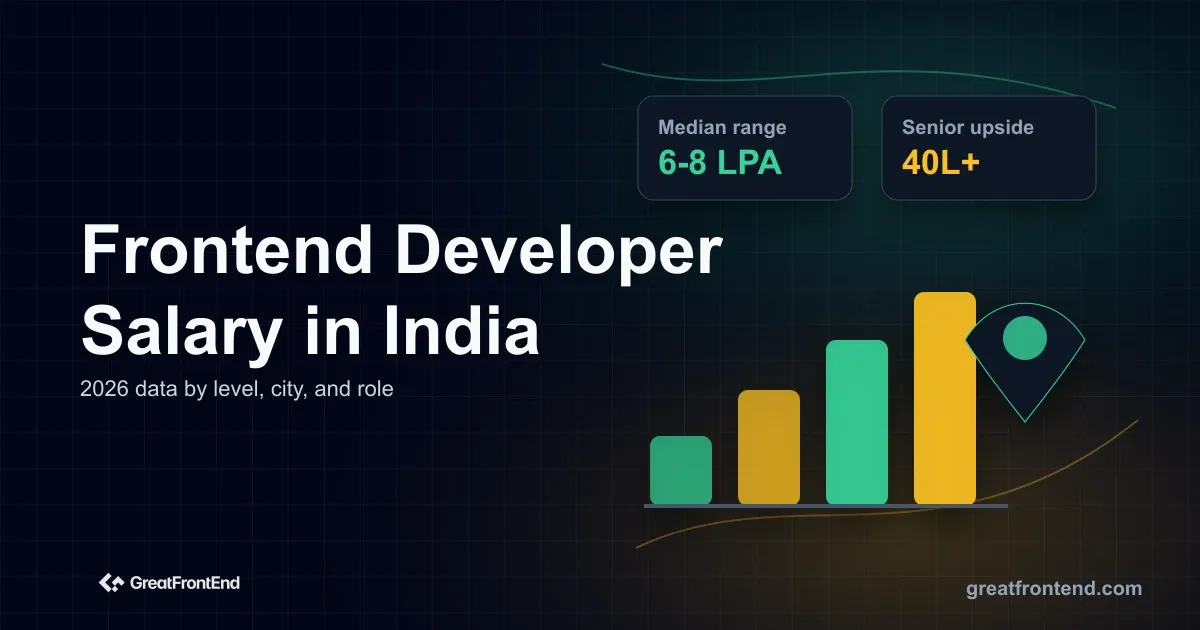 A 2026 India frontend developer salary guide using Glassdoor, PayScale, Indeed, NodeFlair, Adecco, and AmbitionBox data with caveats by level, city, and employer type.
 Discover the best medium-sized tech companies for a great career as a Front End Engineer.
 Learn how to find remote frontend developer jobs in 2026, evaluate good roles, prepare your portfolio, and prove you can work well remotely.