Senior Frontend Developer Resume: What to Emphasize at 5+ Years (2026)
Write a senior frontend developer resume that proves architecture scope, product judgment, performance, accessibility, design-system work, mentoring, and delivery risk ownership.
A senior frontend developer resume should make your level obvious without forcing the reader to count years. At 5+ years, the question is no longer "Can this person build React screens?" It is "Can this person own frontend problems with ambiguity, tradeoffs, other teams, production risk, and long-term maintainability?"
That means a senior resume needs different evidence from a junior or mid-level resume. It should show scope, judgment, risk reduction, technical direction, product context, and influence through other people or shared systems.
If you need the all-level version first, read How to Write a Frontend Developer Resume. This article is specifically for senior frontend engineers, senior UI engineers, frontend platform engineers, design-system engineers, and senior product engineers whose work touches the frontend deeply.
What changes at senior level
The senior resume is not a longer mid-level resume. The strongest bullets shift from implementation output to ownership quality.
| Mid-level signal | Senior signal |
|---|---|
| Built a feature | Owned a product flow, migration, system, or quality bar |
| Used React and TypeScript | Chose component, state, routing, and API boundaries under constraints |
| Fixed bugs | Reduced a recurring class of regressions |
| Improved performance | Diagnosed bottlenecks, chose tradeoffs, measured impact, prevented regression |
| Collaborated with design and backend | Aligned design, backend, product, QA, and support before release |
| Mentored juniors | Created review habits, docs, pairing patterns, or migration guides |
| Created reusable components | Drove adoption of a component API across product areas |
| Worked on accessibility | Established keyboard, semantics, focus, and release checks for risky flows |
The U.S. Bureau of Labor Statistics software developer profile describes software developers as people who analyze users' needs, design software, ensure software functions through maintenance and testing, document systems, and work on teams. For senior frontend developers, your resume should show those responsibilities through browser-facing systems: UI architecture, interaction quality, performance, accessibility, and release safety.
Choose your senior frontend lane
Senior frontend roles are not interchangeable. A resume for a design-system role should not lead with the same proof as a resume for a product UI or frontend platform role.
| Senior lane | Lead with | Weak lead |
|---|---|---|
| Senior product frontend | End-to-end flows, product tradeoffs, async state, release coordination | Component snippets with no product context |
| Design-system engineer | Component APIs, accessibility, tokens, docs, migration, adoption | A gallery of unrelated components |
| Frontend platform engineer | Build tooling, test reliability, shared patterns, migration paths | Individual UI features only |
| Performance-focused frontend | LCP, INP, CLS, profiling, bundle strategy, render cost, monitoring | "Optimized app" without diagnosis or verification |
| Accessibility-focused frontend | Semantics, keyboard support, focus recovery, accessible names, review gates | Color contrast only |
| Staff-leaning frontend engineer | Cross-team architecture, standards, technical strategy, incident prevention | One-team delivery with no wider influence |
| Senior full-stack with frontend | Frontend ownership plus API contracts, data modeling, observability, release | Backend-heavy bullets with frontend reduced to "built UI" |
Your summary should name the lane and the proof.
| Weak senior summary | Stronger senior summary |
|---|---|
| Senior frontend developer with 7 years of experience | Senior frontend engineer owning React product flows, typed component APIs, and performance work for data-heavy dashboards |
| React and TypeScript developer with leadership skills | Senior UI engineer leading checkout and account flows across design, backend, QA, and release coordination |
| Experienced frontend developer focused on clean code | Frontend platform engineer reducing duplicated app patterns through shared state, testing, and migration tooling |
| Senior developer with design-system experience | Design-system engineer driving accessible component APIs, documentation, and adoption across product squads |
Use a senior bullet formula
Senior bullets should show what changed because you owned the problem.
Owned [scope] under [constraint/risk],chose [technical/product direction],and produced [measured or observable result].
Or, for leadership and influence:
Created [artifact/system/review habit] that helped [team/users]make [decision/action] more reliably across [scope].
Good senior bullets usually include:
- Scope: product area, flow, system, team count, component set, migration size, user segment.
- Constraint: compatibility, performance, accessibility, deadlines, legacy code, API changes, risk of regression.
- Decision: architecture, state model, component API, rollout, testing approach, monitoring, documentation.
- Result: adoption, fewer regressions, faster release, lower render cost, better conversion, clearer ownership, reduced support.
Senior bullet examples
| Weak bullet | Stronger senior bullet |
|---|---|
| Led frontend development | Led checkout settings refactor across web, design, backend, and QA, preserving URL contracts while replacing duplicated form state |
| Worked on app architecture | Split dashboard state into URL filters, server data, and local UI state so users could share views and refresh without losing context |
| Improved performance | Reduced slow table interactions by profiling render cost, virtualizing long lists, and moving expensive derived data behind memoized inputs |
| Built design system | Owned Dialog, FormField, and Toast APIs with focus behavior, error states, docs, and migration examples used by three product teams |
| Mentored developers | Turned repeated review feedback on forms, loading states, and accessibility into a checklist used during frontend code review |
| Improved accessibility | Standardized modal focus return, keyboard escape behavior, accessible labels, and error announcements after regressions in account flows |
| Reduced bugs | Removed a class of stale async-result bugs by introducing request cancellation and response-ordering guards for search and filtering screens |
| Coordinated migration | Migrated shared table actions behind a compatibility wrapper, enabling gradual adoption without blocking active feature work |
Notice what these bullets do: they show judgment. They name the problem shape, the technical decision, and the operational result.
Show architecture without writing a design doc
A senior resume should not explain your whole system. It should expose the decisions an interviewer will want to discuss.
Useful architecture proof includes:
| Architecture area | Resume evidence |
|---|---|
| State ownership | URL state, server state, local UI state, derived state, optimistic state, persisted draft state |
| Data contracts | API versioning, typed responses, pagination, stale responses, partial failures, permission boundaries |
| Component APIs | controlled/uncontrolled behavior, composition, variants, accessibility, adoption constraints |
| Routing | shareable filters, deep links, auth redirects, route ownership, backward compatibility |
| Migration strategy | compatibility wrapper, staged rollout, codemod, review checklist, deprecation plan |
| Quality gates | component tests, visual checks, accessibility checks, monitoring, rollback plan |
| Design collaboration | design tokens, Figma parity, component specs, release QA, edge-state review |
React's official Thinking in React guide frames UI work around component hierarchy, visual states, data flow, minimal state, and state location. Senior bullets should show how you applied those ideas under production constraints instead of repeating them as theory.
Make performance claims credible
"Improved performance" is one of the easiest senior claims to weaken. A credible performance bullet names the user pain, the measurement, the bottleneck, the fix, and the tradeoff.
Use current web performance language:
| Performance claim type | Strong evidence |
|---|---|
| Loading | LCP, image priority, font loading, render-blocking resources, server response, route-level bundles |
| Interactivity | INP, long tasks, expensive renders, unnecessary re-renders, input delay, hydration cost |
| Visual stability | CLS, reserved image dimensions, ad/embed shifts, skeleton layout, async content placement |
| Runtime UI | table virtualization, memoized derived data, debounced search, worker offload, chart rendering |
| Monitoring | field data, real-user monitoring, alerting, dashboards, regression checks |
Google's Core Web Vitals currently focus on LCP, INP, and CLS. If you mention those metrics, be prepared to explain whether you used lab tools, field data, or both. If the metric is private, anonymize the number or describe the verified direction without leaking confidential details.
Weak:
Improved dashboard performance.
Strong:
Reduced slow dashboard interactions by profiling long render paths, virtualizing 1,000+ row tables, and moving expensive derived filters out of keystroke updates.
Even without a public metric, the second bullet creates a real interview path.
Make accessibility senior-level
Accessibility is not a decoration line. At senior level, it should show interaction ownership.
The WAI-ARIA Authoring Practices Guide emphasizes accessible semantics, common widget patterns, functional examples, keyboard support, and accessible names. Translate that into resume evidence:
| Accessibility area | Resume evidence |
|---|---|
| Forms | labels, instructions, validation, error identification, error announcement |
| Modal dialogs | initial focus, Tab contained within the dialog, focus return, escape behavior, accessible name |
| Tabs and menus | keyboard navigation, selected/active/disabled states, semantics |
| Async UI | loading announcements, status messages, retry paths, preserved focus |
| Design system | accessible defaults, usage docs, review checks, examples, testing notes |
| Release process | keyboard QA checklist, screen reader smoke checks, regression notes |
Weak:
Improved accessibility across the app.
Strong:
Standardized dialog and form accessibility across account flows, documenting focus return, keyboard escape behavior, labels, error messages, and release checks.
Prove design-system work through adoption
Senior design-system work is not "built buttons." It is API design, quality, migration, and adoption.
| Design-system proof | Strong resume detail |
|---|---|
| Component API | controlled props, composition model, variants, disabled/loading/error states |
| Accessibility | keyboard behavior, focus management, semantic defaults, labelled examples |
| Documentation | usage guidance, do/don't examples, migration notes, design token mapping |
| Adoption | teams or product areas migrated, duplicate patterns removed, compatibility support |
| Governance | review checklist, contribution model, release notes, versioning, deprecation process |
| Quality | visual regression, component tests, Storybook examples, accessibility checks |
Better bullet:
Owned shared Dialog and FormField APIs across three product areas, adding accessibility defaults, usage docs, migration examples, and review checks that reduced repeated implementation drift.
Translate leadership into artifacts
"Mentored juniors" is weak because it tells the reviewer nothing about how your influence scaled. Senior leadership is easier to believe when it left artifacts.
| Leadership claim | Stronger evidence |
|---|---|
| Mentored engineers | pairing plan, review checklist, onboarding guide, repeated feedback turned into docs |
| Led a project | RFC, migration plan, rollout stages, risk log, stakeholder alignment, release checklist |
| Improved code quality | lint rule, shared pattern, test helper, component API, refactor guide |
| Raised team standards | accessibility checklist, performance budget, PR template, design QA routine |
| Cross-team influence | adopted by multiple squads, shared in engineering forum, used in release process |
Strong:
Created a frontend review checklist for forms, async states, accessibility, and mobile layouts that converted repeated senior review comments into reusable team guidance.
This says more than "excellent communication skills."
Handle confidential metrics
Senior work often has private numbers. You can still write useful bullets without exposing sensitive data.
| Confidential detail | Safer resume version |
|---|---|
| Revenue or conversion | "improved checkout completion for a high-traffic purchase flow" |
| Exact customer count | "used by enterprise customers" or "used by internal support teams daily" |
| Private incident details | "after a production regression in account settings" |
| Internal project codename | "dashboard migration," "billing workflow," "content review tool" |
| Proprietary architecture | "split server state, URL state, and local UI state" without exposing implementation |
| Exact performance number | "reduced interaction delay after profiling render cost" if the number is not public |
Do not make the bullet so anonymized that it becomes meaningless. Keep the shape of the problem visible.
Senior resume structure
Most senior frontend resumes can be one or two pages. Two pages are fine when the second page contains real scope, not old task lists.
NameCity | email | phone | LinkedIn | GitHub | Portfolio or selected writingSenior frontend engineer focused on [lane], with experience owning [scope],[architecture/performance/accessibility/design-system signal], and cross-team delivery.Selected Impact- Owned [largest or most relevant senior proof].- Drove [system, migration, performance, accessibility, design-system, or platform result].- Created [artifact/process] adopted by [team/product area].ExperienceCompany, Senior Frontend Engineer, Month Year - Present- Owned [product/system scope] under [constraint], choosing [technical direction] and producing [result].- Reduced [risk/friction/regression class] by [architecture/testing/documentation/release decision].- Led [cross-functional/cross-team work] across [design/backend/QA/product/support], preserving [contract/quality].Company, Frontend Engineer, Month Year - Month Year- Show progression from feature ownership to system ownership.- Keep older bullets shorter unless they still support the target senior lane.SkillsFrontend: TypeScript, React, Next.js, HTML, CSSArchitecture: state modeling, component APIs, routing, async data, performanceQuality: Playwright, React Testing Library, accessibility checks, monitoringCollaboration: RFCs, design-system docs, technical mentoring, release planning
Use a "Selected Impact" section only if it helps the top third of the resume. If it repeats the first experience bullets, skip it.
Downleveling red flags
These patterns can make a senior resume read mid-level:
- Every bullet starts with "built" and describes isolated features.
- The resume lists React, TypeScript, CSS, Redux, GraphQL, and testing but never shows decisions.
- Leadership is described only as "mentored juniors" or "collaborated with teams."
- Performance, accessibility, and reliability claims have no measurement, behavior, or process.
- Design-system work lists components but not API choices, docs, adoption, or migration.
- The summary says "5+ years" but the bullets do not show increased scope.
- Older roles take as much space as the most senior work.
- Tools appear in skills with no corresponding experience.
If the resume could describe a mid-level feature contributor, add ownership, constraint, and result.
Tailor for senior roles
Senior tailoring is not keyword stuffing. It is choosing the right senior proof for the company problem.
| Job description signal | Move up | Rewrite around |
|---|---|---|
| "Design systems" | Component API, tokens, docs, adoption, accessibility | migration, governance, usage examples, review process |
| "Performance" | LCP/INP/CLS, profiling, bundle work, runtime UI | measurement, bottleneck, fix, tradeoff, monitoring |
| "Highly collaborative product team" | Cross-functional flow ownership | design/backend/QA/product alignment and release decisions |
| "Data-heavy UI" | Dashboards, tables, filters, permissions, server state | URL state, pagination, stale data, virtualization, error recovery |
| "Frontend platform" | Tooling, test reliability, shared patterns, migrations | adoption, developer experience, compatibility, release safety |
| "Accessibility" | Keyboard behavior, semantics, focus recovery, design-system defaults | APG patterns, review gates, release checks |
| "Tech lead" | RFCs, cross-team migration, mentorship artifacts, risk management | decision quality, sequencing, alignment, follow-through |
Keep one master resume with all senior proof. For each application, reorder and trim.
Senior interview-test every bullet
Every senior bullet should create a real technical conversation. Before sending, ask:
- What was the original problem and why did it matter?
- What options did you consider?
- What did you choose and why?
- What tradeoff did you accept?
- How did you know it worked?
- What broke or almost broke?
- Who needed to agree?
- What would you do differently now?
If you cannot answer those questions, rewrite the bullet until it matches the work you can defend.
The final senior audit
Read the resume for 90 seconds and check:
- Does the top third show your senior frontend lane?
- Do the first three bullets prove scope, judgment, and result?
- Is there evidence beyond implementation: architecture, quality, risk, mentorship, or systems?
- Are performance and accessibility claims specific enough to be credible?
- Are design-system claims tied to adoption or quality, not only component creation?
- Does the skills section support the story instead of listing every tool?
- Are older roles compressed so recent senior work gets the space?
- Can an interviewer see what to ask you next?
A senior frontend resume should not shout "senior." It should make the reader feel the shape of the problems you can own: ambiguous, cross-functional, user-facing, measurable, and hard to keep healthy over time.
相关文章
 Learn the senior frontend developer skills that matter in 2026, from UI architecture and accessibility to performance, testing, judgment, and AI verification.
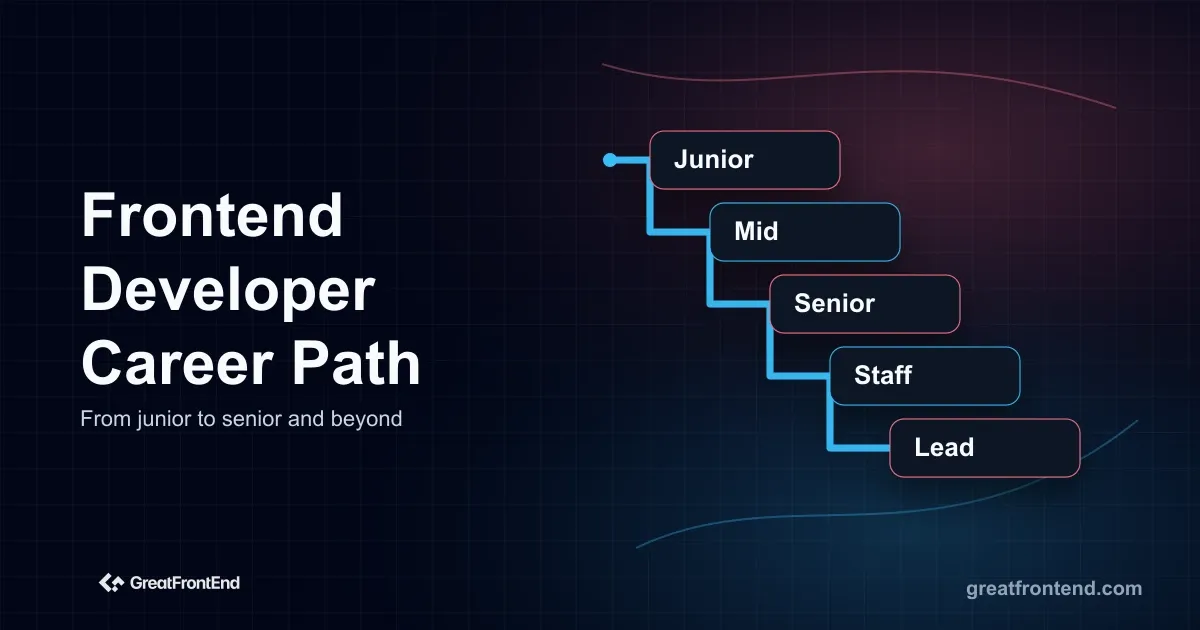 Map the frontend developer career path in 2026 from junior to mid-level, senior, staff, lead, specialist, and manager roles.
 Learn what to build for a frontend developer portfolio in 2026, how to structure case studies, and how to prove frontend skill beyond screenshots.
 A practical set of TypeScript interview questions for senior frontend developer interviews, with coding problems on generics, unions, utility types, and React TypeScript.