How to Grow as a Frontend Developer: From Junior to Senior and Beyond (2026)
Grow as a frontend developer with a practical matrix for UI craft, product judgment, reliability, influence, and a 90-day growth plan.
To grow as a frontend developer, increase the size, ambiguity, and business cost of the problems you can handle. Learning another framework can help, but growth usually comes from better UI craft, product judgment, reliability, and influence.
The path from junior to senior is not a library checklist. It is the shift from "I can implement this screen" to "I can make this user flow work correctly, help the team make the right tradeoff, and reduce the chance we repeat the same mistake."
The 2025 Stack Overflow Developer Survey shows JavaScript, HTML/CSS, TypeScript, React, and Node.js as commonly used professional tools. Framework familiarity is therefore weak evidence of seniority on its own. Promotion and interview examples need to show decisions, measurements, and user-facing failure handling.
If you are still choosing what to learn next, pair this guide with the frontend developer roadmap. If you want title expectations, read the frontend developer career path.
The direct answer
Grow by creating visible evidence in four lanes:
- UI craft: screens work across content, devices, input methods, and edge states.
- Product judgment: you ask better questions before code is written.
- Reliability: your work has tests, measurements, fallbacks, and safer release steps.
- Influence: your decisions improve the work of other engineers, designers, QA, support, or product teams.
Do not try to improve everything at once. Pick one lane per month and leave proof behind.
Growth is a scope change
Many developers think the next level means "knows more React" or "writes cleaner code." Those matter, but they are not enough.
The real question is: what can the team trust you with now that they could not trust you with before?
| Level | Typical scope | What growth looks like |
|---|---|---|
| New frontend engineer | Clear tasks with known patterns | Completes screens, asks timely questions, handles obvious UI states |
| Solid mid-level | Features with some ambiguity | Owns the flow, coordinates API/design questions, catches missing states |
| Senior | Ambiguous product or platform work | Shapes the plan, names tradeoffs, protects quality, reduces future cost |
| Staff or lead | Cross-team technical direction and decision-making | Sets patterns, prevents repeated mistakes, improves how teams build UI |
This matters because "I used Next.js" is a tool claim. "I reduced failed checkout attempts by fixing validation, retry behavior, and focus recovery" is a scope claim.
Use the four-lane growth matrix
Growth stalls when one lane gets all the attention. A frontend developer who only improves visuals may struggle with data and reliability. A developer who only improves architecture may miss user friction. A developer who only ships tickets may never become trusted on ambiguous work.
| Lane | Junior signal | Senior signal | Practice this month |
|---|---|---|---|
| UI craft | Matches a mockup | Handles responsive layout, accessibility, content length, and states | Fix one form, modal, or table until edge cases are boring |
| Product judgment | Implements acceptance criteria | Spots missing cases, questions the data model, and protects user goals | Write five questions before coding a feature |
| Reliability | Fixes bugs after review | Adds tests, monitoring, fallback paths, and smaller rollout steps | Add one test or checklist that catches a repeated mistake |
| Influence | Receives feedback well | Improves reviews, docs, component APIs, and team habits | Turn one repeated review comment into shared guidance |
| Technical communication | Explains what changed | Explains why it changed, alternatives rejected, and risk | Add a short decision note to one meaningful pull request |
You do not need a promotion to behave one level higher. You need one concrete problem where you can practice the next behavior.
Make UI craft measurable
"Good UI" sounds subjective until you break it into inspectable checks.
For any important frontend flow, ask:
- Does it work on mobile, tablet, and desktop without hidden controls?
- Are loading, empty, error, invalid, unauthorized, slow, and success states handled?
- Can a keyboard user complete the flow?
- Are form labels, errors, focus order, and button states clear?
- Does long content break the layout?
- Does the URL, browser back button, and refresh behavior match user expectations?
- Does the UI recover from failed network requests?
A junior developer may build the default state. A growing developer builds the surrounding states that users actually hit.
Improve product judgment before writing code
Senior frontend work often starts before implementation. The valuable move is asking the question that avoids a week of rework.
Good frontend questions sound like this:
- What should happen when this API returns no data?
- Can two users have different permissions for the same screen?
- Should filter state live in the URL so links are shareable?
- What happens if the user refreshes after step three?
- Which error needs user action and which one should retry automatically?
- What is the simplest version we can ship without trapping ourselves?
- Which metric or support signal will tell us whether the change helped?
Product judgment is not saying no to everything. It is making the cost of choices visible early.
Grow reliability through boring checks
Frontend reliability is not only unit tests. It is the set of habits that make shipped UI less surprising.
| Reliability habit | What it catches | Example |
|---|---|---|
| State checklist | Missing loading, empty, error, permission cases | Add a review checklist for every data-backed page |
| Focus check | Broken forms, modals, menus | Verify focus moves to the first invalid field after submit |
| Small release steps | Risky rewrites | Ship a new table behind one route or user segment before replacing all use |
| Runtime measurement | Slow interactions | Measure interaction time before and after a heavy client-side change |
| Root-cause note | Repeated bugs | Write why a stale cache bug happened and how to prevent the next one |
Great frontend engineers often look calm because they create fewer surprises for everyone else.
Turn work into proof artifacts
Career growth becomes easier to evaluate when it leaves artifacts behind. Private effort is easy to forget. Visible proof helps promotion discussions, interviews, and self-review.
| Artifact | What it proves | Good example |
|---|---|---|
| Decision note | You can compare options and explain tradeoffs | Why a filter uses URL state instead of only component state |
| Debugging note | You can trace failures across UI, API, state, and browser | Root cause of a stale search-result bug |
| Review checklist | You can turn repeated mistakes into team practice | Loading/error/accessibility checklist added to frontend PRs |
| Migration plan | You can move code without stopping product work | Replacing a form library one flow at a time |
| Measured improvement | You can connect frontend work to user or developer experience | Before/after LCP, interaction delay, conversion step, or support-ticket count |
| Teaching note | You can raise team quality | Short guide explaining how your team should build modals or table filters |
One artifact per month is enough to change how your growth story reads.
A practical 90-day growth plan
Do not make a 90-day plan that says "learn advanced React." Make one that changes your behavior at work or in a serious project.
Days 1-15: pick one recurring problem
Choose a problem that has repeated cost:
- Forms keep shipping with inconsistent validation.
- Tables are slow and hard to filter.
- Modals are inaccessible.
- API state is duplicated across pages.
- Mobile layouts break near release.
- Pull requests keep missing the same edge states.
Write the current failure mode in one paragraph. Include who pays the cost: users, QA, designers, support, backend engineers, future maintainers, or your own team.
Days 16-35: study the boundary
Do not jump straight to the fix. Map the boundary:
- Which components own the state?
- Which API shape creates complexity?
- Which browser behavior is involved?
- Which tests already exist?
- Which design states are missing?
- What is the smallest reversible improvement?
This is where growth happens. You are learning to reason, not only to patch.
Days 36-65: ship a narrow improvement
Pick a change small enough to review properly:
- Add missing states to one important flow.
- Improve one slow interaction and measure it.
- Replace one duplicated pattern with a clearer component API.
- Add a checklist that prevents a recurring review issue.
- Improve one accessibility problem and document the check.
The change should be narrow, but the reasoning should be serious.
Days 66-90: write the lesson
Capture the result in a short note:
- Problem
- Options considered
- Chosen approach
- Rejected approach
- Risk
- Verification
- Follow-up
This note becomes interview material, promotion material, and future team memory.
How junior, mid-level, and senior growth differ
The same skill can mean different things at different levels.
| Area | Junior growth | Mid-level growth | Senior growth |
|---|---|---|---|
| React | Understands props, state, effects | Chooses state ownership and avoids tangled data flow | Shapes component/API boundaries for other engineers |
| CSS | Builds responsive layouts | Handles overflow, stacking, focus, and content cases | Sets patterns that reduce layout regressions across product |
| Accessibility | Adds labels and keyboard basics | Handles forms, modals, errors, focus recovery | Builds review practices and reusable accessible components |
| Performance | Avoids obvious waste | Measures slow pages and fixes real bottlenecks | Chooses architecture and rollout plans around runtime cost |
| Communication | Explains implementation | Explains tradeoffs | Helps the team choose under uncertainty |
If you are aiming for senior, do not only add harder syntax to your learning list. Add harder ownership.
Use AI without outsourcing judgment
AI tools can speed up drafts, test cases, examples, and unfamiliar API exploration. They can also create confident mistakes in frontend code: broken accessibility, invalid CSS assumptions, unnecessary abstractions, stale library usage, and code that passes the default case while failing edge states.
Use AI as a fast assistant, then verify:
- Run the code in the browser.
- Test keyboard navigation.
- Inspect responsive widths.
- Check generated dependencies and APIs against official docs.
- Write the failure states yourself.
- Ask: would I defend this in code review?
The developers who grow fastest are not the ones who paste more. They are the ones who can review faster and think better.
Build a promotion or interview packet
Keep a private document with five sections:
| Section | What to save |
|---|---|
| Shipped work | Links to PRs, demos, screenshots, tickets |
| Decisions | Notes comparing options and tradeoffs |
| Quality | Tests, checklists, metrics, incident fixes |
| Collaboration | Design/API/QA coordination, mentoring, review impact |
| Results | User impact, support reduction, speed improvement |
Update it monthly. The goal is not bragging. The goal is avoiding a blank page when you need to explain your growth.
Common traps that slow frontend growth
Trap 1: collecting frameworks instead of range
React, Vue, Svelte, and Angular are useful. But switching frameworks every month can hide weaker fundamentals: layout, accessibility, state, debugging, and product reasoning.
Trap 2: chasing senior title without senior behavior
If your work still needs someone else to define the edge cases, API questions, and rollout risk, the title will not hold up in interviews.
Trap 3: treating polish as decoration
Frontend polish is often product correctness. Focus states, copy length, empty states, and mobile controls are not visual extras. They decide whether people can use the feature.
Trap 4: avoiding messy cross-functional work
The uncomfortable conversations with design, backend, QA, product, and support are often where senior judgment is built.
Trap 5: never writing down tradeoffs
If the decision exists only in chat, it disappears. A short note can save future rework and prove how you think.
Common questions
Should I focus on depth or breadth?
Pick one main stack for depth and use breadth to improve judgment. For example, get deep enough in React and TypeScript to build serious product UI, then study browser APIs, accessibility, performance, design systems, and testing so you can reason across the full range of frontend work.
How do I grow if my current job gives me small tasks?
Turn small tasks into better artifacts. Add missing states, write clearer PR notes, improve tests, document one tradeoff, or fix a repeated accessibility issue. If the job still gives no room, create a portfolio project that mirrors the next level of scope.
What is the fastest way to look more senior?
Stop making vague claims. Bring proof: a decision note, a measured improvement, a migration plan, a bug postmortem, or a component API that other engineers used. Seniority is easier to believe when the evidence is inspectable.
How do I know what to practice next?
Look at your last three pieces of feedback. If they mention edge cases, practice state handling. If they mention confusion, practice communication. If they mention bugs, practice testing and debugging. If they mention over-engineering, practice smaller reversible decisions.
Choose the next visible upgrade
Do not end this as a private learning goal. Pick one upgrade that someone else can inspect.
Good next upgrades include:
- A form with better validation, server errors, and focus recovery.
- A slow interaction measured and improved.
- A component API that removes repeated misuse.
- A decision note that explains a tradeoff your team keeps debating.
- A review checklist that prevents the same UI bug from returning.
- A project README that explains state ownership and edge cases.
The best growth plan is not dramatic. It is one visible improvement, repeated until people trust you with wider scope.
相关文章
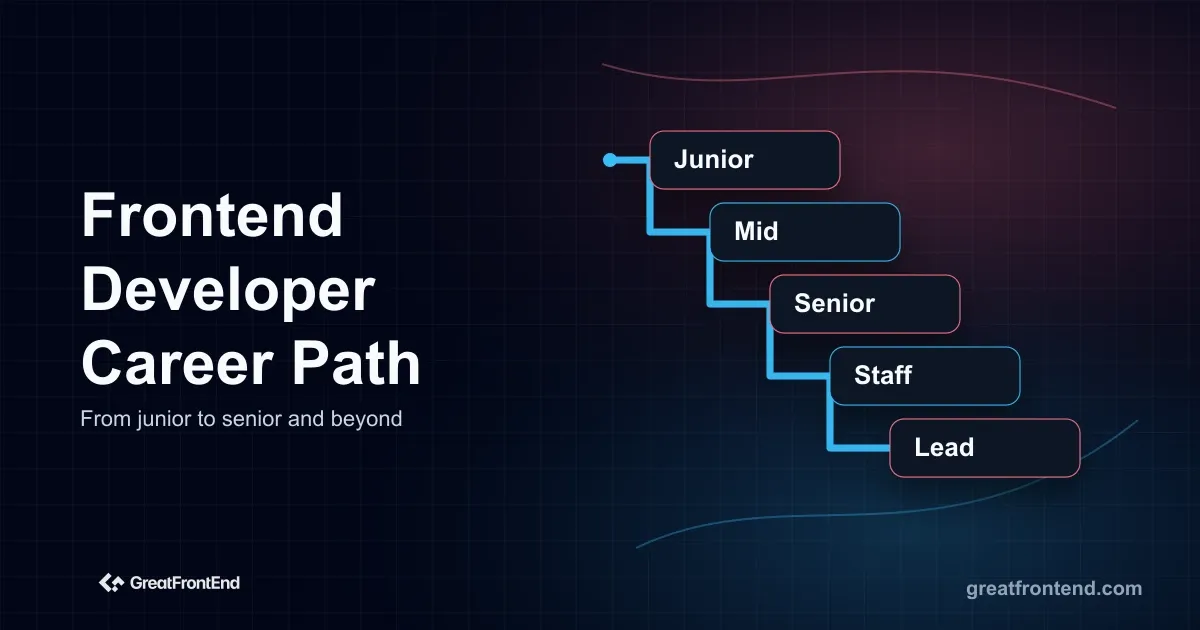 Map the frontend developer career path in 2026 from junior to mid-level, senior, staff, lead, specialist, and manager roles.
 A detailed frontend developer roadmap for 2026 covering the skills, tools, projects, milestones, and interview practice needed for modern frontend roles.
 Learn the senior frontend developer skills that matter in 2026, from UI architecture and accessibility to performance, testing, judgment, and AI verification.
 An exclusive interview with Jordan Cutler, Senior Engineer at Pinterest, on his career journey, mentorship, and strategies for professional growth.
 A practical 2026 look at whether frontend development is still a good career, what changed, and what skills make the path worth choosing.