Frontend Developer to Product Manager: How to Make the Switch
Frontend developer to product manager: the real paths in, what PM interviews test, which frontend skills transfer, and when staying an engineer is the better move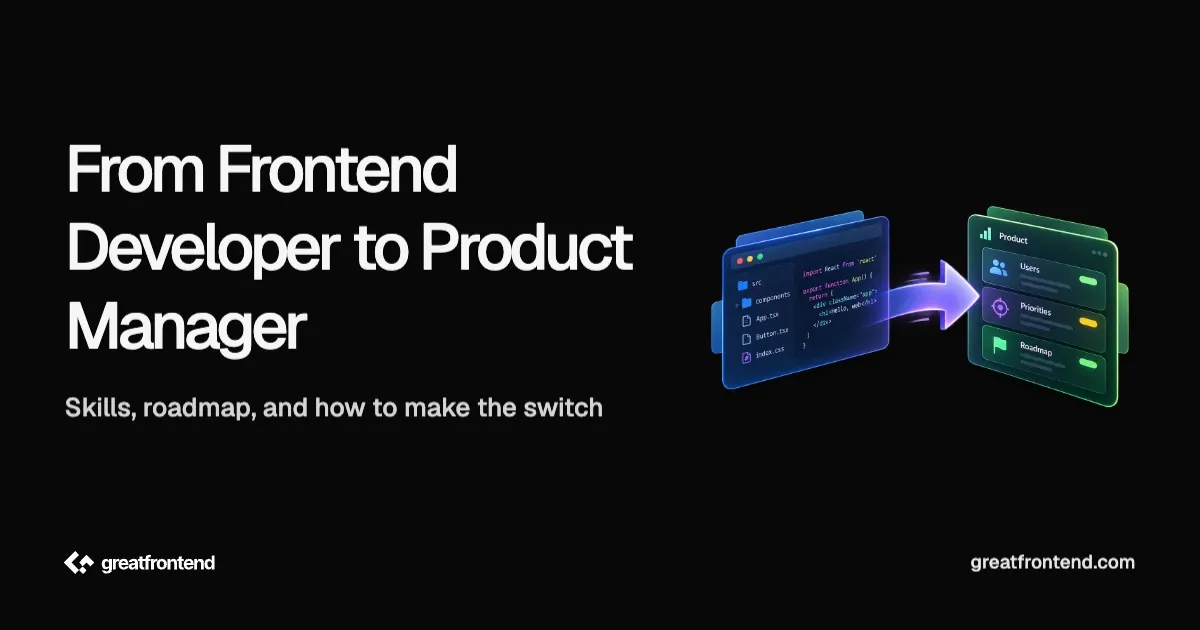
Moving from frontend developer to product manager looks like a short step from the outside. You already sit in planning meetings, you already argue about scope, and you already know what makes a feature hard to ship. The job itself is different in ways that are easy to underestimate: you stop owning how something gets built and start owning what gets built and why, usually without authority over the people building it. This guide covers how engineers actually make the move, what product manager interviews test that engineering interviews do not, which frontend skills carry over, and when staying an engineer is the better decision.
A note on sources. Most of what follows comes from people who have hired or trained product managers, and from first-person accounts of engineers who switched. There is very little hard data on engineer-to-PM transitions, so where something is one person's experience, it is labeled as such.
Is product management the right move for you?
Start here, because it is the question people skip.
Lenny Rachitsky includes a fit test in his guide on how to get into product management. His list of reasons not to become a PM includes being mainly fulfilled by building things yourself, valuing long stretches of focused work, wanting to be left alone, and disliking meetings. He also stresses that PMs lead through influence rather than authority. If those describe what you enjoy about frontend work, take that seriously before you plan a transition.
Shardul Mehta makes a related point in a 2026 essay on starting over as a PM: engineers often picture product management as building with more say, when the real change is from being a builder to being someone responsible for growing a business, with more time spent with customers than with code.
There is also a question of reversibility. One anonymous engineer on Blind wrote that they switched to PM, regretted it, and found returning to engineering much harder than leaving it. That is a single anecdote, not a pattern you can generalize from, but it is a useful prompt: before you leave engineering, ask how you would get back if the role does not fit.
Frontend developer to product manager: what actually changes in the job
The clearest description of the shift comes from Victor Kosonen, who moved from engineering to product management at Oracle NetSuite and wrote about it for Mind the Product. The hardest part for him was letting go of how something is built and owning what is built and why, including resisting the urge to over-specify requirements for the engineers who now owned the how.
In practice, that changes your week in a few concrete ways:
| As a frontend developer | As a product manager |
|---|---|
| You receive a problem, often already scoped | You decide which problem is worth solving, and say no to others |
| Success is a working, maintainable feature | Success is a change in a user or business outcome |
| You can resolve ambiguity by building a prototype | You resolve ambiguity by talking to users, data and stakeholders |
| Your output is code you can point to | Your output is decisions, documents and alignment |
| Authority comes from expertise in the codebase | Influence comes from context, clarity and trust |
Lenny's guide lists the core PM skills in his order of importance: strategic thinking, execution, communication, leading through influence, data-informed decision making, product intuition, and preparedness. Notice that only some of these are things an engineering role regularly asks you to practice.
What a frontend developer brings, and what is usually missing
Product School's guide to moving from software engineer to product manager lists strengths engineers typically bring: credibility with engineering teams, comfort with data and metrics, structured problem breakdown, and a realistic sense of how long things take. The same guide lists the common gaps: shifting from solutions to customer problems, storytelling and communication, business and go-to-market knowledge, and comfort with ambiguity.
None of the sources above write specifically about frontend engineers, so the following is our own reasoning rather than a cited finding. Frontend work does tend to put you closer to some PM concerns than other engineering roles:
- You see the user's experience directly. You implement flows, empty states and error messages, so you have opinions about where users get stuck.
- You work with design every week. Negotiating a design trade-off with a designer is a small version of the cross-functional work at the center of a PM role.
- You often own user-facing instrumentation. If you have added analytics events to a funnel, you already know what is measurable and what is not.
The gap to watch is the one Kosonen describes: frontend developers are used to resolving questions by building. A PM has to resolve them before anything gets built, often with incomplete information.
The realistic paths from engineer to PM
Lenny's guide describes four common paths into product management, and they map well onto an engineer's options.
1. An internal transfer. Lenny calls an internal move at a large company generally the easiest and quickest route. He says it needs three things to line up: a transfer process of some kind, a chance to show PM skills, and an internal PM champion, usually your future manager. Kosonen took this route, spending about a year on courses, mentoring from his team's existing PM and hackathon projects before moving. He also suggests a product owner role as a softer first step where one exists.
2. A junior PM role or associate program. Lenny describes this as likely the most common route, but limited to companies that run associate PM or internship programs. Check who a program targets before you plan around it:
- Google's Associate Product Manager program recruits through internship and university graduate applications, so it is aimed at students and recent graduates rather than working engineers.
- Meta's Rotational Product Manager program is an 18-month rotational program that, per Meta's careers page, hires people with four or more years of related experience. That makes it the more realistic of the two for an engineer a few years into their career.
3. A startup with an urgent need. Lenny's third path is joining a startup that needs product help, either as an early PM or by moving into the role after starting in another one. It rewards connections with founders and a willingness to learn the job on the fly.
4. Founding a company. Lenny's fourth path. He calls it the most work-intensive and does not recommend planning around it, though it is how he got into the role himself.
Technical and platform PM roles are worth a separate mention. Platform product managers treat internal developer platforms as products whose customers are developers, and platformengineering.org describes infrastructure and platform engineering as a common entry point into that role. For a frontend developer, the closest equivalent is often a design system or frontend platform team, where the "customers" are other engineers. That is our inference rather than a sourced pattern, but it is a reasonable place to look for a first product-shaped role.
Moving to another company directly as a PM is the path with the least evidence behind it. None of the sources here measure how often engineers are hired externally into PM roles, so treat it as possible but harder to plan for than an internal move.
How product manager interviews differ from engineering interviews
Expect a different kind of loop. The PM interview guides below describe rounds built around product judgment, analysis and communication rather than writing code.
Meta's careers blog describes the initial PM interview as covering product sense and analytical thinking, with leadership and drive added in the full loop. For Google, IGotAnOffer's Google PM interview guide, updated in September 2026, describes rounds on product vision, product analysis (including estimation and metrics), strategic insight, and leadership, plus a newer problem-space round, and notes that AI-focused roles may add AI or machine learning technical questions.
Here are example questions from those guides and from Aced's PM question list, grouped by what they test:
| Category | Example question | Source |
|---|---|---|
| Product sense | How would you improve Google Calendar for remote teams? | IGotAnOffer |
| Product sense | Design a shopping experience tailored for elderly users | Aced |
| Metrics | How do you determine success for Instagram Reels? | Aced |
| Execution | YouTube comments are up but watch time is down. What do you do? | Aced |
| Analytical | Received emails in Gmail dropped 15% last weekend. How would you investigate? | IGotAnOffer |
| Estimation | How many messages per second does Gmail receive? | IGotAnOffer |
| Strategy | How would you double YouTube's user base? | IGotAnOffer |
| Technical | Explain what cookies are to a grandmother | IGotAnOffer |
| Technical | Design the architecture for Instagram's home feed | Aced |
A frontend developer has a real advantage in some of these. The cookies question is a frontend topic explained for a non-technical audience. A product sense question about a mobile or web experience rewards someone who has shipped user-facing flows. The categories most likely to need deliberate practice are metrics, estimation and strategy, since frontend work does not typically ask you to define a success metric or size a market.
One shift worth knowing about: Aced now treats AI product management interviews as their own category, with questions on safety trade-offs, competitive positioning and shipping under uncertainty. If the role you target is AI-adjacent, prepare for those as well.
Behavioral questions matter in both tracks, and Meta's description above names leadership and drive as a full-loop focus. GreatFrontEnd's behavioral interview playbook is written for front end engineers, and much of it, such as structuring a story around a decision you drove and its outcome, carries over directly.
What the job market looks like
The PM market has recovered from its low point. Lenny's March 2026 job market report, based on TrueUp data, counts more than 7,300 open product management roles globally, the highest in more than three years, alongside more than 67,000 open engineering roles. His May 2025 report counted 688 open AI PM roles and noted that remote options were declining.
Read those numbers carefully. More open PM roles is good news, but engineering roles still outnumber them several times over in the same data, so a PM search can involve fewer openings to choose from than an engineering search at a similar level.
On pay, avoid assuming product management pays more. Self-reported Levels.fyi data for Google's product manager and software engineer ladders does not show PM paying more than software engineering at comparable levels. Sample sizes per level are small, so treat it as a sense check rather than a precise comparison.
Alternatives worth weighing first
If what pulls you toward PM is more influence over what gets built, two other moves might deliver that without leaving engineering.
Engineering management. Charity Majors argues in The Engineer/Manager Pendulum that management is a change of profession rather than a promotion, and that moving between individual contributor and manager roles over a career builds unusual breadth. It is also a people-focused change, but you stay inside engineering. GreatFrontEnd's guide to moving from frontend developer to tech lead covers a smaller step in the same direction.
The staff engineer track. Will Larson's Staff archetypes describe senior individual contributor roles, Tech Lead, Architect, Solver and Right Hand, that carry real influence over direction without moving into management. If you enjoy shaping architecture and technical strategy, GreatFrontEnd's guide on how to become a frontend architect is closer to what you want than a PM role.
A useful test: write down the three decisions you most wish you could make at work. If they are about which problems the business should solve, that points toward PM. If they are about how a system should be designed, that points toward staff or architect roles. If they are about how a team works, that points toward management.
First steps while you are still a frontend developer
You can test the role before you change jobs. These steps combine the advice in Lenny's guide and Product School's guide with practical steps any frontend developer can take:
- Watch how the PMs around you get things done. Lenny recommends observing how PMs drive outcomes without formal authority, then finding a small project to lead with a PM's support.
- Take on product work in your current role. Product School suggests shadowing a PM, gathering user feedback and volunteering for cross-functional work.
- Find your champion and learn the transfer process. Lenny's internal route depends on both, and Kosonen's move worked because he had the existing PM's support.
- Rewrite your experience as outcomes. Product School recommends describing past work in terms of user and business impact rather than tasks. "Rebuilt the checkout form" becomes "reduced checkout drop-off by fixing validation errors users kept hitting", if you have the data to support it.
- Write a spec for a feature you will build anyway. This one is our suggestion rather than a sourced recommendation: before your next feature, write a one-page document covering the problem, who has it, how you will measure success and what is out of scope. Ask your PM to critique it.
- Learn your team's analytics tool. Also our suggestion. If your product uses an analytics platform, learn to answer a simple question with it yourself, such as where users drop off in a flow you built.
Frequently asked questions
Do I need an MBA to move from engineering to product management? None of the sources here say you do. Lenny notes that associate programs increasingly draw MBA graduates but that an MBA is not necessary.
Is a technical PM role easier to get as an engineer? It can be a more natural first step, because your engineering depth is part of the job rather than a side benefit. Platform and developer-facing product roles are the clearest examples. The trade-off is that you may spend more time on technical decisions than on customer discovery, so check that it is the change you actually want.
How long does the switch take? There is no reliable data on this. Kosonen describes about a year of preparation before his internal move. Treat that as one person's timeline, not a benchmark.
Can I go back to engineering if PM does not work out? Possibly, but plan as if it might be harder than leaving. The Blind post above is one engineer's account of finding the return difficult, and your frontend skills will need active maintenance if you are not writing code day to day.
Conclusion
The move from frontend developer to product manager is less about learning new tools and more about changing what you are responsible for: from how something works to whether it should exist and how you will know it succeeded. Lenny calls an internal move with a PM champion the easiest and quickest route, and for programs, check that you target ones aimed at experienced hires rather than new graduates. Before you commit, test it inside your current job by owning a spec, a metric and a user conversation, and weigh it honestly against engineering management and the staff track. If the work you most want to do is deciding which problems matter, product management is worth pursuing. If it is designing how systems work, the better path may still be in engineering.
相关文章
 Move from frontend developer to tech lead with a practical frontend playbook for technical direction, reviews, planning, mentoring, and promotion evidence.
 Learn how to become a frontend architect by building architecture decision records, frontend platform standards, design-system governance, performance budgets, accessibility reviews, and rollout plans.
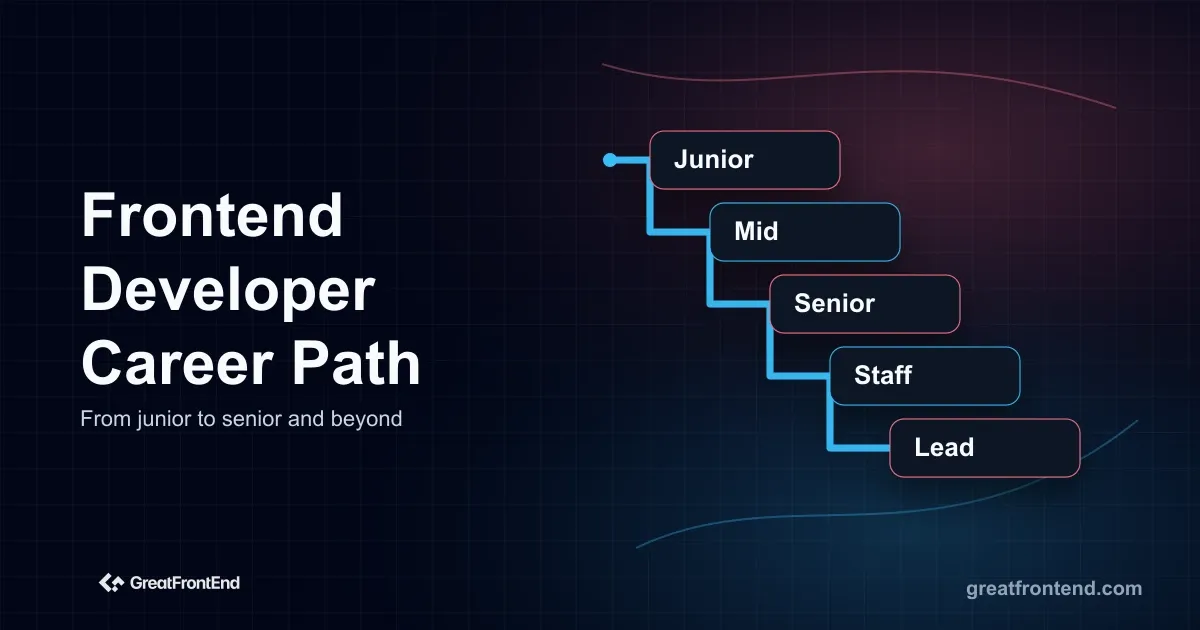 Map the frontend developer career path in 2026 from junior to mid-level, senior, staff, lead, specialist, and manager roles.