Frontend Developer Salary in India 2026: What to Expect at Every Level
A 2026 India frontend developer salary guide using Glassdoor, PayScale, Indeed, NodeFlair, Adecco, and AmbitionBox data with caveats by level, city, and employer type.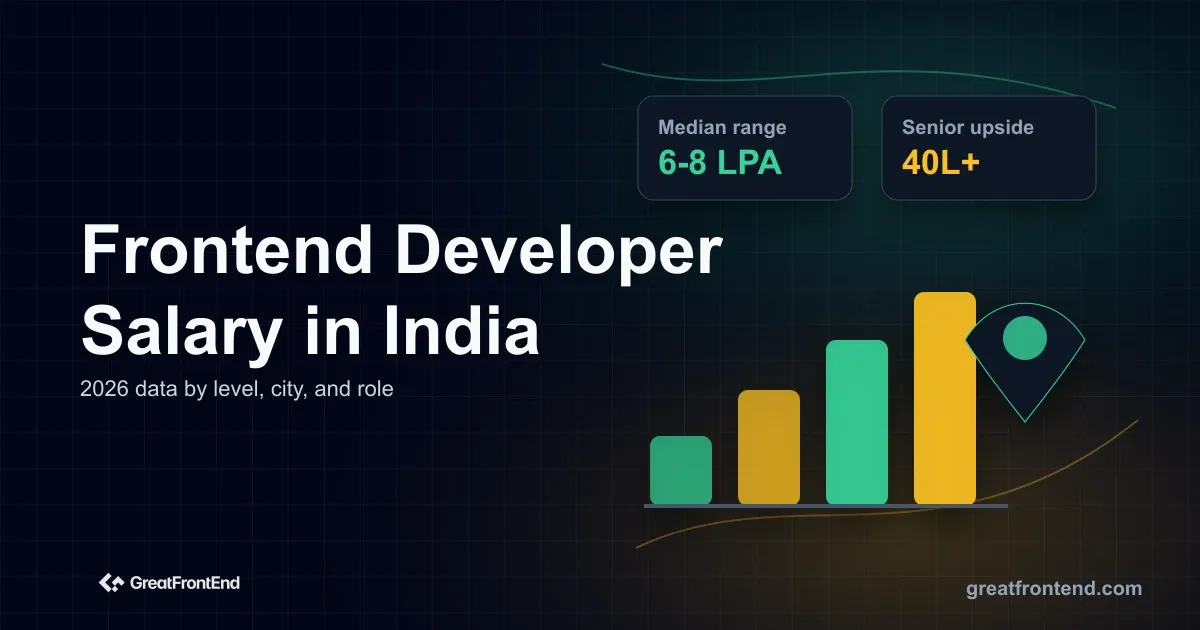
In India, a typical frontend developer salary in 2026 sits around Rs 6.4-7.5 LPA in broad self-reported datasets, but product companies, GCCs, and senior roles can pay much higher. Treat averages as a starting point, not your ceiling.
Salary data is messy because every site measures a different slice of the market. Some report base pay, some total pay, some job listings, and some self-reported profiles.
2026 salary data comparison
| Source | Latest accessible data | What it says | Caveat |
|---|---|---|---|
| Glassdoor India | Updated May 9, 2026, 4.1K salary submissions | Median total pay around Rs 6.4 LPA, with a reported range around Rs 4.49-10.2 LPA and 90th percentile around Rs 18.67 LPA | Self-reported and title-dependent |
| PayScale India | Updated May 14, 2026, 927 profiles | Average base salary Rs 6.57 LPA, base range around Rs 2.91-20 LPA | Base salary focus; sample skews by profile submissions |
| Indeed India | Updated May 8, 2026, 205 salary reports | Average base salary around Rs 6.86 LPA, with higher city and company examples | Smaller sample and listing/reporting mix |
| NodeFlair India | Updated June 8, 2026 | Median base salary Rs 62,500 per month, or about Rs 7.5 LPA; range Rs 37,500-1,87,500 per month | Mixes verified salaries and curated job listings |
| Adecco India Salary Guide 2026 | 2026 guide | Front-end developer bands from about Rs 5-10 LPA at 0-3 years to about Rs 40-73 LPA at 15+ years | Recruiter/employer guide, not a self-reported salary dataset |
| AmbitionBox | Latest accessible frontend software developer result was updated in 2025 | Historical context showed roughly Rs 2-16 LPA for less than 1 year to 4 years | Treat as 2025 context unless the page refreshes with 2026 data |
For early-career roles, Rs 6-8 LPA is a reasonable broad-market midpoint. Strong product companies, GCCs, funded startups, and senior specialist roles can move much higher.
How much to trust each source
The sources are useful, but none of them should be treated as a perfect salary truth.
Glassdoor and PayScale are good broad-market anchors because they have salary-profile samples and publish clear ranges. They are weaker for top-of-market product roles because titles and seniority can be inconsistent.
Indeed is useful for live market signals because it connects salaries, job postings, cities, and companies. Its current average is based on a smaller sample than Glassdoor, so use it to compare patterns rather than as the final number.
NodeFlair is useful because it presents monthly base salary and current job-listing context. The caveat is that recently submitted salaries may lag behind the page update date, so the salary range should be treated as a directional benchmark.
Adecco is useful as an employer-side salary guide. It is especially helpful for experience bands, but it is not a self-reported employee salary database.
AmbitionBox is useful for India-specific company and title context. For this article, the latest accessible frontend software developer result is still 2025, so it should support historical context only, not the headline 2026 number.
Why salary averages differ
Glassdoor, PayScale, Indeed, NodeFlair, Adecco, and AmbitionBox are not measuring the same thing.
The biggest differences are:
- Base salary versus total pay or CTC
- Self-reported salary versus job-posted salary
- Frontend developer versus frontend engineer versus UI developer titles
- Service companies versus product companies
- Metro cities versus smaller markets
- Junior-heavy samples versus senior-heavy samples
- Cash compensation versus bonus, stock, and benefits
Two developers with the same title can see very different numbers. A frontend developer building marketing pages at a services firm and a frontend engineer owning a high-traffic product surface at a GCC are both "frontend developers" in salary databases. They are not the same market profile.
Salary by experience level
Use these bands as a practical reading of the 2026 market, not as guaranteed offers.
| Experience | Broad-market expectation | Product company or GCC upside | What usually changes pay |
|---|---|---|---|
| 0-2 years | Rs 3-7 LPA | Rs 5-10 LPA | Web foundations, React basics, TypeScript, portfolio quality, internships |
| 2-5 years | Rs 6-14 LPA | Rs 10-22 LPA | Owning features, API integration, testing, performance awareness |
| 5-8 years | Rs 12-24 LPA | Rs 18-40 LPA | UI architecture, design systems, accessibility, mentoring, delivery judgment |
| 8-12 years | Rs 20-35 LPA | Rs 32-60 LPA | Leading frontend scope, cross-team decisions, performance and reliability ownership |
| 12+ years | Rs 30-50+ LPA | Rs 45-75+ LPA | Staff, principal, lead, architect, or manager scope; company type matters heavily |
The jump from mid-level to senior is where frontend pay starts to diverge. Years alone do not create the jump. Scope does.
Salary by employer type
Employer type often matters more than the title.
| Employer type | Typical pattern |
|---|---|
| IT services firms | More structured bands, slower compensation growth, title inflation possible |
| Indian product startups | Higher upside when the company is funded and frontend is core to the product |
| GCCs and multinational product teams | Stronger pay for engineers who meet a higher interview bar |
| Agencies | Wide range; depends on client quality and technical depth |
| Early-stage startups | Cash may be lower or uneven, but scope can be high |
| Large consumer internet companies | Strong pay for complex UI, performance, and product ownership |
If you are comparing two offers, do not stop at CTC. Ask what the frontend team owns. A lower-looking offer can be better if the work builds stronger experience, but only if compensation, mentorship, and company quality are still reasonable.
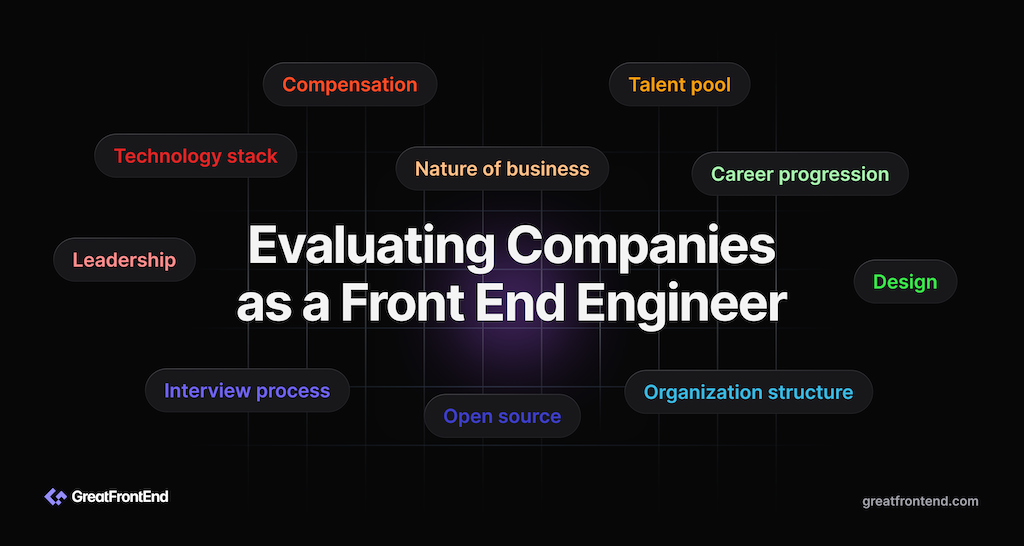
Use How to Evaluate Companies as a Front End Engineer before accepting a role.
Salary by city
Indeed's 2026 India salary page surfaced higher average salaries in Hyderabad, Gurgaon, Bengaluru, Pune, and Ahmedabad. Its current city examples include Hyderabad around Rs 11.12 LPA, Gurgaon around Rs 8.55 LPA, Bengaluru around Rs 7.96 LPA, Pune around Rs 7.92 LPA, and Ahmedabad around Rs 7.40 LPA. Treat city data carefully because sample sizes can be small, and one or two high-paying employers can move the average.
In practice:
- Bengaluru and Hyderabad have strong product-company and GCC density.
- Gurgaon has strong startup, SaaS, fintech, and corporate hiring pockets.
- Pune and Chennai can offer solid engineering roles with somewhat different compensation bands.
- Remote roles can break city averages, but they usually raise the interview bar.
Location helps, but it does not replace skill and company selection.
Base pay, CTC, and take-home pay
One common mistake in India salary research is mixing base salary, CTC, total pay, bonus, stock, and monthly take-home as if they were the same thing.
When reading an offer, separate:
- Fixed base salary
- Variable bonus
- Joining bonus
- Retention bonus
- ESOPs or RSUs
- Employer PF contribution
- Insurance and other benefits
- Notice-period buyout or relocation support
A Rs 18 LPA CTC offer with a high variable component can be weaker than a Rs 15 LPA offer with cleaner fixed pay. A startup ESOP component can be meaningful, but only if you understand vesting, strike price, liquidity, and whether the company has a realistic path to an exit.
For negotiation, ask for the compensation breakup before comparing offers. Averages from salary sites are useful only after you know what number you are comparing against.
Skills that increase frontend salary
The highest-paid frontend engineers are rarely paid only for React syntax. They are paid because they reduce product and engineering risk.
Skills that move compensation:
- JavaScript and TypeScript depth
- React, Next.js, or another modern frontend stack
- CSS layout without constant trial and error
- Accessibility for forms, navigation, modals, and complex widgets
- Web performance and Core Web Vitals
- API contracts, caching, and error handling
- Testing with unit, component, and end-to-end coverage
- Design systems and component API design
- Debugging production issues
- Reviewing AI-generated code safely
If your CSS is weak, fix it. The top CSS mistakes made by front-end engineers are still common in paid work.
To build interview evidence for higher-paying frontend roles, practice TypeScript interview questions, React interview questions, UI coding questions, and system design questions. These are closer to the signals product companies and GCCs usually test than generic portfolio pages.
How to negotiate with salary data
Do not walk into negotiation with one average number. Use a range and explain your fit.
Better negotiation evidence includes:
- Current salary data from multiple sources
- Interview performance
- Competing offers
- Product complexity of the role
- Your experience with similar problems
- Clear examples of ownership
- Whether the offer is base, bonus, stock, benefits, or full CTC
For example, "Glassdoor and PayScale put the broad market around Rs 6.4-6.6 LPA, but this role is a TypeScript-heavy product role with design system ownership. Based on the scope and my experience, I am targeting X" is stronger than quoting a single website average.
What to remember
Frontend developer salary in India in 2026 is not one number. Broad datasets cluster around Rs 6.4-7.5 LPA, but roles at stronger frontend teams can move far above that when the engineer owns product quality, performance, accessibility, TypeScript, and cross-team UI architecture.
Use salary sites to anchor the conversation. Use skill depth and company selection to change the conversation.
相关文章
 Compare frontend and fullstack developer paths in 2026, including work style, hiring signal, learning curve, and which path fits your goals.
 Learn the senior frontend developer skills that matter in 2026, from UI architecture and accessibility to performance, testing, judgment, and AI verification.