Frontend Interview Process at Google, Amazon, and Meta: What to Expect
The frontend interview process at Google, Amazon, and Meta: each company's official prep guide, a round-by-round comparison table, and the 2026 AI-assisted rounds.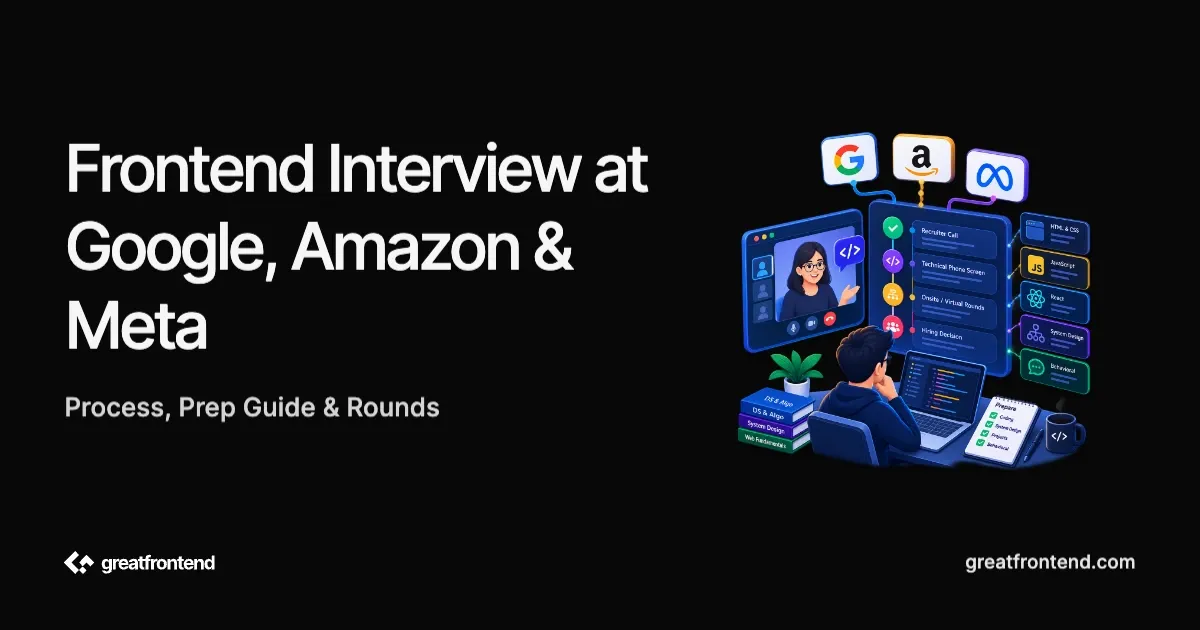
If you are researching the frontend interview process at Google Amazon Meta specifically, the three share a shape, a coding component, a frontend-fundamentals or system-design layer, and a behavioral round, but the details that actually determine how you prepare differ by company: how many rounds, what each one weighs, and, as of 2026, whether an AI assistant sits in the room with you. This guide walks through each company's process specifically, then covers what changed most recently: AI-assisted coding rounds, now real at both Google and Meta, not a rumor. None of the three companies publishes its exact interview structure officially, so treat the round counts and formats below as commonly reported across candidate experiences rather than guaranteed identical for every team, level, or interviewer.
Start with each company's own official interview-prep guide
Read the primary source before any third-party roundup, including this one. Each company publishes its own interview-prep page directly.
| Company | Official resource | What it covers |
|---|---|---|
| How we hire: interview | Round structure, what interviewers evaluate, general preparation advice | |
| Amazon | Amazon FEE Interview Prep | Coding and technical-fundamentals expectations, how interviews map to the Leadership Principles |
| Meta | Preparing for your software engineering interview at Meta | What to expect in each round, tips from Meta's own engineers |
None of the three publishes the frontend-specific round-by-round breakdown below, that has to be reconstructed from candidate reporting, which is why this guide exists. But the official page is worth reading first: it sets expectations directly from the source, and Meta's own guide already addresses the AI-assisted round directly, since many of its interviews now include an AI assistant built into the interview environment.
Google's frontend interview process
Google's process typically opens with a recruiter screen, followed by a technical phone interview, then a multi-round onsite loop, 4 to 5 rounds, either in person or virtual. The loop commonly includes 2 coding rounds, 1 system design round for mid-level and above, 1 behavioral or "Googleyness" round, and 1 leadership-focused round.
The technical screen can be algorithmic or frontend-focused depending on the loop. Frontend-focused screens may cover JavaScript, DOM/browser fundamentals, or UI implementation, while DSA remains fair game even for frontend candidates.
What's new for 2026: Google is piloting an AI-assisted coding round. This is confirmed, not a rumor, an internal document describing the pilot was publicly reported and a Google spokesperson confirmed candidates in the pilot use the company's own Gemini model as the AI assistant. As of the pilot's public reporting, it is scoped to junior and mid-level roles on select US teams, not a company-wide replacement of the standard loop. For junior candidates in the pilot, one traditional technical interview is replaced with a session focused on solving open-ended engineering problems, and a separate "code comprehension" round is also being introduced. If you are interviewing at Google now, it is worth asking your recruiter directly whether your loop includes this pilot, since it is not yet the default experience for every candidate.
Amazon's frontend interview process
Amazon's onsite is commonly reported as 4 to 5 rounds, each around 55 to 60 minutes. The core rounds: a Coding Round with medium-to-hard difficulty questions on fundamental algorithms and data structures, a Front-End Fundamentals Round that tests JavaScript, HTML, CSS, relevant libraries, and DOM knowledge directly, and a Systems Design Round assessing how you reason about scalable systems.
The structural difference worth knowing going in: Amazon weaves behavioral assessment through the entire loop rather than isolating it into one round. Every interview, technical or not, is also evaluated against Amazon's Leadership Principles, so a strong technical answer that never demonstrates ownership, bias for action, or a relevant principle in how you talk through your approach is a weaker interview than the code alone would suggest.
No public reporting surfaced in this research pass indicating Amazon has introduced an AI-assisted coding round comparable to Google's or Meta's. Do not assume Amazon has adopted one just because its two closest peers have, ask your recruiter directly if this matters to your preparation. The absence of public reporting is not the same as a confirmed absence of a pilot, large companies sometimes run small pilots quietly before any candidate-facing guide picks them up, but there is nothing to prepare for on this front based on what is currently documented.
Candidate reports describe the Front-End Fundamentals Round as separate from the DSA coding round, though Amazon's own interview-prep page does not confirm this exact split. If that reporting holds, it is worth planning around: a candidate who is strong at algorithms but shaky on, say, event delegation, CSS specificity, or how the browser's rendering pipeline actually works may not be able to rely on the coding round to compensate. That would be different from Google and Meta, where a weak frontend-fundamentals answer inside a coding round can sometimes be offset by strong algorithmic performance in the same session.
Meta's frontend interview process
Meta's process is commonly reported to start with a single 45-minute coding interview as the initial screen. Clearing it moves you into the full loop, 4 to 6 interviews spanning coding, a UIE architecture and design round, and behavioral rounds.
The onsite traditionally includes two coding interviews focused on data structures and algorithms with a practical lean toward building user interfaces the way Meta's frontend teams actually work, a design and architecture interview covering how you would build web application products and structure UI components, and a career and coding round that mixes behavioral questions about your background and motivation with more technical discussion.
What's new for 2026, and this is the most concretely documented change across all three companies: Meta rolled out an AI-assisted coding round starting October 2025, replacing one of the two traditional onsite coding interviews, and it is reported to be expanding across more of Meta's software engineering loops through 2026. Multiple independent, detailed guides describe the same specific mechanics, which is why this is treated as reliable rather than a single aggregator's summary: the round runs in a CoderPad environment with a three-panel layout, a file explorer, a code editor, and an AI assistant chat window, for 60 minutes. Candidates choose among several AI models during the session, GPT, Claude Sonnet, Claude Haiku, Gemini, and Llama are all reported as options. The AI can respond in the chat panel but cannot directly edit files, so you still have to write and own the code yourself. The session moves through phases, bug fixing, core implementation, and optimization, and Meta evaluates candidates on four criteria: problem solving, code quality, verification, and communication.
How much of Meta's overall loop now runs through this format is not independently verified in the sources behind this guide, treat "expanding through 2026" as the reported direction, not a confirmed percentage.
Round-by-round comparison
The prose above covers the reasoning behind each company's structure; this table is the scannable version to check your prep against.
| Round type | Amazon | Meta | |
|---|---|---|---|
| Coding / DSA | 2 onsite rounds + 1 phone screen | 1 dedicated round, medium-to-hard difficulty | 2 onsite rounds (1 may now be AI-assisted) + 1 initial 45-min screen |
| Frontend fundamentals | Folded into the coding rounds | Reported as a separate standalone round, graded independently | Folded into the coding rounds |
| System design / architecture | 1 round, mid-level and above | 1 round | 1 round (UIE architecture and design) |
| Behavioral | 1 "Googleyness" round + 1 leadership round | Woven through every round via the Leadership Principles | 1 dedicated career-and-coding round |
| AI-assisted coding round | Piloting, junior and mid-level, select US teams | Not reported as of this guide | Live since October 2025, expanding through 2026 |
| Total onsite rounds | 4 to 5 | 4 to 5, each 55 to 60 minutes | 4 to 6 |
What's common across all three
A DSA-style algorithmic coding component is present at all three companies, and none of the AI-assisted pilots have removed it entirely, they replace or sit alongside one coding round, not the whole loop. Frontend-specific fundamentals, JavaScript, the DOM, HTML, CSS, get tested somewhere in every loop, though Amazon gives it a dedicated standalone round while Google and Meta fold it into the coding interviews. All three introduce an architecture or system-design-style round at mid-level and above. And all three assess behavioral fit, though the structure differs: Amazon ties it explicitly to the Leadership Principles across every round, while Google and Meta each carry a more standalone behavioral interview.
The practical implication for preparation is that no single company's process is a superset of the others. Someone who prepares only algorithmic coding will be underprepared for Amazon's dedicated fundamentals round and for the behavioral framing every Amazon interview carries. Someone who only prepares frontend fundamentals and system design will be underprepared for the algorithmic depth Google's rounds are reported to expect. Cross-company preparation means covering all three layers, not picking the one that feels most comfortable and hoping it generalizes.
The AI-assisted coding round: what's actually changing
If there is one thing worth internalizing before walking into a 2026 loop at either company, it's this: an AI assistant being present does not mean the bar for you personally has dropped. Meta's own evaluation criteria, problem solving, code quality, verification, and communication, are the same categories a traditional coding round would grade on. The assistant changes the mechanics of typing code, it does not change what a strong candidate demonstrates. If anything, being unable to verify or explain code the assistant suggested is now itself a visible weak signal, since "communication" is an explicit grading category and the interviewer is watching how you use the tool, not just whether the final code works.
Practically, that means treating the AI assistant the way you would treat a very fast, occasionally wrong pair programmer: use it to move faster on boilerplate, but narrate your reasoning, catch what it gets wrong, and be ready to explain any line of code it produced as if you had written it yourself.
It also changes what a mistake looks like. In a traditional round, silence while you think is normal. In an AI-assisted round, silence while the assistant generates code and you simply accept it without comment reads very differently to an interviewer scoring you on communication. The safer default is to talk through what you expect the assistant's suggestion to do before you run it, then confirm or correct that expectation out loud once you see the result.
Frequently asked questions
Do all three companies test the same coding topics? The underlying skill set overlaps heavily, algorithms, data structures, JavaScript and DOM fluency, but the packaging differs. Amazon isolates frontend fundamentals into their own round; Google and Meta fold them into general coding rounds. If you are preparing across all three, the safest approach is to prepare the fundamentals deeply rather than trying to guess which company will ask what.
Should I ask my recruiter whether my loop includes an AI-assisted round? Yes, particularly at Google right now, since the pilot is scoped to junior and mid-level roles on select US teams rather than every candidate. Knowing in advance changes how you would practice: a traditional round rewards fast, correct typing, an AI-assisted round rewards fast, correct verification of someone else's typing.
Is the AI-assisted round easier because you have help? Not based on what Meta's own evaluation criteria suggest. Problem solving, code quality, verification, and communication are the same categories a traditional round grades on, and an unverified or unexplained suggestion from the assistant is a visible weak signal, not a shortcut past the bar.
Does Amazon's Leadership Principles framing mean the technical rounds matter less? No, it means the technical rounds are graded on two dimensions instead of one. A technically correct answer delivered without any signal of ownership, bias for action, or a relevant principle is still reported as a weaker interview at Amazon than the same code paired with that framing, which is a meaningfully different bar than a purely code-scored round at Google or Meta.
How to prepare
Read the official company page first: Google's interview process, Amazon's FEE Interview Prep, and Meta's software engineering interview prep. Then layer on the fundamentals every one of these loops still tests regardless of format changes: algorithmic coding under time pressure, JavaScript and DOM fluency, and the ability to reason through a frontend system design question out loud. GreatFrontEnd's algorithmic coding practice questions and 10 must-know JavaScript coding interview questions cover the coding-round layer that has not gone away at any of the three companies.
For the system design and architecture rounds that show up at mid-level and above across all three, GreatFrontEnd's front-end system design material is built around the same reasoning senior loops are testing for, requirements gathering, trade-off analysis, and reasoning through failure modes, not memorized diagrams.
If your loop includes or might include an AI-assisted round, practice with an AI coding assistant deliberately before the interview, not for the first time during it. The skill being tested, catching what the assistant gets wrong and explaining your reasoning clearly, is not something you want to be doing consciously for the first time under interview pressure. Pick one real problem, work through it with an assistant, and pay attention to the moments where you were tempted to accept a suggestion without checking it, that moment is exactly what an interviewer is watching for.
Conclusion
The frontend interview process at Google Amazon Meta rhymes more than it repeats: a coding component, frontend fundamentals or a dedicated system-design round, and a behavioral assessment, structured slightly differently at each company, with Amazon threading its Leadership Principles through every round rather than isolating them. The one genuine 2026 shift is the AI-assisted coding round, confirmed and expanding at Meta since October 2025, confirmed as a pilot at Google for junior and mid-level roles on select teams, and not reported at Amazon as of this guide. Read each company's own official prep page first, prepare for the fundamentals since none of the three has removed them, then get comfortable narrating your reasoning with an AI assistant in the room if your loop might include one.
Related articles
 A frontend-focused guide to machine coding round questions, including what is machine coding round, how to prepare for machine coding round interviews, and how to practice in React.