Is Frontend Development a Good Career in 2026? An Honest Breakdown
A practical 2026 look at whether frontend development is still a good career, what changed, and what skills make the path worth choosing.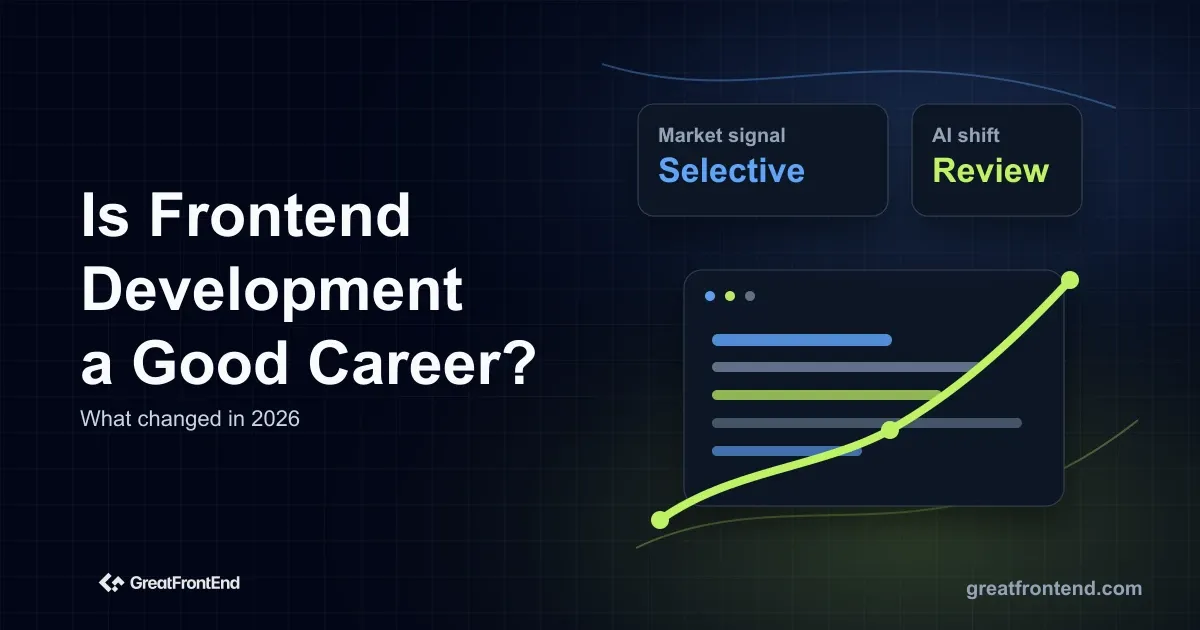
Yes, frontend development is still a good career in 2026 if you can build product UI that holds up when data, state, accessibility, performance, edge cases, and AI-assisted code all meet in the same feature.
That distinction matters because many beginners are asking the wrong version of the question.
What changed
Frontend used to be seen as the easiest software path to enter. Learn HTML, CSS, JavaScript, React, build a portfolio, apply widely. That path still exists, but it is more crowded and less forgiving.
Three things changed:
- AI tools can generate basic UI quickly.
- Companies have become more selective with junior hiring.
- Product teams expect frontend engineers to understand both implementation and quality.
Frontend is not dying, but shallow frontend work is easier to replace. A person who can only assemble prompted components has a weaker market position than someone who can verify behavior, debug product issues, and make tradeoffs.
For the broader "dying" question, read Is Frontend Development Dying in 2026?.
How AI changes frontend work
AI changes frontend development by making first drafts cheaper. It can generate a React component, write CSS, suggest tests, explain an error, convert JavaScript to TypeScript, or produce a quick API integration.
Useful, yes, but it also changes the hiring signal.
The old signal was often: can you build the screen? The 2026 signal is closer to: can you decide whether the generated screen is correct, accessible, maintainable, and aligned with the product?
Stack Overflow's 2025 Developer Survey found that 84% of respondents were using or planning to use AI tools, while more developers actively distrusted AI accuracy than trusted it. DORA's 2025 AI-assisted software development report frames AI as an amplifier of existing strengths and weaknesses, not as a replacement for sound engineering practice.
For frontend developers, that means AI can help you move faster if you already understand the web. If you do not, it can hide mistakes behind code that looks plausible.
AI is often weak at:
- Knowing whether markup is semantic and accessible
- Handling keyboard and screen reader behavior
- Choosing the right state boundary
- Understanding product edge cases
- Preserving design-system constraints
- Avoiding unnecessary dependencies
- Knowing whether a loading, empty, or error state is acceptable
- Catching subtle performance problems
- Explaining why a UI decision is right for the user
Those are exactly the areas where good frontend engineers still matter.
How expectations have changed
Frontend hiring is shifting from output volume to verification and ownership.
| Earlier expectation | 2026 expectation |
|---|---|
| Build screens from a design | Build product flows that handle real data, errors, loading, permissions, and accessibility |
| Know one framework | Understand the browser, JavaScript, TypeScript, CSS, APIs, and the framework |
| Use component libraries quickly | Know when a component library helps and when custom behavior needs careful implementation |
| Ship the happy path | Test edge cases, keyboard behavior, responsive states, and API failures |
| Ask AI for code | Review AI output for correctness, security, accessibility, and maintainability |
| Show a portfolio | Explain tradeoffs, debugging decisions, and how the project would behave in production |
AI makes frontend harder for people who rely on drafts and better for candidates who can review, debug, and explain their work. If a draft takes seconds, the valuable skill is deciding what should ship.
The market is mixed, not dead
The software market still has demand, but it is uneven. In the US, the Bureau of Labor Statistics projects 15% growth for software developers from 2024 to 2034, much faster than the average for all occupations.
India's hiring picture is more selective. Naukri's March 2026 Jobspeak report showed white-collar hiring growth, but IT was flat while AI/ML hiring grew much faster.
The broader global picture points the same way. The World Economic Forum's Future of Jobs Report 2025 still lists software and applications developers among roles expected to grow through 2030.
Frontend jobs are not easy to get by default. Software work is not disappearing, but the hiring bar has shifted. A resume that lists React and a few projects is weaker than evidence that you can build and reason through product UI under constraints.
Why frontend is still valuable
Every serious digital product needs user-facing software. Banking apps, SaaS dashboards, developer tools, marketplaces, internal tools, healthcare portals, education platforms, commerce sites, and AI products all need interfaces that people can understand and trust.
Frontend engineers sit at a difficult boundary. They translate product intent, design systems, backend APIs, user behavior, browser constraints, accessibility needs, and performance budgets into working software.
Most useful frontend work happens at that boundary.
The work that still earns trust includes:
- Making complex flows understandable
- Preventing broken forms, dead states, and confusing errors
- Keeping interfaces usable with keyboards and assistive technology
- Reducing load time and interaction delay
- Building component systems that teams can reuse safely
- Debugging issues across browser, network, API, and state layers
- Reviewing AI-generated UI for correctness
Frontend work here is product engineering in the browser: user flows, constraints, failure states, and the details people notice when software breaks.
Where the career is weaker
Frontend is a weaker career bet if you plan to stop at surface-level skills.
The risky profile looks like this:
- Can copy React examples but cannot explain state or rendering behavior
- Avoids CSS and uses libraries for every layout problem
- Does not test forms, empty states, loading states, or errors
- Ignores accessibility
- Cannot debug API issues
- Treats TypeScript as decoration
- Ships UI that works only on the happy path
This profile is more vulnerable in 2026 because AI tools can produce similar output quickly. Companies do not need to hire a full-time engineer for code that still requires heavy review by someone else.
Frontend candidates therefore need to show judgment. AI can draft a component. It will not reliably know whether the flow is accessible, the form state is recoverable, the API error is handled, or the product behavior is right.
What makes frontend a good career now
Frontend work with staying power combines web foundations with product judgment.
You do not need to master everything before your first job, but you do need to build toward these areas:
| Area | Why it matters |
|---|---|
| HTML and accessibility | Users need interfaces that work beyond mouse clicks and perfect eyesight |
| CSS layout | Most UI bugs are layout, spacing, overflow, or responsive behavior problems |
| JavaScript and TypeScript | Frontend apps are stateful software, not static pages |
| React or another framework | Teams need maintainable UI architecture |
| APIs and data fetching | Product UI depends on network and backend behavior |
| Testing | Teams need confidence when features change |
| Performance | Slow UI loses trust, revenue, and user patience |
| Product thinking | Good frontend work solves user problems instead of only finishing design tickets |
| AI verification | Generated code still needs a human who knows what correct means |
If you want a staged learning path, use How to Become a Frontend Developer in 2026 as your roadmap.
If you want to test whether your skills are beyond surface-level UI, work through JavaScript interview questions, React interview questions, and user interface coding questions.
What a good first frontend role looks like
A useful first frontend role is not always the highest-paying one. It gives you repeated practice with product UI under review.
Look for:
- A codebase with active frontend engineers
- Pull requests that get useful feedback
- Product forms, dashboards, workflows, or customer-facing surfaces
- Exposure to APIs and backend contracts
- Some expectation around testing
- Designers or product managers you can learn from
- Accessibility and performance treated as normal quality work
Be cautious with roles where frontend means only slicing static pages, editing templates, or wiring prebuilt components with no product ownership. That experience can be useful at the beginning, but it can trap you if it never grows.
Where the career can grow
Frontend is not a single-track career. After the first few years, you can move toward different kinds of depth.
Common growth paths include:
- Product frontend engineering, where you own user-facing flows and product quality
- Design systems, where you build shared components, tokens, documentation, and accessibility standards
- Frontend platform, where you improve build tooling, testing, monorepos, and developer experience
- Web performance, where you measure and reduce loading, rendering, and interaction cost
- Frontend-heavy fullstack, where you own UI plus enough backend to ship complete features
- Technical leadership, where you guide frontend architecture and unblock other engineers
- Engineering management, where you move from code ownership to team ownership
That variety keeps the career interesting. You can start with visible product UI, then choose the kind of complexity you want to become known for.
Who should choose frontend
Frontend is a good career fit if you enjoy the user-facing side of software. You should like details, but not only visual details. The work also needs patience with state, data, edge cases, and browser behavior.
You may enjoy frontend if you:
- Like seeing your work in the product
- Notice when interfaces feel confusing
- Enjoy working with designers and product managers
- Can debug visual and logical problems
- Care about accessibility and performance
- Want to build software that people touch directly
Frontend is also a good base for product engineering. Many strong product engineers start with frontend and add backend fluency over time.
Who should avoid frontend
Do not choose frontend only because it looks easier than backend. The beginner path may feel friendlier, but professional frontend work still demands careful engineering.
You may prefer backend, data, infrastructure, security, or mobile if you dislike:
- Visual iteration
- Browser debugging
- CSS layout details
- Ambiguous product requirements
- Accessibility constraints
- Working close to design feedback
Choosing the wrong path because it looks easy is expensive. Choose the problems you are willing to keep solving.
Frontend development is a good career in 2026 if you treat user-facing software as engineering work. The market is less generous to shallow skills, and AI has made basic code cheaper.
That should not push you away from frontend. It should push you to learn it properly. Build interfaces that work under pressure, explain your decisions, test the behavior, and understand the product. That version of frontend still has room.
相关文章
 Is frontend development dying in 2026? A data-backed look at AI, frontend career demand, what is changing, and what frontend developers should learn now.