Frontend Developer to Tech Lead: What Changes and How to Make the Jump (2026)
Move from frontend developer to tech lead with a practical frontend playbook for technical direction, reviews, planning, mentoring, and promotion evidence.
Moving from frontend developer to tech lead means shifting from "I can ship this feature" to "this team can ship the right frontend work safely." You still code, but your most valuable work becomes technical direction, risk spotting, review quality, and helping other engineers make better decisions.
A tech lead is not simply a manager with a different title. In teams that separate the roles, the manager handles people management and team health while the tech lead drives technical clarity: what the team should build, where the frontend risk is, how work should be sliced, and how the team will verify the result. Some companies combine both jobs, so clarify the local expectations before accepting the title.
What changes
The jump is not from coding to meetings. It is from local execution to team execution.
| Area | Frontend developer | Frontend tech lead |
|---|---|---|
| Success metric | Ships assigned work well | Helps the team ship important work with fewer surprises |
| Planning | Estimates own tasks | Finds hidden state, API, accessibility, performance, and release risk |
| Coding | Owns components and flows | Codes where uncertainty is highest or example code is needed |
| Review | Catches bugs in PRs | Improves the team's review standard and decision quality |
| Architecture | Follows existing patterns | Chooses patterns the team can maintain and migrate toward |
| Collaboration | Works with design, product, and backend | Aligns those partners before unclear work becomes rework |
| Mentoring | Helps when asked | Turns repeated problems into examples, checklists, and better habits |
Own frontend risk earlier
Frontend tech leads are useful before implementation starts. Many expensive frontend problems are visible early if someone asks the right questions.
Before a large feature starts, write a short risk note:
| Risk area | Questions to answer before coding |
|---|---|
| Product states | What happens in loading, empty, error, invalid, slow, offline, unauthorized, and partial-success states? |
| Data and API | Which fields are required, paginated, cached, stale, permissioned, or backward-compatible? |
| Accessibility | Does the flow follow web accessibility basics: semantic HTML, keyboard navigation, labels, focus recovery, and announcements? |
| Performance | Which page, interaction, image, bundle, or hydration cost can hurt Core Web Vitals? |
| Design system | Are we extending an existing component, creating a new one, or breaking consistency for a reason? |
| Release safety | Can this ship behind a flag, be rolled back, measured, and debugged after release? |
| Testing | Which behavior needs unit, component, integration, end-to-end, or visual coverage? |
This note should be short enough for product and design partners to read. The goal is not a long architecture document. The goal is to prevent avoidable ambiguity.
Use decision notes, not private opinions
Tech leads make tradeoffs visible. A decision that lives only in a meeting disappears by the time someone reviews the PR three weeks later.
Use this lightweight template:
Problem:What user or team problem are we solving?Options:Option A: fastest path, with cost.Option B: safer path, with cost.Recommendation:I recommend [option] because [reason].Risks:What can break, slow down, or become harder to change?Verification:What test, metric, demo, screenshot, or rollout check proves this worked?Rollback:How do we undo or contain the change?
Good recommendation language is direct:
I recommend option B. It costs one extra API field and one migration PR, but it keeps state ownership in the route layer and gives us a clean rollback path. Option A is faster this week, but it duplicates validation logic across three forms.
Make code review a quality system
Tech lead review is not heavier style policing. It is better filtering for design, behavior, complexity, tests, and user impact.
Google's code review guidance is a useful model: reviewers should aim for improving code health over time, not forcing perfect code. Their review checklist also calls out design, functionality, complexity, tests, documentation, and context as separate concerns.
For frontend work, review for these questions:
- Does the UI handle the important states, not only the happy path?
- Does the markup preserve semantics, labels, focus, keyboard behavior, and accessible errors?
- Does the state model make ownership obvious?
- Does the API contract match product behavior, permissions, pagination, caching, and errors?
- Is the component API harder to misuse than the old pattern?
- Will this change hurt LCP, INP, CLS, bundle size, hydration, or a slow device?
- Does the PR include the right test for the risk?
- Is the change small enough to review and roll back?
Write review comments that teach the standard:
Required: This modal closes visually, but focus stays on the removed button. Please return focus to the trigger after close so keyboard users do not lose their place.Optional: This helper name works, but `getVisibleMenuItems` would make the filtering rule easier to scan.
Required comments protect correctness, accessibility, maintainability, or product behavior. Optional comments should not block progress.
Lead execution without taking over
The easiest way to fail as a new tech lead is to keep the hardest work, answer every question yourself, and become the team's bottleneck.
Use a better pattern:
- Write the first technical shape: boundaries, risks, sequence, and rollback.
- Split the work into reviewable slices.
- Give ownership of slices to engineers with enough context to succeed.
- Pair early on the uncertain part instead of rewriting late.
- Review the highest-risk PRs yourself.
- Turn the learning into a checklist, example, or follow-up task.
This keeps technical quality high without making every important decision depend on one person.
Stay close enough to the code
Tech leads do not need to code every feature. They do need enough codebase closeness to make useful decisions.
Good places to code:
- A proof of concept for a risky state model
- The first example of a new component API
- A migration slice that teaches the team the pattern
- A debugging patch for a production issue
- Test helpers or fixtures that make future work easier
Bad places to hide:
- Taking all difficult implementation work because delegation feels slower
- Reviewing only after the feature is almost done
- Owning meeting notes, status updates, and coordination while losing technical judgment
Treat AI output as review pressure
In 2026, AI-assisted coding makes tech lead work more important, not less. The 2025 Stack Overflow Developer Survey found broad AI tool usage but more distrust than trust in AI output accuracy. DORA's 2025 report frames AI as an amplifier of an organization's existing strengths and weaknesses.
For frontend teams, that means AI can speed up routine output, but it can also produce code that looks fine while missing product states, accessibility behavior, data constraints, or maintainability.
Set a simple team rule: generated code gets the same review bar as hand-written code, plus one extra question:
Can the author explain why this solution is correct for our product, users, codebase, and rollback path?
If the answer is no, the team is shipping borrowed confidence.
Build proof before asking for the title
Promotion to tech lead is easier when the evidence already exists.
| Evidence | What it proves | Weak version to avoid |
|---|---|---|
| Decision note | You can compare options and recommend a path | "We discussed it in Slack" |
| Review standard | You improve team output through review | "I left many comments" |
| Migration plan | You can change code safely while product work continues | "We should rewrite this later" |
| Measured improvement | You connect frontend work to user or developer impact | "The code feels cleaner" |
| Mentoring artifact | You make another engineer more effective | "I helped people sometimes" |
| Release note | You can ship with verification and rollback | "QA passed it" |
Keep this evidence as it happens. Do not reconstruct six months of leadership from memory during promotion season.
A 30-day transition plan
Use one month to practice the job before asking for it.
| Week | Action | Output |
|---|---|---|
| 1 | Pick one ambiguous frontend feature and write the risk note | State/API/accessibility/performance/release checklist |
| 2 | Split the work into reviewable slices and name owners | PR sequence with dependencies and rollback path |
| 3 | Review the riskiest slices and turn repeated feedback into a checklist | Review examples and team standard |
| 4 | Write the result, what changed, and what should become reusable | Promotion/interview story with proof |
Choose a feature with real ambiguity: a checkout flow, dashboard table, onboarding wizard, permissions-heavy admin page, design-system component, or migration from duplicated state to a shared pattern.
Mistakes that slow the jump
- Only becoming faster at coding. Speed helps, but lead scope is about decisions other people can build on.
- Becoming the unofficial project manager. Coordination matters, but tech lead evidence must include technical judgment.
- Reviewing taste instead of risk. Style comments are cheap. Behavior, accessibility, state, tests, and rollback matter more.
- Hoarding the hard work. If every important task comes back to you, the team is not getting stronger.
- Pushing architecture without a migration path. A better pattern that nobody can adopt safely is not leadership.
- Doing invisible work with no artifact. Useful technical leadership should leave notes, examples, checklists, plans, or measurable improvements.
How to explain tech lead work in interviews
Do not say, "I led the frontend." Say what changed because you were involved.
Use this story shape:
- The product or engineering problem was...
- The hidden frontend risk was...
- The options were...
- I recommended...
- I split the work by...
- I verified it through...
- The team now does...
Example:
Our checkout forms had duplicated validation and inconsistent error handling. The risk was not only code duplication. It was failed submissions, poor focus recovery, and hard-to-debug backend errors.I compared keeping validation per form with moving shared rules into a form package. I recommended a smaller migration first: one shared error model, one reference form, and a checklist for future forms. We shipped it behind a route-level flag, added component tests for error behavior, and measured fewer repeated review comments on the next two forms.
That answer shows frontend judgment, sequencing, accessibility awareness, team influence, and proof.
Practice the skills deliberately
Use GreatFrontEnd's front end system design questions, UI coding questions, and React interview questions to practice the technical side. For lead readiness, do not only solve the problem. Write the decision note, review checklist, test plan, and rollout risk as if another engineer had to implement it.
Good practice problems include Data Table, File Explorer, and Autocomplete. These force decisions about state, loading, accessibility, performance, and API boundaries.
What to remember
The best first tech lead move is not taking control of everything. It is making the team's hardest frontend decisions clearer, safer, and easier for other engineers to execute.
The title follows when the behavior is already visible: better plans, sharper reviews, safer releases, stronger engineers, and frontend work that improves after you touch the system around it.
相关文章
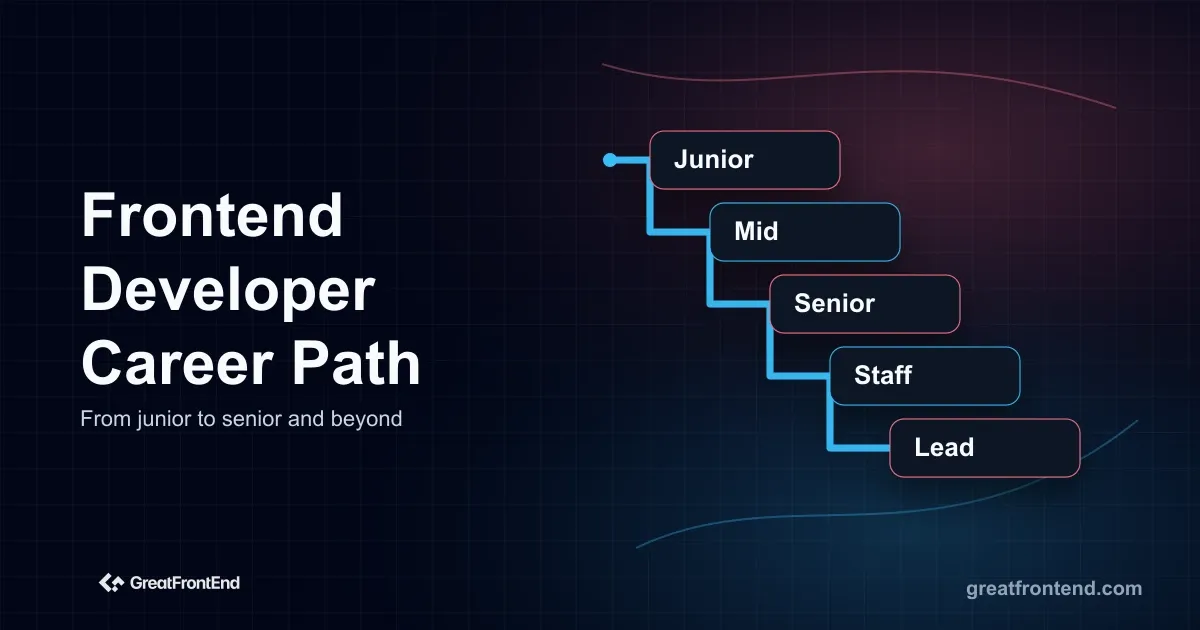 Map the frontend developer career path in 2026 from junior to mid-level, senior, staff, lead, specialist, and manager roles.
 Learn the senior frontend developer skills that matter in 2026, from UI architecture and accessibility to performance, testing, judgment, and AI verification.
 An exclusive interview with Jordan Cutler, Senior Engineer at Pinterest, on his career journey, mentorship, and strategies for professional growth.
 Discover the best big tech companies for a great career as a Front End Engineer.