Front End Jobs with Good Salary in India: Where to Target in 2026
Which frontend jobs in India actually pay well: product companies, GCCs, and IT services compared, with real company data and how to target each type.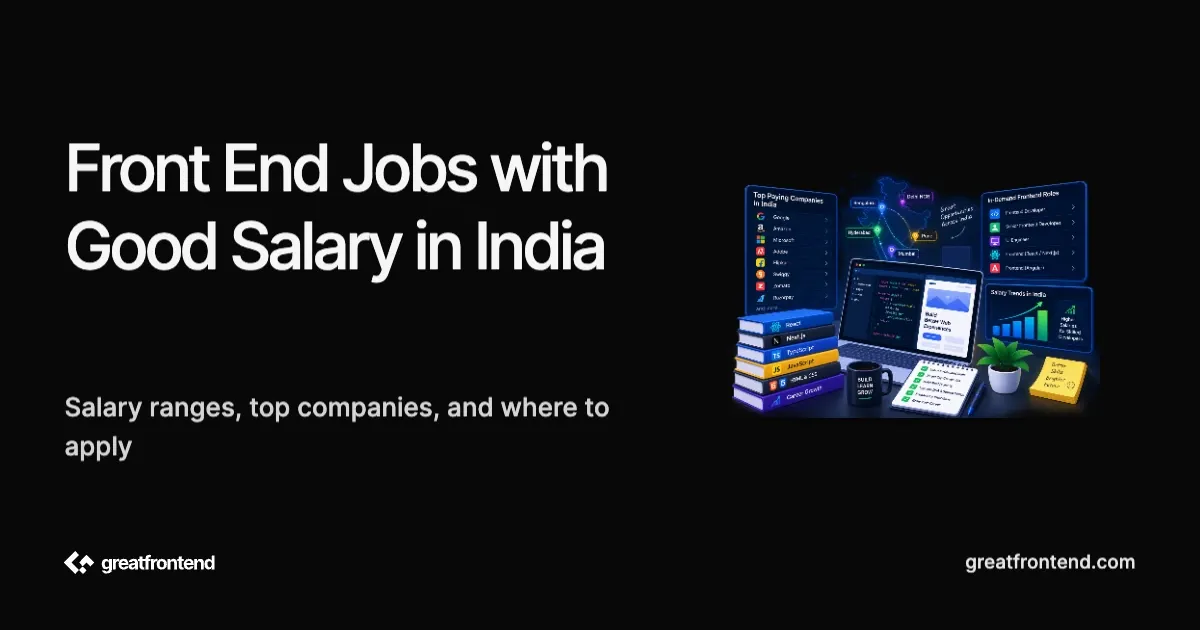
If you already know roughly what frontend developers earn in India, the harder question is where to actually apply. Front end jobs with good salary in India are not evenly spread across the market. They cluster in a handful of employer types, and the type of company you target changes your ceiling more than the city you work from or the framework on your resume.
This guide does not repeat the salary bands by experience level. GreatFrontEnd's frontend salary guide already covers that in detail, along with city-by-city breakdowns and how to read a CTC offer. What follows here is narrower: which kinds of companies to target, what genuinely differs between them, and how a few named companies actually pay for frontend roles right now.
The real axis is employer type, not company size
It is tempting to sort companies by brand recognition or headcount, but that is not what predicts frontend pay. A large, well-known enterprise can still pay services-tier rates for a frontend role if frontend is not core to what the company sells. A ten-person, well-funded startup can outpay a household-name enterprise for the right hire if the product depends on the interface working well.
The distinction that actually holds up is whether frontend is a valued, product-differentiating function at that company, not how big or famous the company is. Three employer types cover most of the market: IT services firms, Indian product and consumer-internet companies, and Global Capability Centres (GCCs) of multinational companies. Each treats frontend differently, and that difference is where the pay gap comes from.
IT services firms: the widest entry point, the lowest ceiling
Companies like TCS, Infosys, and Wipro post by far the largest volume of frontend and "web developer" openings in India. For a first job, this is often the most accessible on-ramp, and it is a reasonable place to start if your goal is to get hired quickly and build experience.
The tradeoff is that frontend is rarely a named, standalone track here. Postings frequently bundle it into a generic "web developer" or "full stack" requisition, working across whatever the client project needs rather than a dedicated design-system or product-frontend role. Multiple salary-aggregator sources (recrew.ai, omnivoo.com, upgrad.com) converge on the same directional pattern: IT services pay commonly runs meaningfully below product companies and GCCs at the same experience level, often cited in the 25 to 35 percent range. These are aggregator estimates rather than a single disclosed survey, so treat the specific percentage as directional, not a guarantee for any individual offer.
Indian product companies: frontend becomes a named, valued track
At consumer-internet and product companies built in India, such as Flipkart, Swiggy, and Razorpay, frontend is usually its own hiring track rather than a subset of generic web development. That distinction is not cosmetic. When a company's revenue depends on checkout completion, activation flows, or day-to-day app usage, frontend quality is directly tied to what the business earns, and hiring reflects that.
Practically, this means a narrower hiring bar (data structures and algorithms, machine coding, and system design rounds are typical for these roles) and a role definition that is closer to "own this surface" than "implement this ticket." It also means real, checkable compensation data exists for some of these companies through self-reported platforms.
On Levels.fyi, the Frontend Software Engineer track at Razorpay shows self-reported total compensation in roughly the 2.6 to 4.3 million rupee per year range, with a reported median close to 2.9 million. At Flipkart, the same title at the SDE2 to SDE3 band shows a reported range of roughly 4.0 to 5.4 million rupees per year, with a reported median close to 3.8 million. Both figures come from a small number of self-reported data points rather than a large-sample survey, so read them as a directional signal for what this tier of company can pay at these levels, not a guaranteed number for any specific offer. Levels.fyi did not have frontend-specific submissions for every well-known Indian product company at the time of writing, so a company's absence from this list does not mean it pays less, only that no one has reported a number yet.
GCCs: multinational compensation and structured career ladders
Global Capability Centres, the India-based engineering arms of multinational companies such as Walmart Global Tech, Atlassian, Adobe, ServiceNow, and Target India, are the third major target. These operate as genuine product engineering teams, not outsourced support, and frontend roles here often carry structured, level-based career ladders that mirror the company's global engineering organization.
GCC roles often come with structured leveling and compensation bands, and many multinational employers combine base salary with bonuses and RSUs. Compared with private-startup ESOPs, equity in a public multinational can be easier to value and more liquid, but stock can still make up a meaningful share of total compensation. The tradeoff for a candidate is that some GCC frontend roles compete globally for the same requisition, meaning the bar can be as demanding as applying directly to the company's headquarters office.
Where the premium concentrates within a company
Employer type is the first filter, but within any product company or GCC, not every frontend team pays or scopes work the same way. Design-system teams, platform and developer-tooling teams, and performance-focused teams are commonly cited by the same salary-aggregator sources as carrying a premium over a generic feature team, because the work has outsized leverage across the whole product rather than a single flow. GreatFrontEnd's salary guide already covers how skills such as UI architecture, design systems, accessibility, performance, and broader frontend ownership can affect compensation, so this article will focus instead on where those skills tend to be valued. The practical takeaway for targeting is simpler: when you have a choice between two open roles at the same company, the one on a design-system, platform, or performance team is usually the better bet on pay and scope, not just interest.
This is different from evaluating companies purely on brand strength. GreatFrontEnd's comparison of Meta, Google, Microsoft, ByteDance, and Netflix looks at project quality and culture at global big-tech employers specifically. That comparison does not cover India-based product companies, GCCs, or IT services, and it is not built around employer type as the axis, which is why it is a useful companion read rather than a substitute for the targeting question this guide answers.
How to actually find these roles
Each employer type surfaces differently, and searching all three the same way wastes time.
IT services openings are the easiest to find and the least worth optimizing your search for: they dominate general job boards like Naukri and Indeed by sheer volume, so a broad keyword search will surface far more of these than anything else. If this is your target, apply broadly and prioritize roles that name a specific frontend stack in the description over ones that say only "web developer."
Indian product companies rarely need to advertise widely, since they get enough inbound interest through their own careers pages and referrals. The more reliable approach is to go directly to the careers page of the specific companies you want (Flipkart, Swiggy, Razorpay, and similarly sized product companies all list frontend-specific openings there, not just generic engineering roles), and to treat a referral from someone already on a frontend or platform team as meaningfully more effective than a cold application through the general pipeline, a pattern that shows up broadly in hiring but is especially pronounced here given application volume.
GCC roles can be easy to overlook because job titles and employer branding vary across companies. Walmart's India engineering organization, for example, is commonly branded as Walmart Global Tech, while companies such as Atlassian, Adobe, ServiceNow, and Target list India roles through their broader careers infrastructure. The most reliable approach is to search the company's official careers site directly and filter for India or specific engineering hubs such as Bengaluru and Hyderabad, rather than relying only on generic job-board searches.
Matching your profile to the right target
If you are early in your career and need experience fast, an IT services firm or a smaller Indian product company is usually the realistic starting point, since the hiring bar is lower and the volume of openings is higher. If you already have a couple of years of frontend-specific experience and can pass a machine coding and system design round, an Indian product company is where the named frontend track and the associated pay step tend to appear. If you value predictable, structured compensation and are comfortable with a global-standard interview bar, a GCC is worth targeting directly rather than treating it as a fallback from a product-company application.
None of this replaces reading the actual offer. GreatFrontEnd's salary guide is the right place to check whether a specific CTC number reflects a strong offer once you have one in hand, since a higher headline number with a large variable component can be a weaker offer than it first appears.
A note on timing and market conditions
None of this is static. Aggregator-reported comp bands shift as hiring demand moves, and a GCC that was expanding aggressively last year can freeze headcount the next, just as a fast-growing product company can slow its hiring after a funding round closes. The employer-type framework in this guide is meant to tell you where to look and how to compare offers once you have them, not to predict which specific company is hiring this quarter. Check a company's own careers page and recent funding or expansion news before assuming last year's hiring pace still applies, particularly for GCCs, where India headcount decisions are often made independently of what the parent company's global hiring looks like.
This also means the three-tier split is a starting map, not a permanent ranking. A services firm that wins a large, frontend-heavy client contract can temporarily offer product-company-style pay and scope for that engagement. A product company going through a slow growth period can pull back on frontend hiring even while GCCs in the same city keep expanding. Treat the categories in this guide as the lens for evaluating any specific opening you find, not a fixed league table of which companies are worth applying to this year.
Frequently asked questions
Do GCCs pay better than Indian product companies for frontend roles?
Based on aggregator-reported data, the two bands overlap significantly, and GCCs can pay at or above product-company levels for equivalent experience. The more reliable differentiator is not which category pays a higher headline number, but the shape of the offer: GCCs typically weight fixed salary more heavily, while a product company's offer may lean more on equity or variable pay.
Is it worth taking an IT services job to build a portfolio before targeting a product company?
For many candidates this is a reasonable path, particularly if a services role is the fastest way to get hands-on production experience. The tradeoff is that a generic "web developer" requisition may not build the specific frontend depth, design systems, performance work, complex state management, that product-company and GCC interviews test for, so it helps to seek out frontend-specific work within a services role where possible.
Do design-system or platform teams always pay more than product feature teams?
Not always, and this varies by company. What the research above shows is a commonly cited pattern, not a guarantee. Confirm the actual banding for a specific team during the interview process rather than assuming it from the team's function alone.
Where to start
Finding front end jobs with good salary in India comes down to matching your search method to the employer type you are actually targeting, not applying the same way everywhere and hoping the pay works out. The fastest way to find out what a specific company or team actually pays is to interview there, and the fastest way to be ready for that interview is to practice the rounds these companies actually run. GreatFrontEnd's front end interview questions cover the coding, system design, and quiz formats that Indian product companies and GCCs use to screen frontend candidates, with reference solutions written by ex-FAANG engineers.
相关文章
 A 2026 India frontend developer salary guide using Glassdoor, PayScale, Indeed, NodeFlair, Adecco, and AmbitionBox data with caveats by level, city, and employer type.
 Understand FAANG frontend developer salary in India with 2026 big-tech software-engineer compensation data, frontend level signals, India offer-breakup caveats, and recruiter questions.