FAANG Frontend Developer Compensation: What to Expect at Each Level
FAANG frontend developer compensation broken down by structure, not dollar figures: how Google, Meta, and Amazon pay differently by level and vesting.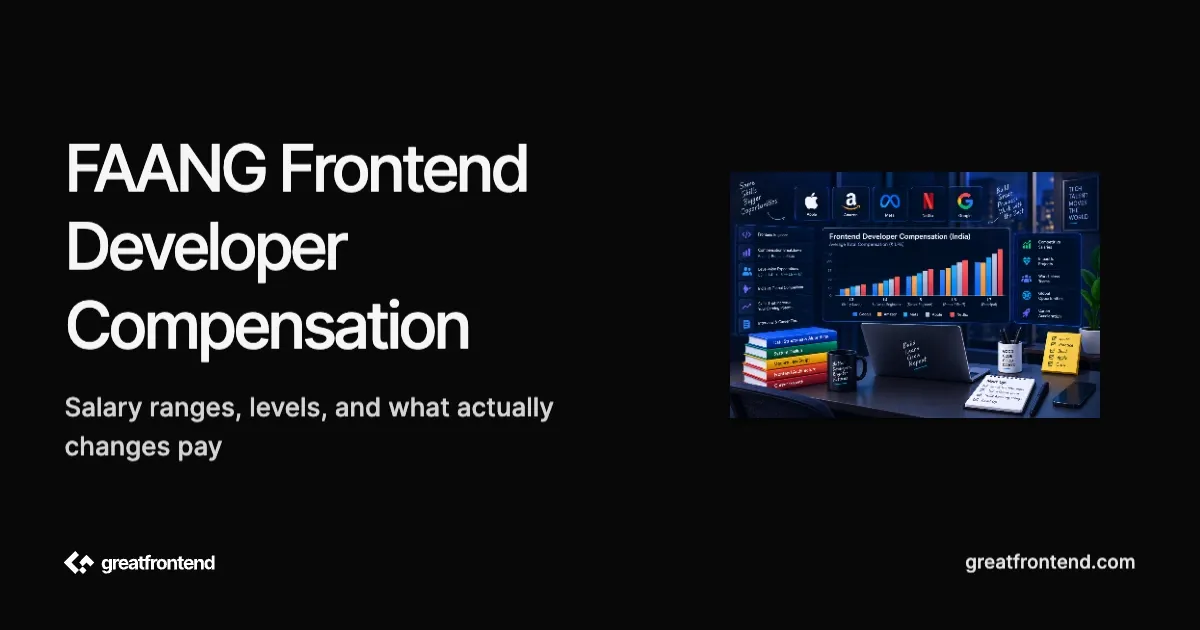
This article will not give you a dollar total for what a Google, Meta, or Amazon offer is worth. Any specific number would be self-reported, point-in-time, and wrong by the time you read it. What is stable, and far more useful when you are actually looking at an offer letter, is a real FAANG frontend developer compensation breakdown: how each company names its levels, what components make up the package, and how the money actually arrives over four years. Two offers with the same headline total compensation can produce meaningfully different paychecks in year one, and that gap comes entirely from structure, not from one company simply paying more.
"FAANG" stands for Meta (Facebook), Apple, Amazon, Netflix, and Google. This guide focuses on Google, Meta, and Amazon specifically, since those three run genuinely different vesting and level structures worth breaking down in detail. Apple and Netflix compensate differently again: Netflix's own job postings state pay "consists solely of an annual salary; we do not have bonuses," with employees able to elect to convert part of that cash salary into fully-vested stock options rather than receiving a company-granted RSU schedule, and Apple discloses far less publicly about its internal leveling than the other three. Both warrant their own breakdown rather than a forced fit into this one.
This is a global, US-context breakdown of that structure. If you're evaluating an India-specific offer, GreatFrontEnd's FAANG frontend developer salary in India guide (https://www.greatfrontend.com/blog/faang-frontend-developer-salary-india) covers that ground directly. If the question is whether to take a FAANG offer over a startup one, startup vs FAANG for frontend developers (https://www.greatfrontend.com/blog/startup-vs-faang-for-frontend-developers) is the right guide. This one assumes you already have, or are about to have, a FAANG-style offer in hand and want to understand what's actually in it.
The level codes you'll hear are not all official
Before the specifics: one distinction is worth knowing up front, because it changes how much weight to put on any level chart you find online.
Amazon's SDE I, SDE II, SDE III, and Principal Engineer titles are public job titles that appear on the company's own career site. Google and Meta also use internal engineering levels commonly referred to as L3, L4, L5 and E3, E4, E5, respectively, but neither company publishes a complete public level-to-title map. The mappings you see on Levels.fyi (https://www.levels.fyi/) and in community writeups are therefore useful references rather than official public ladders.
With that said, the commonly reported mapping looks like this:
- Google: L3 (Software Engineer II) through L4 (Software Engineer III), L5 (Senior Software Engineer), L6 (Staff Software Engineer), and less standardized titles above that, L7 as Senior Staff and L8 as Principal.
- Meta: E3 (entry-level Software Engineer) through E4 (mid-level), E5 (Senior, commonly the terminal level many engineers settle at, since promotion pressure applies through E3 to E4 to E5 but E6 and above is optional and considerably more competitive), E6 (Staff), and E7 and above as Senior Staff, Principal, and Distinguished Engineer.
- Amazon: SDE I (roughly L4), SDE II (roughly L5), SDE III (roughly L6), and Principal Engineer (roughly L7). These four are Amazon's real, official titles.
What actually makes up a FAANG frontend developer compensation breakdown
Across Google, Meta, and Amazon, engineering offers are generally built from three or four levers: base salary, equity, a sign-on bonus, and in some cases an annual cash bonus. What differs by company is which of these levers does the heavy lifting, and that difference is structural, not a matter of one company simply paying more.
Google and Meta both run an annual cash bonus program on top of base and equity. The commonly reported pattern, again community-sourced rather than officially published, is that the bonus target rises with seniority: roughly 15% of base at Google's IC levels through L5, stepping up to 20% at L6 and 25% at L7. Meta's reported pattern is similar in shape, roughly 10% at E3 rising to 25% at E7. Treat the exact percentages as directional rather than precise, the pattern that matters is that the bonus becomes a larger share of the package as you get more senior at both companies.
Amazon does not run a meaningful annual cash bonus program. Its package is built from base, RSUs, and a sign-on bonus, with the RSU grant doing most of the work that a cash bonus would do elsewhere. This is a structural choice, not an oversight, and it's the reason Amazon's vesting mechanics below matter more to understand than they would for a Google or Meta offer.
Vesting mechanics: the part of the compensation breakdown that changes your paycheck
This is the part that changes your actual monthly paycheck, not just the headline total.
Amazon's RSU vesting is back-loaded: 5% of the grant vests in year one, 15% in year two, 40% in year three, and 40% in year four. That means 80% of the equity value sits in the back half of a four-year grant. The 5/15/40/40 annual split is the important structural difference; the exact vesting dates and frequency can vary by grant, so your grant agreement is the source of truth.
New hires commonly receive sign-on bonuses covering year one and year two, often with a larger payment in the first year. These bonuses help offset Amazon's back-loaded equity schedule: without them, the relatively small 5% and 15% RSU vesting in the first two years would make early-year compensation substantially lower.
Google's new-hire RSU grants are typically front-loaded rather than flat, commonly reported patterns put something like a third to slightly more of the grant vesting in year one, tapering down through year four, rather than an even 25% each year. Refresher grants, the additional equity awarded after your initial grant, tend to vest evenly at 25% per year in Google's case. The upshot: your first year at Google is proportionally better compensated by equity than your first year at Amazon, all else equal.
Meta's structure leans toward a larger equity component overall relative to base, which is the flip side of a smaller reported cash bonus target at the lower levels.
A worked example of why the same total is not the same offer
Take a simplified illustration, using the mechanics above rather than any real dollar figures. Suppose an Amazon offer and a Google offer both carry the same reported four-year total compensation. At Amazon, only 5% of the RSU grant vests in year one, so year one's real pay is close to base salary plus whatever sign-on bonus payment lands that year, with the sign-on bonus specifically sized to close that gap. At Google, a front-loaded new-hire grant means year one already carries a meaningfully larger share of the equity than a flat 25% would, on top of base and a smaller reported bonus target at the junior levels.
Run the same comparison at year three: Amazon's cumulative vesting has just crossed into its 40% year, so a large jump in equity value lands in years three and four specifically, while Google's grant is already tapering toward its refresher-grant baseline. Neither pattern is better in the abstract. If you are confident you will stay four years and value a larger payout concentrated later, the Amazon-style structure is not a downgrade. If there's real uncertainty about staying past year two, the same structure costs you disproportionately more of the offer's stated value than a front-loaded one would.
Why this actually matters when comparing offers
Two offers with an identical reported four-year total can produce meaningfully different experiences. An Amazon offer's real value is realized mostly in years three and four; an equivalent Google offer front-loads more of its equity value into year one and evens out from there. If you expect to stay four years, the totals may end up comparable. If there's any real chance you leave before year three, the back-loaded structure costs you a specific, calculable amount of unvested equity that a front-loaded structure would not have withheld.
This is also why Amazon's sign-on bonus size is worth asking about directly rather than treating as a fixed number. Because it's doing real structural work, bridging the gap the vesting schedule creates, it's a lever that's more negotiable, and more consequential, than it would be at a company where the vesting schedule doesn't create that gap in the first place.
Common mistakes evaluating a FAANG offer
- Comparing headline totals without checking the vesting schedule. A larger year-four number is not the same thing as a larger year-one paycheck, and the difference compounds if you're weighing multiple offers with different time horizons in mind.
- Treating Google's or Meta's level codes as an official, fixed system. They're useful shorthand, but they come from community reporting, not a published company document, and titles at the edges (Senior Staff, Principal) are especially loosely defined this way.
- Assuming Amazon's sign-on bonus is just a recruiting perk. It's compensating for a specific structural gap in the vesting schedule. Understanding that changes how you'd negotiate it.
- Quoting a specific total-compensation dollar figure from an aggregator as if it were current and precise. These numbers are self-reported and change constantly; the structure described here is far more durable than any specific figure would be.
Frequently asked questions
Are Google's and Meta's level codes real, official titles? No, not in the way Amazon's SDE titles are. Neither Google nor Meta publishes an official level-to-title map. What circulates is inferred from offer letters, levels.fyi submissions, and employee accounts, consistent enough to be useful, but not a document either company has released.
Does Amazon's back-loaded vesting mean the total offer is worse? Not necessarily, it means the same headline total arrives on a different schedule. Whether that matters to you depends on how long you expect to stay and how much you value near-term cash versus longer-term equity.
Why doesn't Amazon pay an annual cash bonus like Google and Meta? It's a structural choice in how the company builds its package, RSUs and the sign-on bonus do the work a cash bonus would otherwise do. It isn't a sign of a worse offer, it's a different allocation of the same kind of value.
Should I ask my recruiter for specific compensation numbers? Yes, for the actual figures being offered to you. This guide deliberately doesn't include dollar figures because any number here would be stale and unverifiable by the time you read it; your recruiter and your actual offer letter are the source of truth for what you're being offered.
Can I negotiate the vesting schedule itself, not just the amounts? It's rarely offered as an option outright, since the schedule is typically a fixed company policy rather than a per-offer term. What's usually more negotiable is the size of the components that sit around the schedule, the sign-on bonus at Amazon in particular, or the size of the initial equity grant at Google or Meta, since those are the levers that actually vary offer to offer.
How to prepare
Before comparing offers, map out what you'd actually receive in each of the four years, not just the four-year total, using the vesting mechanics above for whichever companies you're evaluating. That single exercise surfaces the real difference between offers far better than comparing headline numbers does. If you're still working on landing the offer itself, GreatFrontEnd's guide to getting a frontend developer job at FAANG (https://www.greatfrontend.com/blog/how-to-get-frontend-developer-job-at-faang) covers the interview process this article assumes you've already been through.
Conclusion
A real FAANG frontend developer compensation breakdown is not one structure with different price tags attached by company. Amazon's back-loaded vesting and sign-on-bonus bridge, Google's front-loaded new-hire grants, and Meta's heavier equity weighting are genuinely different systems, and the level codes attached to each carry different amounts of official weight. Understanding the structure, not chasing a specific dollar figure, is what actually lets you compare two offers honestly.
相关文章
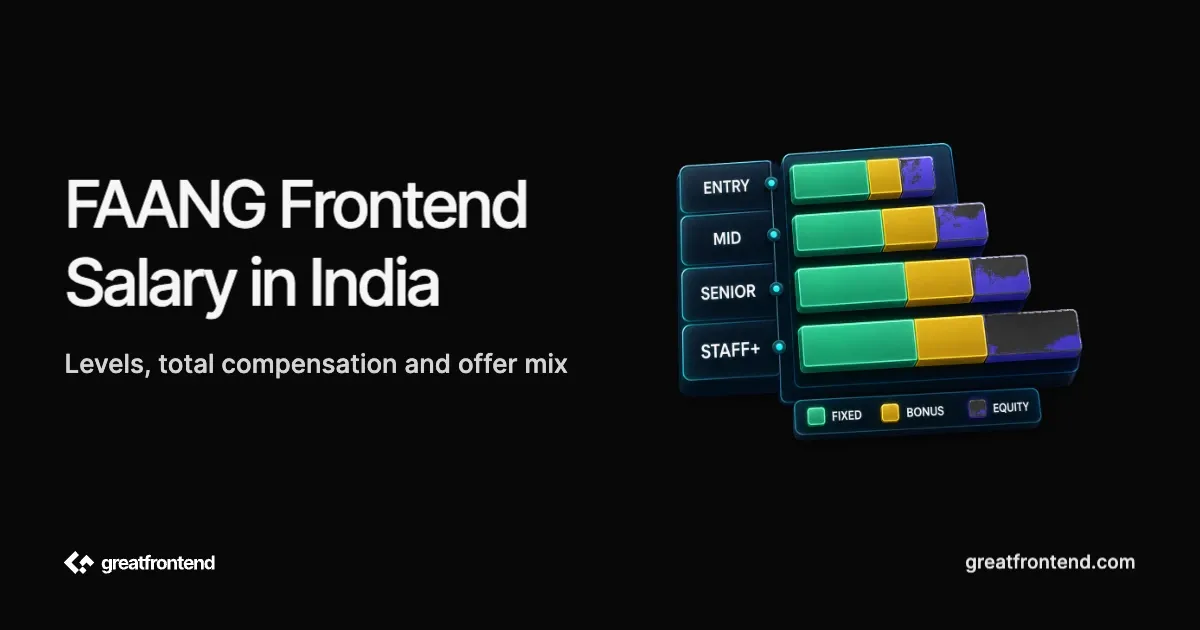 Understand FAANG frontend developer salary in India with 2026 big-tech software-engineer compensation data, frontend level signals, India offer-breakup caveats, and recruiter questions.
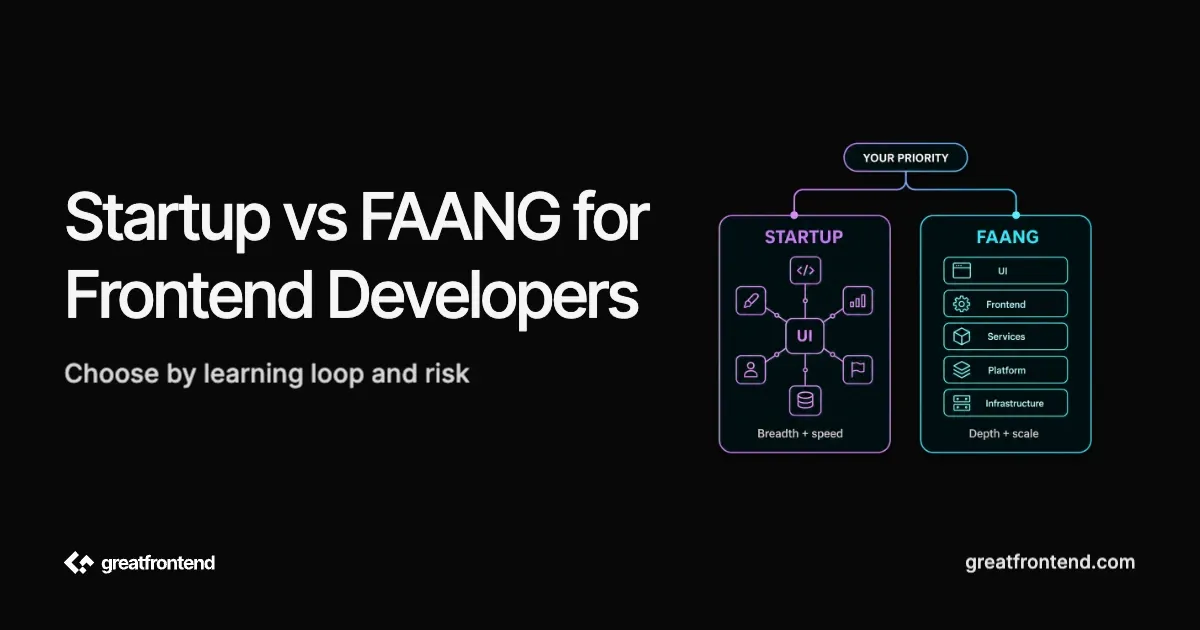 Choose between startup and FAANG frontend roles with a practical framework for learning, scope, mentorship, compensation, equity, risk, and team quality.
 Prepare for a frontend developer job at FAANG with a practical plan for coding, UI, JavaScript, React, frontend system design, resume proof, and mocks.