Frontend Developer Career Path: From Junior to Senior in 2026
Map the frontend developer career path in 2026 from junior to mid-level, senior, staff, lead, specialist, and manager roles.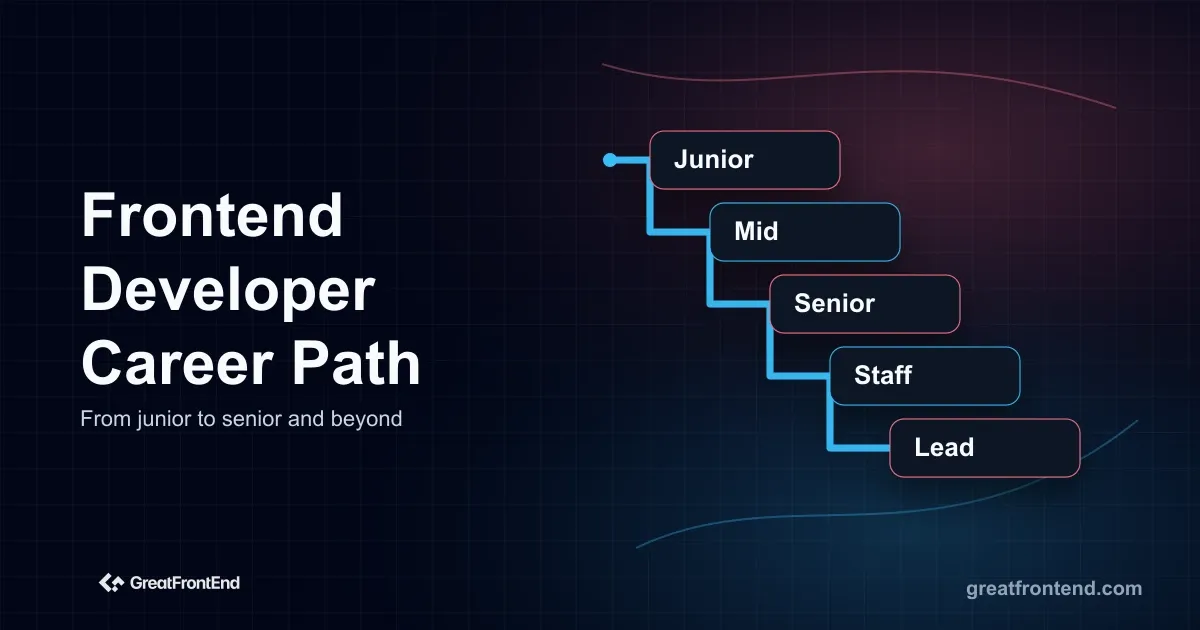
The frontend developer career path moves from completing scoped tasks to owning product outcomes. In 2026, progression is less about years and more about scope, judgment, verification, and impact.
Titles vary by company, but the pattern is similar: junior, mid-level, senior, staff or lead, and sometimes manager.
The career path at a glance
| Level | Typical scope | What the role proves |
|---|---|---|
| Learner | Practice projects and foundations | You can build basic UI and explain your code |
| Junior frontend developer | Scoped tasks inside an existing codebase | You can follow patterns and ask good questions |
| Mid-level frontend developer | Features with moderate ambiguity | You can own delivery with limited guidance |
| Senior frontend developer | Ambiguous product work and technical decisions | You can reduce risk and guide others |
| Staff or lead frontend engineer | Cross-team frontend direction | You can multiply the work of several engineers |
| Engineering manager | People, delivery, and team health | You can build the environment where engineers do good work |
The ladder is not universal. Startups blur levels. Big companies define them more formally. Some engineers stay technical. Some move into management. Some specialize deeply.
Learner to junior
The learner stage is about becoming hireable. You need web foundations, a framework, and enough product sense to build useful projects.
A junior frontend developer is expected to:
- Build UI from existing patterns
- Fix small bugs
- Write simple components
- Use Git and pull requests
- Ask clear questions
- Handle feedback
- Learn the team's stack
To move from learner to junior, prove that you can finish small work reliably. Your portfolio should show forms, API usage, responsive layout, loading states, and error states. A pile of cloned landing pages is weaker than one product workflow that behaves carefully.
Use How to Become a Frontend Developer in 2026 if you need the learning sequence.
Junior to mid-level
The mid-level jump is about independence. A mid-level frontend developer can take a feature, clarify requirements, make reasonable technical choices, and deliver without needing constant correction.
At this stage, you should become solid at:
- React and TypeScript
- CSS layout
- Component composition
- API integration
- Forms and validation
- State management
- Testing important behavior
- Accessibility basics
- Debugging production issues with help
The signal is reliability. Your team should trust you with feature work that has some unknowns.
To reach mid-level, stop waiting for perfect tickets. Learn to ask the questions that make the work clear:
- What are the loading, empty, and error states?
- What happens if the user lacks permission?
- What should be tracked?
- What should happen on mobile?
- What backend contract does this need?
- How will we test the critical path?
For this stage, practice JavaScript questions, React questions, and focused UI tasks such as Contact Form, Data Table, and Auth Code Input.
Mid-level to senior
The senior jump is about judgment. A senior frontend developer does more than finish bigger tickets. They prevent bad decisions from becoming expensive.
Senior frontend engineers are trusted with:
- Ambiguous product flows
- Component and state architecture
- Accessibility decisions
- Performance work
- Design system changes
- Cross-team UI contracts
- Technical proposals
- Mentoring and code review
They also know when not to add complexity. Seniority is not the number of abstractions you create. It is the quality of your tradeoffs.
In the AI era, this level matters more. Generated code can create a lot of output quickly, but senior engineers verify whether the output is correct, accessible, maintainable, and aligned with the product.
At this point, add TypeScript questions, front end system design questions, and larger UI problems such as File Explorer.
Read Senior Frontend Developer Skills: What You Need to Land the Role in 2026 for the deeper skill map.
Promotion evidence by level
Promotion is easier when you collect evidence before the conversation starts. Do not rely on "I have been here for two years" as your main case.
| Target level | Evidence that helps |
|---|---|
| Junior to mid-level | Features shipped with less supervision, fewer repeated review comments, cleaner state handling, and better debugging notes |
| Mid-level to senior | Ambiguous work clarified, technical risks named early, components or flows improved for other engineers, and quality issues prevented |
| Senior to staff or lead | Cross-team problems solved, migrations guided, standards adopted, measurable performance or reliability improvements, and other engineers made more effective |
| Engineer to manager | Hiring support, mentoring, planning, feedback, team health, and delivery improvements beyond personal coding output |
Write this evidence down as it happens. Promotion packets are much easier when you have concrete examples instead of trying to reconstruct a year of work from memory.
Senior to staff or lead
Staff and lead frontend roles are about broader influence. You are no longer measured only by your own delivery. You are measured by whether teams make better technical decisions because you are involved.
Typical work includes:
- Setting frontend architecture direction
- Improving design system adoption
- Reducing performance or reliability risk across surfaces
- Defining standards for accessibility and testing
- Guiding migrations
- Coaching senior and mid-level engineers
- Coordinating with product, design, backend, data, and platform teams
Staff engineers do not need to be the loudest people in the room. They need to notice important problems, frame them clearly, and help teams make progress.
Lead titles vary. In some companies, "lead" means technical leadership. In others, it includes people management. Clarify that before accepting the role.
Manager path
Frontend developers can also move into engineering management. Management is a different job, not a promotion that simply means "more senior engineer."
Engineering managers work on:
- Hiring
- Feedback
- Performance reviews
- Planning
- Team process
- Stakeholder management
- Delivery health
- Career growth
- Conflict and alignment
Good managers need technical context, but they are not judged mainly by their code. They are judged by whether the team can do good work consistently.
If you love the technical depth of frontend, you do not have to become a manager. A senior, staff, or principal frontend path can remain technical.
Specialist tracks
Frontend has several specialist paths. These can exist at mid-level, senior, or staff scope depending on the company.
| Track | What you work on |
|---|---|
| Product frontend engineer | Complex product flows, UX behavior, and feature delivery |
| Design systems engineer | Shared components, tokens, accessibility, documentation, and adoption |
| Frontend platform engineer | Build tooling, monorepos, CI, testing infrastructure, and developer experience |
| Web performance engineer | Metrics, rendering, loading, bundle cost, and runtime behavior |
| Accessibility specialist | Usability across assistive technology, keyboard behavior, semantics, and audits |
| Frontend-heavy fullstack engineer | UI plus API and backend changes for feature ownership |
| Web platform specialist | Browser APIs, offline behavior, media, graphics, WebAssembly, or advanced runtime work |
Specializing too early can narrow your options. Build product frontend competence first, then choose depth.
Startup caveat
Career paths are cleaner on paper than inside companies.
At a startup, a "frontend developer" may own product UI, backend routes, analytics events, customer bugs, and deployment fixes in the same week. You might gain senior scope before you have a senior title.
At a large company, the title may be slower, but the expectations are clearer. You may need promotion evidence, peer feedback, technical design examples, and cross-team impact.
Neither model is automatically better. The key is knowing what evidence you are building.
How to move faster
The fastest career growth usually comes from work that increases trust.
Useful habits:
- Take notes before coding unclear work
- Name edge cases early
- Share small technical proposals
- Improve one repeated pain point at a time
- Review generated code carefully
- Learn the product, not only the codebase
- Make your work easier for the next engineer to change
- Ask for feedback before promotion season
For company selection, use How to Evaluate Companies as a Front End Engineer. The company you choose can accelerate or slow your path.
The frontend developer career path in 2026 is not "junior writes components, senior writes more components." It moves from task completion to product and technical ownership.
Your title will vary by company. Your real growth shows in the size of the problems people trust you to handle, the quality of your decisions, and the number of people whose work gets better because of yours.
Related articles
 Learn the senior frontend developer skills that matter in 2026, from UI architecture and accessibility to performance, testing, judgment, and AI verification.
 Compare frontend and fullstack developer paths in 2026, including work style, hiring signal, learning curve, and which path fits your goals.